Splunk certification · Exam SPLK-1003

SPLK-1003 Mock Exam Page 4

Splunk Enterprise Certified Admin Exam

Free SPLK-1003 mock exam questions 31–40, each with the answer and an explanation.

20 questions · 33 minutes · free, no sign-up

Free SPLK-1003 questions

31–40 of 60 free
Question 31 Choose 1
What will the following inputs. conf stanza do?
[script://myscript . sh]
Interval=0
Show answerHide answer

Correct answer: C The script will be run only once for each time Splunk is restarted.

Explanation

Explanation:
The inputs.conf file is used to configure inputs, distributed inputs such as forwarders, and file system monitoring in Splunk1.
The [script://myscript.sh] stanza specifies a script input, which means that Splunk runs the script and indexes its output1.
The interval setting determines how often Splunk runs the script. If the interval is set to 0, the script runs only once when Splunk starts up1. If the interval is omitted, the script runs at the default interval of 60 seconds2.
Therefore, option C is correct, and the other options are incorrect.
Question 32 Choose 1
A configuration file in a deployed app needs to be directly edited. Which steps would ensure a successful deployment to clients?
Show answerHide answer

Correct answer: C Make the change in $SPLUNK HOME/etc/dep10yment apps/$appName/10ca1/ on the deployment server, and then run $SPLUNK HOME/bin/sp1unk reload deploy—server.

Explanation

Explanation: According to the Splunk documentation1, to customize a configuration file, you need to create a new file with the same name in a local or app directory. Then, add the specific settings that you want to customize to the local configuration file. Never change or copy the configuration files in the default directory. The files in the default directory must remain intact and in their original location. The Splunk Enterprise upgrade process overwrites the default directory.
To deploy configuration files to deployment clients, you need to use the deployment server. The deployment server is a Splunk Enterprise instance that distributes content and updates to deployment clients2. The deployment server uses a directory called $SPLUNK_HOME/etc/deployment-apps to store the apps and configuration files that itdeploys to clients2. To update the configuration files in this directory, you need to edit them manually and then run the command $SPLUNK_HOME/bin/sp1unk reload deploy—server to make the changes take effect2.
Therefore, option A is incorrect because it does not include the reload command. Option B is incorrect because it makes the change on a deployment client instead of the deployment server. Option D is incorrect because it changes the default directory instead of the local directory.
Question 33 Choose 1
Using the CLI on the forwarder, how could the current forwarder to indexer configuration be viewed?
Show answerHide answer

Correct answer: C splunk list forward-server

Question 34 Choose 3
Which of the following are required when defining an index in indexes. conf? (select all that apply)
Show answerHide answer

Correct answer: A, B, D coldPath homePath thawedPath

Question 35 Choose 1
Which of the following monitor inputs stanza headers would match all of the following files?
/var/log/www1/secure.log
/var/log/www/secure.l
/var/log/www/logs/secure.logs
/var/log/www2/secure.log
Show answerHide answer

Correct answer: C [monitor:///var/log/www1/secure.log]

Question 36 Choose 1
Search heads in a company's European offices need to be able to search data in their New York offices. They also need to restrict access to certain indexers. What should be configured to allow this type of action?
Show answerHide answer

Correct answer: C Distributed search

Explanation

Explanation:
The correct answer is C. Distributed search is the feature that allows search heads in a company’s European offices to search data in their New York offices.Distributed search also enables restricting access to certain indexers by using the splunk_server field or the server.conf file1.
Distributed search is a way to scale your Splunk deployment by separating the search management and presentation layer from the indexing and search retrieval layer. With distributed search, a Splunk instance called a search head sends search requests to a group of indexers, or search peers, which perform the actual searches on their indexes.The search head then merges the results back to the user2.
Distributed search has several use cases, such as horizontal scaling, access control, and managing geo-dispersed data.For example, users in different offices can search data across the enterprise or only in their local area, depending on their needs and permissions2.
The other options are incorrect because:
A. Indexer clustering is a feature that replicates data across a group of indexers to ensure data availability and recovery.Indexer clustering does not directly affect distributed search, although search heads can be configured to search across an indexer cluster3.
B. LDAP control is a feature that allows Splunk to integrate with an external LDAP directory service for user authentication and role mapping. LDAP control does not affect distributed search, although it can be used to manage user access to data and searches.
D. Search head clustering is a feature that distributes the search workload across a group of search heads that share resources, configurations, and jobs. Search head clustering does not affect distributed search, although the search heads in a cluster can search across the same set of indexers.
Question 37 Choose 1
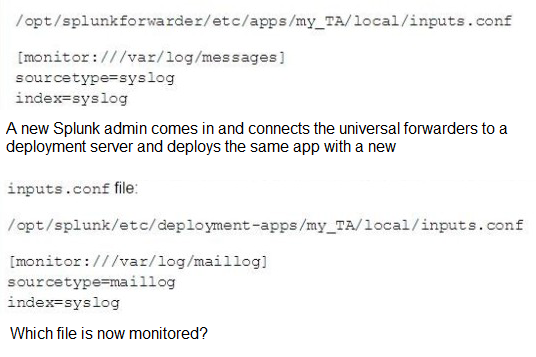
This file has been manually created on a universal forwarder
Show answerHide answer

Correct answer: B /var/log/maillog

Question 38 Choose 1
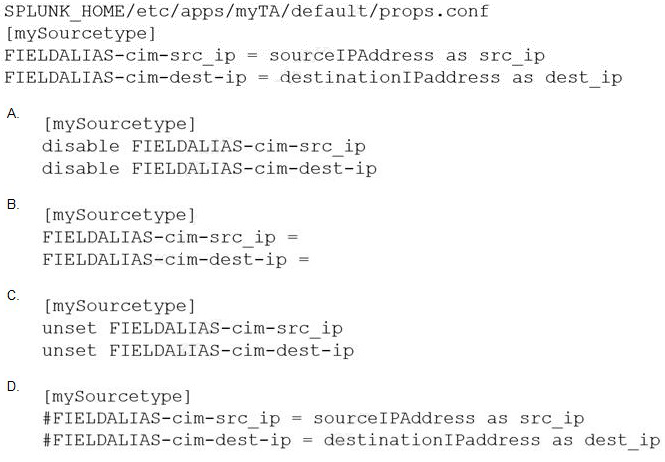
An add-on has configured field aliases for source IP address and destination IP address fields. A specific user prefers not to have those fields present in their user context. Based on the defaultprops.confbelow, whichSPLUNK_HOME/etc/users/buttercup/myTA/local/props.confstanza can be added to the user’s local context to disable the field aliases?
Show answerHide answer

Correct answer: B Option B

Question 39 Choose 1
The following stanza is active in indexes.conf:
[cat_facts]
maxHotSpanSecs = 3600
frozenTimePeriodInSecs = 2630000
maxTota1DataSizeMB = 650000
All other related indexes.conf settings are default values.
If the event timestamp was 3739283 seconds ago, will it be searchable?
Show answerHide answer

Correct answer: D No, because the event time is greater than the retention time.

Explanation

Explanation: The correct answer is D. No, because the event time is greater than the retention time.
According to the Splunk documentation1, the frozenTimePeriodInSecs setting in indexes.conf determines how long Splunk software retains indexed data before deleting it or archiving it to a remote storage. The default value is 188697600 seconds, which is equivalent to six years. The setting can be overridden on a per-index basis.
In this case, the cat_facts index has a frozenTimePeriodInSecs setting of 2630000 seconds, which is equivalent to about 30 days. This means that any event that is older than 30 days from the current time will be removed from the index and will not be searchable.
The event timestamp was 3739283 seconds ago, which is equivalent to about 43 days.
This means that the event is older than the retention time of the cat_facts index and will not be searchable.
The other settings in the stanza, such as maxHotSpanSecs and maxTota1DataSizeMB, do not affect the retention time of the events. They only affect the size and duration of the buckets that store the events.
Question 40 Choose 2
What is required when adding a native user to Splunk? (select all that apply)
Show answerHide answer

Correct answer: A, B PasswordUsername

Explanation

Explanation: According to the Splunk system admin course PDF, When adding native users, Username and Password ARE REQUIRED
Full mock exam

Sit the SPLK-1003 exam before exam day

Full-length mocks with the same number of questions and the same time limit as the real SPLK-1003 exam. Every attempt draws a new set of questions from the full bank, so you can keep going until you pass comfortably.

Get full SPLK-1003 mock exam
  • 65questions per mock
  • 105 mintime limit
  • 202questions in the bank
  • Newmock on every attempt