Explanation: The intensity of an ultrasound beam is measured using a hydrophone. A
hydrophone is a specialized device that detects and measures the acoustic pressure of the
ultrasound waves in water or tissue-mimicking materials. It is highly sensitive and can
measure the variations in pressure, which are used to calculate the intensity and other
acoustic parameters of the ultrasound beam.
Question 22Choose 1
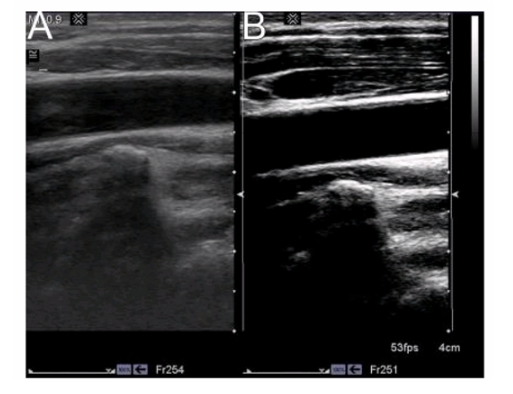
Which statement characterizes the primary difference between image A and image B?
Show answerHide answer
Correct answer: BImage A demonstrates a lower overall gain setting.
Explanation
Explanation: The primary difference between Image A and Image B is the overall gain
setting. Gain controls the amplification of the received echoes. A lower gain setting results
in a darker image with less overall brightness, which is evident in Image A compared to
Image B. Image B appears brighter, indicating a higher gain setting that amplifies the
echoes more, making the structures appear more prominently.
Question 23Choose 1
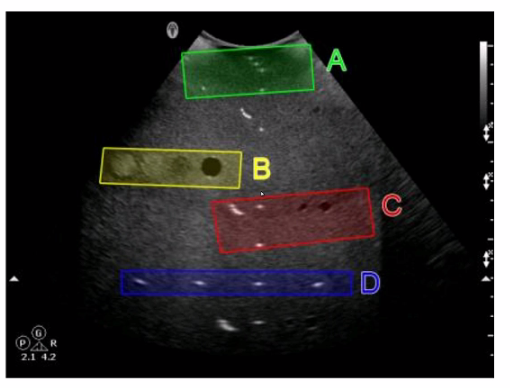
Which target group is used to evaluate transverse distance measurement accuracy in this
tissue-mimicking phantom image?
Show answerHide answer
Correct answer: DOption D
Explanation
Explanation: In the tissue-mimicking phantom image, Option D (blue box) is used to
evaluate transverse distance measurement accuracy. Phantoms are used to simulate
human tissue and provide a standardized way to test the accuracy and precision of
ultrasound machines. Transverse distance measurement accuracy is assessed by
measuring known distances between targets in the phantom. The blue box (Option D)
typically contains targets positioned to specifically test the accuracy of transverse
measurements, ensuring that the ultrasound system provides reliable and precise distance
readings.
Question 24Choose 1
Which resolution is degraded when utilizing multiple transmit focal zones?
Show answerHide answer
Correct answer: ATemporal
Explanation
Explanation: When utilizing multiple transmit focal zones, the ultrasound system must
perform multiple transmissions at each focal depth. This process requires more time for
data acquisition, which in turn decreases the frame rate. A lower frame rate directly impacts
temporal resolution, which is the ability to accurately depict moving structures over time.
Thus, using multiple focal zones improves lateral resolution but degrades temporal
resolution.
Question 25Choose 1
What results from increasing the packet length when using color Doppler imaging?
Show answerHide answer
Correct answer: DDecreased frame rate
Explanation
Explanation: Increasing the packet length in color Doppler imaging means increasing the
number of pulses used to interrogate each scan line. This improves the accuracy of velocity
measurements and sensitivity to low flow velocities but has the drawback of decreasing the
frame rate. A longer packet length requires more time to acquire the necessary data, which
reduces the number of frames that can be processed and displayed per second.
Consequently, while color Doppler imaging becomes more precise, the temporal resolution
(frame rate) decreases.
Question 26Choose 1
Which change can be made in order to avoid exceeding the Nyquist limit?
Show answerHide answer
Correct answer: CIncrease pulse repetition frequency
Explanation
Explanation: To avoid exceeding the Nyquist limit and prevent aliasing in Doppler
ultrasound, the pulse repetition frequency (PRF) should be increased. The Nyquist limit is
half of the PRF, so by increasing the PRF, the Nyquist limit is raised, allowing the system to
accurately measure higher velocities without encountering aliasing artifacts.
Question 27Choose 1
What is an advantage of power Doppler over color Doppler?
Show answerHide answer
Correct answer: DLess angle dependent
Explanation
Explanation: Power Doppler, unlike color Doppler, is less angle dependent because it
detects the strength of the Doppler signal rather than the velocity of the blood flow. This
means it is more sensitive to detecting low-velocity flow and flow in smaller vessels,
regardless of the angle between the ultrasound beam and the flow direction. Color Doppler
provides information on flow direction and velocity but is highly dependent on the angle of
insonation, making it less reliable when the angle is suboptimal.
Question 28Choose 1
Which will affect the gray-scale of a 2-D image?
Show answerHide answer
Correct answer: DDynamic range
Explanation
Explanation:
Reject: This control eliminates low-level noise and weak signals, affecting image
quality but not primarily used for contrast resolution.
Output Power: This adjusts the intensity of the transmitted ultrasound waves but
does not directly change contrast resolution.
Gain: This control amplifies all signals equally, affecting brightness but not
specifically the contrast resolution.
Dynamic Range: Adjusting the dynamic range changes the range of grayscale that
the ultrasound system displays, which directly affects the contrast resolution by
altering how many shades of gray are visible between the black and white
extremes.
Question 29Choose 1
What is the effect of an increased aperture in a linear array transducer?
Show answerHide answer
Correct answer: ADeeper focus
Explanation
Explanation: The aperture of a transducer is the active area that emits and receives the ultrasound waves. In a linear array transducer, increasing the aperture (using more
elements for transmission and reception) results in a deeper focus because the beam is
more tightly focused over a longer distance. This improves lateral resolution at greater
depths, as the ultrasound beam maintains a narrower width for a longer distance. It allows
for better imaging of deeper structures without sacrificing resolution.
Question 30Choose 1
What is the primary factor that improves lateral resolution?
Show answerHide answer
Correct answer: BBeamwidth
Explanation
Explanation: Lateral resolution refers to the ability of the ultrasound system to distinguish
two structures that are side by side, perpendicular to the direction of the sound beam. This
resolution is primarily improved by reducing the beamwidth. A narrower beamwidth allows
for better differentiation between adjacent structures, enhancing the lateral resolution.
Higher frequency transducers can also help achieve a narrower beamwidth, but beamwidth
is the primary factor.
Full mock exam
Sit the SPI exam before exam day
Full-length mocks with the same number of questions and the same time limit as the real SPI exam. Every attempt draws a new set of questions from the full bank, so you can keep going until you pass comfortably.