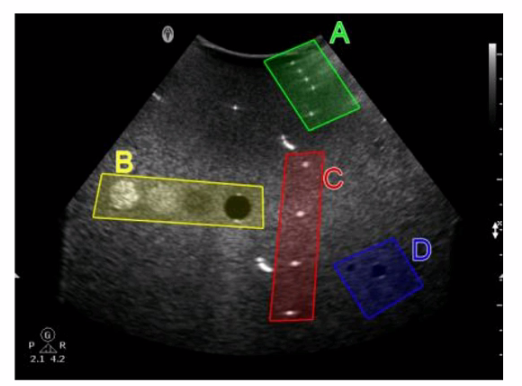
Which target group in this image of a tissue-mimicking phantom is used for gray-scale
evaluation?
Show answerHide answer
Correct answer: COption C
Explanation
Explanation:
Gray-scale evaluation in a tissue-mimicking phantom involves assessing the
uniformity and accuracy of the gray-scale representation of the tissues.
Option C typically contains structures designed to test the machine's ability to
accurately depict varying levels of echogenicity, which is essential for proper grayscale
evaluation.
This area will have a range of echo intensities that help in determining the contrast
resolution and the ability of the system to distinguish between different tissue types
based on their gray-scale values.
Question 12Choose 1
Which color Doppler setting can be optimized to eliminate low-frequency Doppler shifts
without having any effect on higher Doppler frequency shifts?
Show answerHide answer
Correct answer: CWall filter
Explanation
Explanation: The wall filter is used in color Doppler and spectral Doppler imaging to
eliminate low-frequency Doppler shifts caused by tissue motion or vessel wall movement.
Adjusting the wall filter removes these low-frequency signals without affecting higher frequency Doppler shifts that represent blood flow. Other settings like gain, scale, and
persistence do not selectively filter out low-frequency shifts in the same manner.
Question 13Choose 1
The ability to resolve two separate reflectors perpendicular to the path of the beam
describes which type of resolution?
Show answerHide answer
Correct answer: CLateral
Explanation
Explanation: Lateral resolution describes the ability of an ultrasound system to distinguish
between two structures that are side by side (perpendicular to the path of the ultrasound
beam). This type of resolution depends on the beam width; narrower beams provide better
lateral resolution. As the ultrasound beam travels deeper into the tissue, it generally
widens, which can reduce lateral resolution. Techniques such as focusing the beam can
help improve lateral resolution at specific depths by narrowing the beam width.
Question 14Choose 1
At which angle to blood flow would the maximum Doppler shift occur?
Show answerHide answer
Correct answer: D0 degrees
Explanation
Explanation: The Doppler shift is highest when the angle between the ultrasound beam
and the direction of blood flow is 0 degrees. This is because the cosine of 0 degrees is 1,
maximizing the Doppler frequency shift. As the angle increases towards 90 degrees, the
cosine value decreases, reducing the Doppler shift.
Question 15Choose 1
Which technique averages individual frames together to improve the image?
Show answerHide answer
Correct answer: CPersistence
Explanation
Explanation: Persistence is a technique used in ultrasound imaging that averages
individual frames together to improve the overall image quality. This process helps to
reduce noise and improve the signal-to-noise ratio, leading to clearer and more stable
images. By averaging multiple frames, transient artifacts are minimized, and the continuity
of structures is better visualized. Persistence is particularly useful in imaging static or slow-moving
structures.
Question 16Choose 1
Which is a method to reduce noise?
Show answerHide answer
Correct answer: DIncrease persistence
Explanation
Explanation: Persistence is a form of temporal averaging where consecutive frames are
averaged to reduce random noise, resulting in a smoother image. Increasing persistence
effectively reduces noise by averaging out transient noise artifacts while preserving the true
signal. This improves image quality, although it may also reduce the temporal resolution,
making it less suitable for rapidly moving structures.
Question 17Choose 1
Which ultrasound adjustment allows for an increased frame rate in color flow Doppler?
Show answerHide answer
Correct answer: BDecreasing depth
Question 18Choose 1
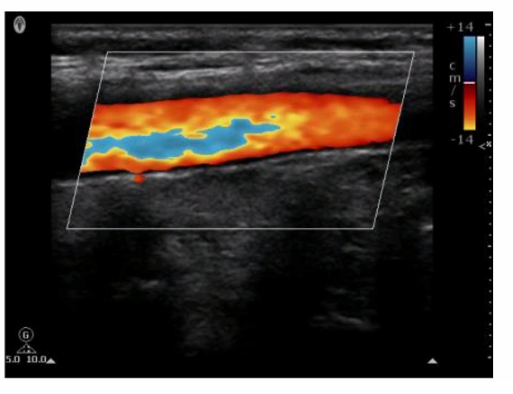
Which pulsed-wave Doppler adjustment would be appropriate to correct the aliasing seen
in this image?
Show answerHide answer
Correct answer: CIncrease the Doppler pulse repetition frequency.
Explanation
Explanation: Aliasing in pulsed-wave Doppler occurs when the sampled Doppler
frequency exceeds the Nyquist limit, which is half of the pulse repetition frequency (PRF).
This results in an incorrect representation of the blood flow velocities, causing the
waveform to wrap around and appear on the opposite side of the baseline. To correct
aliasing, the PRF should be increased, which raises the Nyquist limit and allows for
accurate measurement of higher velocities without aliasing. Increasing the PRF effectively
reduces the likelihood of aliasing artifacts in the Doppler signal.
Question 19Choose 1
Which component of a contrast agent causes a marked mismatch in impedance between
the agent and blood?
Show answerHide answer
Correct answer: DGas
Explanation
Explanation: Contrast agents used in ultrasound imaging typically consist of microbubbles
filled with gas. The significant mismatch in acoustic impedance between the gas in the
microbubbles and the surrounding blood creates strong reflectors of the ultrasound waves,
enhancing the echogenicity of blood and improving the visibility of blood flow and tissue
perfusion. The high contrast provided by the gas-filled microbubbles makes them
particularly effective as ultrasound contrast agents.
Question 20Choose 1
What is the primary reason to use compression?
Show answerHide answer
Correct answer: DAdjust the contrast resolution
Explanation
Explanation:
Compression in ultrasound imaging adjusts the range of grayscale displayed,
affecting the contrast resolution.
This function allows sonographers to enhance the differentiation between
structures of varying echogenicities.
By modifying the contrast resolution, sonographers can better visualize subtle
differences in tissue composition and improve the diagnostic quality of the images.
Increasing contrast resolution is particularly important in differentiating between
fluid-filled cysts and solid masses.
Full mock exam
Sit the SPI exam before exam day
Full-length mocks with the same number of questions and the same time limit as the real SPI exam. Every attempt draws a new set of questions from the full bank, so you can keep going until you pass comfortably.