Microsoft certification · Exam SC-200

SC-200 Mock Exam Page 11

Microsoft Security Operations Analyst

Free SC-200 mock exam questions 101–107, each with the answer and an explanation.

20 questions · 33 minutes · free, no sign-up

Free SC-200 questions

101–107 of 107 free
Question 101

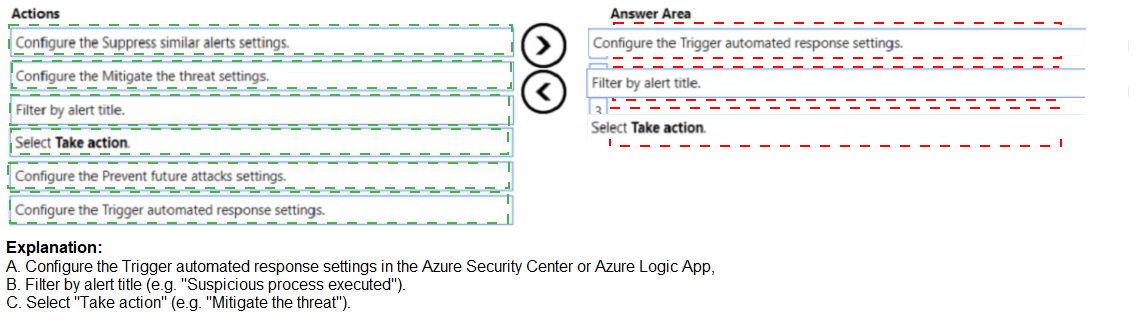
You have a Microsoft subscription that has Microsoft Defender for Cloud enabled You
configure the Azure logic apps shown in the following table.

Show answerHide answer

Explanation
Question 102

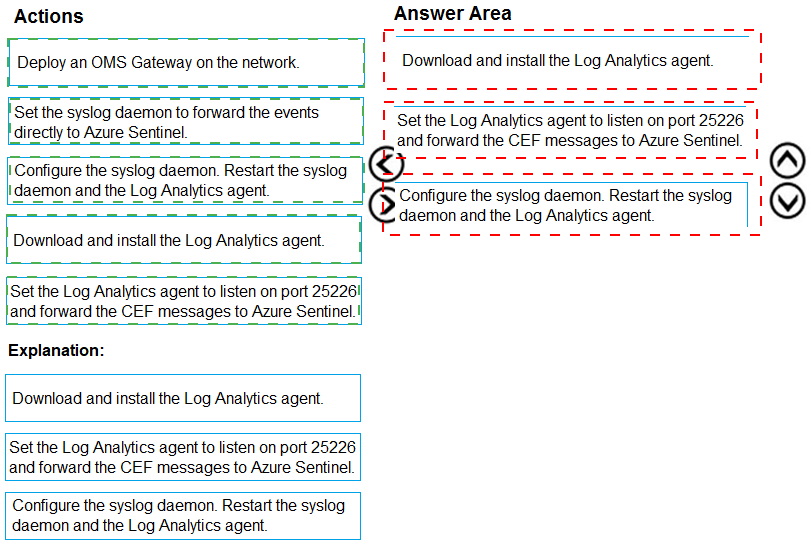
You plan to connect an external solution that will send Common Event Format (CEF)
messages to Azure Sentinel. You need to deploy the log forwarder.
Which three actions should you perform in sequence? To answer, move the appropriate
actions form the list of actions to the answer area and arrange them in the correct order.

Show answerHide answer

Explanation

Question 103

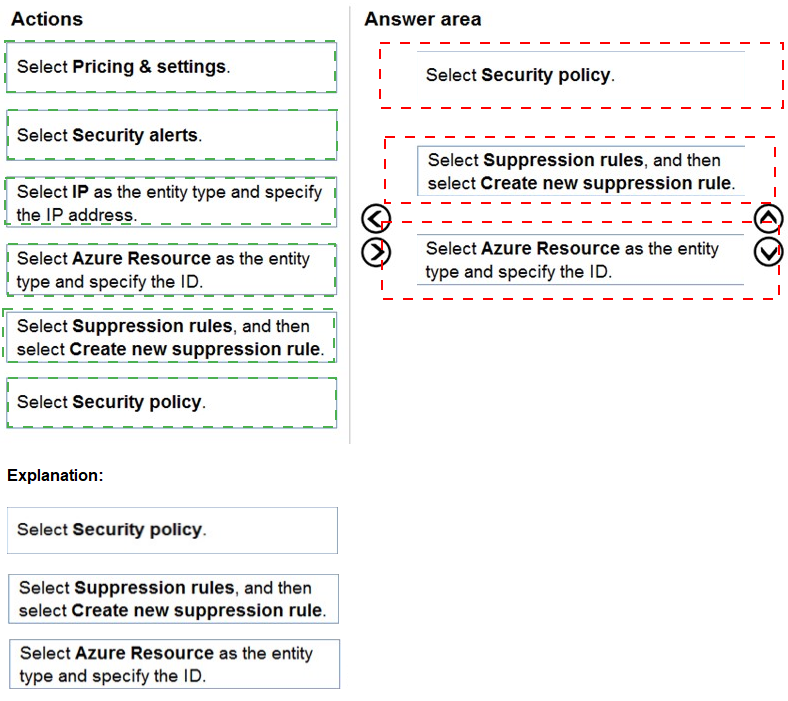
You have an Azure Functions app that generates thousands of alerts in Azure Security
Center each day for normal activity.
You need to hide the alerts automatically in Security Center.
Which three actions should you perform in sequence in Security Center? Each correct
answer presents part of the solution.
NOTE: Each correct selection is worth one point.

Show answerHide answer

Explanation

Question 104

You have a Microsoft Sentinel workspace named Workspaces
You configure Workspace1 to collect DNS events and deploy the Advanced Security
information Model (ASIM) unifying parser for the DNS schema.
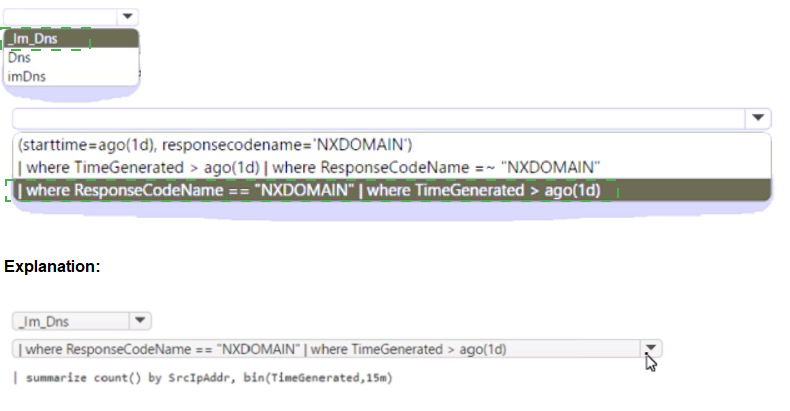
You need to query the ASIM DNS schema to list all the DNS events from the last 24 hours
that have a response code of 'NXDOMAIN' and were aggregated by the source IP address
in 15-minute intervals. The solution must maximize query performance.
How should you complete the query? To answer, select the appropriate options in the
answer area
NOTE: Each correct selection is worth one point.

Show answerHide answer

Explanation

Question 105 Choose 1
You need to implement the Defender for Cloud requirements. What should you configure for Server2?
Show answerHide answer

Correct answer: C an Azure resource tag

Explanation

Explanation:

In Microsoft Defender for Cloud, resource tags are essential for applying governance, compliance, and security requirements across Azure resources. Tags allow administrators to classify resources with metadata such as environment (Prod, Dev), owner, or business unit. When Defender for Cloud requirements specify that a server must be categorized or aligned with compliance policies, configuring a resource tag ensures that the server is properly identified and included in policy assignments, recommendations, and reporting. Tags also enable scoping of security initiatives, such as applying regulatory compliance standards or monitoring specific workloads. For Server2, applying a tag ensures that Defender for Cloud can evaluate and enforce requirements consistently across the environment.

Other options are not correct:

A. Microsoft Antimalware extension:
This provides endpoint protection against malware but does not fulfill the requirement of aligning the server with Defender for Cloud governance or compliance policies.

B. Azure resource lock:
Locks prevent accidental deletion or modification of resources. While useful for resource protection, they do not address Defender for Cloud’s requirement to classify or manage resources.

D. Azure Automanage machine configuration extension for Windows:
Automanage simplifies VM management by applying best practices, but it is not directly tied to Defender for Cloud’s tagging requirement.

Therefore, the correct choice is Azure resource tag, as it directly supports Defender for Cloud’s ability to organize, monitor, and enforce security requirements across resources. This aligns with SC-200 exam objectives around implementing governance and compliance in cloud security operations.

Reference:
Use tags to organize your Azure resources (learn.microsoft.com in Bing)
Question 106 Choose 1
You need to implement the Defender for Cloud requirements. Which subscription-level role should you assign to Group1?
Show answerHide answer

Correct answer: B Owner

Explanation

Explanation:

Why B is correct (Owner)
The Owner role at the subscription level is the only built-in role that grants full access to all Defender for Cloud capabilities, including enabling all Microsoft Defender plans and configuring all monitoring components. While Security Admin can enable/disable Defender plans, certain critical actions like assigning initiatives (including regulatory compliance standards) and fully managing monitoring extensions require Owner permissions.

The question specifies "implement the Defender for Cloud requirements," which typically involves full configuration capabilities—not just security-specific actions. The Owner role provides the complete set of permissions needed for a comprehensive implementation.

Why other options are incorrect

A. Security Admin
Security Admin can update security policies and dismiss alerts, but cannot assign initiatives (compliance standards) or deploy all monitoring components. It has access only within Defender for Cloud, not to other Azure services needed for complete implementation.

C. Security Assessment Contributor
This is not a valid built-in role in Defender for Cloud or Azure RBAC. The actual built-in roles are Owner, Contributor, Reader, Security Reader, and Security Admin.

D. Contributor
Contributor has most management permissions but cannot assign initiatives at subscription level (Owner-only action). According to Microsoft documentation, "Add/assign initiatives (including regulatory compliance standards)" requires Owner, not Contributor

Reference:

Microsoft Learn: User roles and permissions - Microsoft Defender for Cloud – "While the three roles mentioned are sufficient for enabling and disabling Defender for Cloud plans, the Owner role is required to enable all capabilities of a plan".
Question 107 Choose 1
You need to ensure that the Group1 members can meet the Microsoft Sentinel requirements. Which role should you assign to Group1?
Show answerHide answer

Correct answer: C Automation Operator

Explanation

Explanation:

Why C is correct (Automation Operator)
The Automation Operator role is specifically designed to allow users to create and run playbooks in Microsoft Sentinel. This role provides the necessary permissions to design and execute automation logic using playbooks without granting excessive privileges to sensitive areas such as Microsoft Sentinel configuration settings or data sources. This aligns perfectly with the principle of least privilege, ensuring Group1 members can perform their required tasks without unnecessary access.

Why other options are incorrect

A. Microsoft Sentinel Automation Contributor
This role is not meant for user accounts. It allows Microsoft Sentinel's service account (not human users) to add playbooks to automation rules.

B. Logic App Contributor
While this role lets you edit, manage, and run playbooks (since playbooks are built on Logic Apps), it grants broader permissions than necessary. The Automation Operator role is more restrictive and follows least privilege better for just creating and running playbooks.

D. Microsoft Sentinel Playbook Operator
This role only allows you to run playbooks manually. It does not grant permission to create playbooks, making it insufficient for the requirement.

Reference:
Microsoft Learn documentation confirms that users with particular job requirements for working with playbooks should be assigned the Automation Operator role for running playbooks.

That's the last free question

You've seen the free 30% (107 of 361 questions). Full access unlocks every question and full-length SC-200 mock exams (65 questions, 105 minutes), a different mock on every attempt.

Unlock full mock exam
Full mock exam

Sit the SC-200 exam before exam day

Full-length mocks with the same number of questions and the same time limit as the real SC-200 exam. Every attempt draws a new set of questions from the full bank, so you can keep going until you pass comfortably.

Get full SC-200 mock exam
  • 65questions per mock
  • 105 mintime limit
  • 361questions in the bank
  • Newmock on every attempt