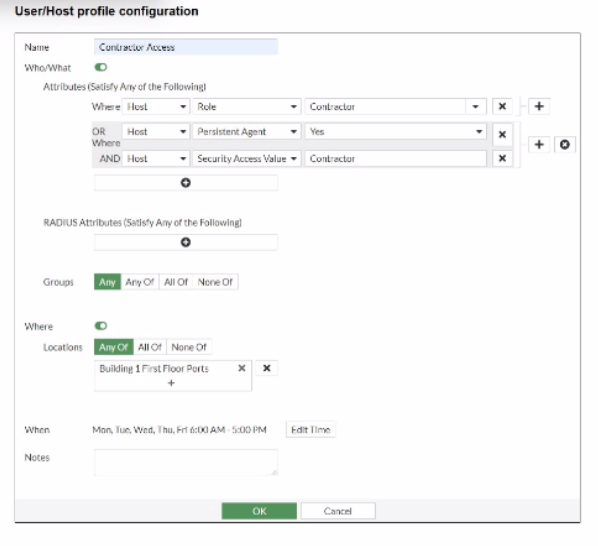
When creating a user or host profile, which three criteria can you apply? (Choose three.)
Show answerHide answer
Correct answer: A, B, E Host or user group memberships Host or user attributes Location
Explanation
Explanation:This question tests your understanding of Profile configuration within FortiNAC-F. Profiles are the primary building blocks used to categorize entities based on specific identifying data points before they are evaluated by the policy engine for network access.
✔️Correct Options:
Host or user group memberships:
This criterion allows the system to identify devices based on their presence in local or directory-based groups. It simplifies policy application by grouping multiple entities that share the same organizational role or technical classification.
Host or user attributes:
Attributes allow for granular identification by looking at specific data points like OS version, serial numbers, or LDAP fields. This ensures that security policies are tailored to the exact technical specifications and ownership details of the connecting device.
Location:
Location-based criteria utilize the physical connection point, such as the specific switch, port, or SSID, to define a profile. This is essential for enforcing localized access rules where a user’s permissions may change based on their physical office.
❌Why the Other Options Are Wrong:
C. Adapter current VLAN:
The current VLAN is an operational state resulting from an applied policy rather than a classification criterion used to define a profile. Using the current VLAN as a criterion would create a circular logic loop where the current state determines the profile that is supposed to assign that state. The system needs to identify what the device is before it decides which VLAN it should be placed in.
D. An applied access policy:
Access policies are the final results of a match between a profile and a logical network, not a criterion used within the profile itself. A profile must be defined and matched first before an access policy can even be considered for application to a specific host or user session. Including a policy as a profile criterion would reverse the logical flow of the FortiNAC policy evaluation engine.
Reference:
🔧 FortiNAC-F 7.6 Administration Guide: User and Host Profiles
The documentation confirms that profiles are constructed using location data, group memberships, and specific user or host attributes to facilitate precise network segmentation and identification.