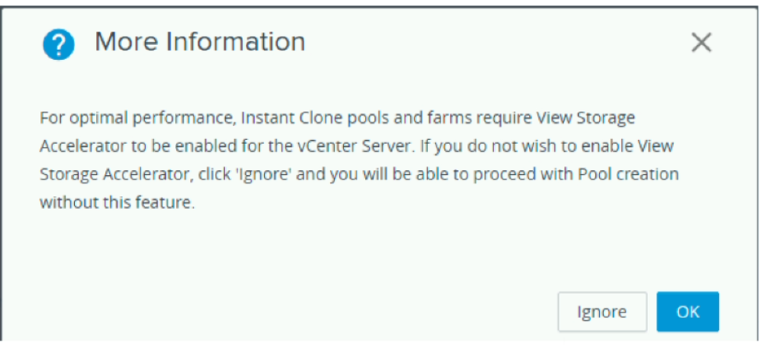
An administrator is deploying an Instant Clone desktop pool on an 8-node Nutanix cluster.
The system displays a warning message, asshown in the exhibit.
What should the administrator do to resolve the issue?
Show answerHide answer
Correct answer: DDisable Shadow Clones
Explanation
Explanation: Shadow Clones are a unique feature of the AOS storage that enables
distributed caching of virtual disks (vDisks) used by virtual machines1. Shadow Clones
provide effective caching optimization in distributed multireader scenarios, such as large
VDI and cloud deployments2.
The warning message you see indicates that Shadow Clones are disabled on your Nutanix
cluster. This may affect the performance of your Instant Clone desktop pool, as it will not
benefit from the caching optimization provided by Shadow Clones.
Question 12Choose 1
How should an administrator protect Writable AppVolumes during a disaster in a Nutanix
environment?
Show answerHide answer
Correct answer: ACreate a storage container in both the primary and DR datacenters for the
Write able App Volumes. Set up asynchronous DR between the two sites.
Explanation
Explanation: Writable AppVolumes are a feature of VMware App Volumes that provides
users with a dedicated virtual disk for storing user profile data and user-installed
applications1. Writable AppVolumes are stored as VMDK files on a datastore2.
To protect Writable AppVolumes during a disaster in a Nutanix environment, one possible
solution is to use asynchronous DR between two sites. Asynchronous DR allows you to
replicate VMs and their associated data from one site to another at regular intervals using
protection domains and remote sites3.
Question 13Choose 1
An administrator has received multiple tickets from users experiencing log-on and log-off
slowness while using VDI non-persistent desktops, other users in same VDI farm using
persistent desktops are not experiencing the same issue.
Currently, the administrator is levering an ESXi-based Nutanix all-flash cluster environment
with a VMware Horizon Infrastructure.
What is causing the slowness for the non-persistent users?
Show answerHide answer
Correct answer: Buser accounts configured with Roaming Profiles
Explanation
Explanation: roaming profiles are a way to deliver user settings across physical and virtual
desktops. However, they can also cause issues such as profile unload failures2 and slow
log-on and log-off times1.
Question 14Choose 1
A company has deployed Horizon on a Nutanix cluster running the ESXi hypervisor. They
are starting the configuration for thedeployment of 1000 virtual desktops running Windows
10 in a Linked Clone Desktop Pool.
The company has these requirements:
• Reduced time for initial virtual desktop deployment
• Fast recompose time when updating the pool with patches and new application installs
• Provide a high level of availability to the pool
What should the companyenable,that will allow this Nutanix VDI implementation to meet the stated requirements?
Show answerHide answer
Correct answer: CView Composer API for Array Integration
Explanation
Explanation: View Composer API for Array Integration (VCAI) is a feature of VMware
Horizon that leverages the native cloning abilities in the storage array to offload storage
operations within a VMware View environment12. This feature allows customers to offload
the creation of linked clones to the storage array3.
Question 15Choose 1
Which scenario represents the best case for how an organization would deploynonpersistent
desktops to their employee and customer base?
Show answerHide answer
Correct answer: DRegistrationkiosks at a conference
Explanation
Explanation: This is because registration kiosks are used by multiple customers who do
not need to personalize their desktops or applications, and who only need to perform a
specific task such as registering or checking in. Non-persistent desktops can provide a
secure and consistent user experience for these customers, and also reduce management
overhead for the organization.
Question 16Choose 1
An administrator decides to deploy non-persistent virtual desktops for the accounting
department. Currently, the department usesphysicaldesktops and users has full
administrative rights to their machines.
Which capability will persist for users following a migration to non-persistent VDI desktops?
Explanation: non-persistent VDI desktops are virtual desktops that do not save any
changes made by the user after they log off or shut down12. They rely on a master image
that contains the OS, configuration settings, and other customizations that replicate to
multiple virtual desktops1.
Question 17Choose 2
What are the two types Of Launchpads that exist in Frame? (Choose two.)
Show answerHide answer
Correct answer: A, CApplication LaunchpadDesktop Launchpad
Explanation
Explanation: There are two types of Launchpads that exist in Frame: Application
Launchpad and Desktop Launchpad2.
An Application Launchpad is a representation of the applications that are available
for streaming. Users can launch any application they have access to from this
Launchpad. An example of an Application Launchpad is shown below:
A Desktop Launchpad is a representation of the desktops that are available for
streaming. Users can launch any desktop they have access to from this
Launchpad.
Question 18Choose 1
An administrator has deployed Citrix Virtual Apps and Desktops on a Nutanix dedicated
VD' cluster.
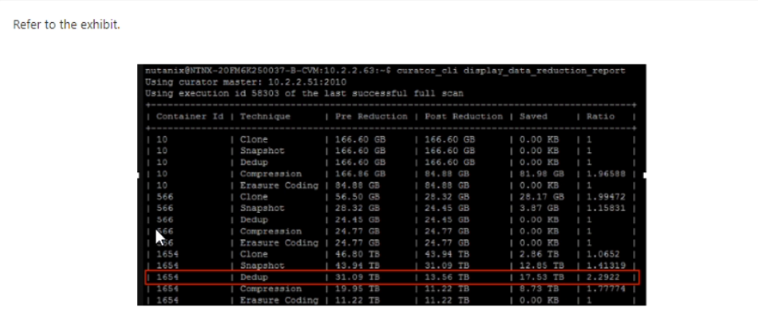
What is the delivery method in use, based on the curator reports shown in the exhibit?
Show answerHide answer
Correct answer: CCitrixMCS
Explanation
Explanation: the delivery method in use is Citrix MCS. Citrix Machine Creation Services
(MCS) is a technology that creates and manages virtual machines from a master image.
MCS uses Nutanix storage efficiency features such as deduplication and shadow clones to
reduce storage consumption and improve performance. The exhibit shows that the VDI
cluster has a high deduplication ratio (7.5x) and a low physical space usage (1.2 TB)
compared to the logical space usage (9.1 TB), which indicates that MCS is in use.
Question 19Choose 1
Where should an administrator configure AWS, Azure, and Google accounts within Frame?
Show answerHide answer
Correct answer: Daccounts
Question 20Choose 1
An administrator supports a user group that spans across10Nutanix clusters for a mediumsized
medical communications firm. The10Nutanix clusters are managed by a single Prism
Central instance.
This group's virtual desktops are all cloned from a common gold image and all applications
are published from a Citrix Virtual Appsfarm. The administrator needs to keep the gold
image in sync across all of the clusters.
What is the best way to achieve this?
Show answerHide answer
Correct answer: CUpload the gold image to Prism Central Image Service.
Explanation
Explanation: Prism Central Image Service allows you to upload and manage images
through Prism Central by using the v3 API. You can also choose where your images will be
available across different clusters123
Full mock exam
Sit the NCP-EUC exam before exam day
Full-length mocks with the same number of questions and the same time limit as the real NCP-EUC exam. Every attempt draws a new set of questions from the full bank, so you can keep going until you pass comfortably.