MuleSoft certification · Exam MCPA-Level-1

MCPA-Level-1 Mock Exam Page 5

MuleSoft Certified Platform Architect - Level 1

Free MCPA-Level-1 mock exam questions 41–45, each with the answer and an explanation.

20 questions · 33 minutes · free, no sign-up

Free MCPA-Level-1 questions

41–45 of 45 free
Question 41 Choose 1

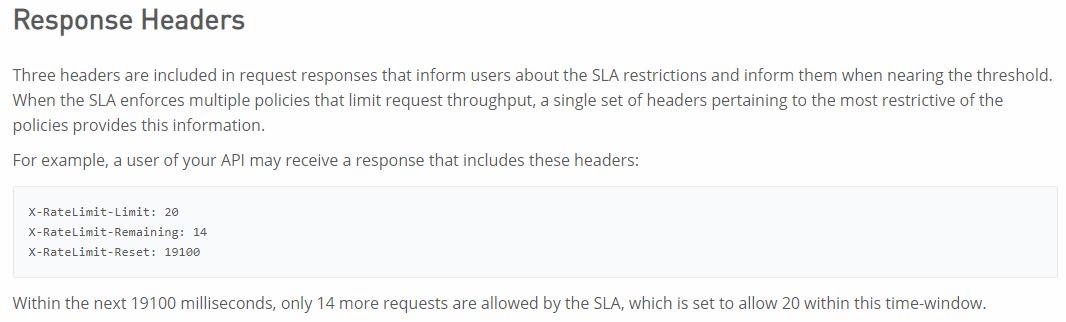
An API implementation returns three X-RateLimit-* HTTP response headers to a requesting API client. What type of information do these response headers indicate to the API client?

Show answerHide answer

Correct answer: D

The remaining capacity allowed by the API implementation

Explanation

Explanation: Explanation
Correct Answer: The remaining capacity allowed by the API implementation.
*****************************************
>> Reference: https://docs.mulesoft.com/api-manager/2.x/rate-limiting-and-throttling-slabased-
policies#response-headers

Question 42 Choose 1

In an organization, the InfoSec team is investigating Anypoint Platform related data traffic. From where does most of the data available to Anypoint Platform for monitoring and alerting originate?

Show answerHide answer

Correct answer: D

From the Mule runtime irrespective of the deployment model

Explanation

Explanation: Explanation
Correct Answer: From the Mule runtime irrespective of the deployment model
*****************************************
>> Monitoring and Alerting metrics are always originated from Mule Runtimes irrespective
of the deployment model.
>> It may seems that some metrics (Runtime Manager) are originated from Mule Runtime
and some are (API Invocations/ API Analytics) from API Manager. However, this is
realistically NOT TRUE. The reason is, API manager is just a management tool for API
instances but all policies upon applying on APIs eventually gets executed on Mule
Runtimes only (Either Embedded or API Proxy).
>> Similarly all API Implementations also run on Mule Runtimes.
So, most of the day required for monitoring and alerts are originated fron Mule Runtimes
only irrespective of whether the deployment model is MuleSoft-hosted or Customer-hosted
or Hybrid.

Question 43 Choose 1

A retail company with thousands of stores has an API to receive data about purchases and
insert it into a single database. Each individual store sends a batch of purchase data to the
API about every 30 minutes. The API implementation uses a database bulk insert
command to submit all the purchase data to a database using a custom JDBC driver
provided by a data analytics solution provider. The API implementation is deployed to a
single CloudHub worker. The JDBC driver processes the data into a set of several
temporary disk files on the CloudHub worker, and then the data is sent to an analytics
engine using a proprietary protocol. This process usually takes less than a few minutes.
Sometimes a request fails. In this case, the logs show a message from the JDBC driver
indicating an out-of-file-space message. When the request is resubmitted, it is successful.
What is the best way to try to resolve this throughput issue?

Show answerHide answer

Correct answer: D

Increase the number of CloudHub workers

Explanation

Explanation: Explanation
Correct Answer: Increase the size of the CloudHub worker(s)
*****************************************
The key details that we can take out from the given scenario are:
>> API implementation uses a database bulk insert command to submit all the purchase
data to a database
>> JDBC driver processes the data into a set of several temporary disk files on the
CloudHub worker
>> Sometimes a request fails and the logs show a message indicating an out-of-file-space
message
Based on above details:
>> Both auto-scaling options does NOT help because we cannot set auto-scaling rules
based on error messages. Auto-scaling rules are kicked-off based on CPU/Memory usages
and not due to some given error or disk space issues.
>> Increasing the number of CloudHub workers also does NOT help here because the
reason for the failure is not due to performance aspects w.r.t CPU or Memory. It is due to
disk-space.
>> Moreover, the API is doing bulk insert to submit the received batch data. Which means,
all data is handled by ONE worker only at a time. So, the disk space issue should be
tackled on "per worker" basis. Having multiple workers does not help as the batch may still
fail on any worker when disk is out of space on that particular worker.
Therefore, the right way to deal this issue and resolve this is to increase the vCore size of
the worker so that a new worker with more disk space will be provisioned.

Question 44 Choose 1

What Mule application deployment scenario requires using Anypoint Platform Private Cloud Edition or Anypoint Platform for Pivotal Cloud Foundry?

Show answerHide answer

Correct answer: C

When regulatory requirements mandate on-premises processing of EVERY data item, including meta-data

Explanation

Explanation: Explanation
Correct Answer: When regulatory requirements mandate on-premises processing of EVERY data item, including meta-data.
*****************************************
We need NOT require to use Anypoint Platform PCE or PCF for the below. So these
options are OUT.
>> We can make ALL applications highly available across multiple data centers using
CloudHub too.
>> We can use Anypoint VPN and tunneling from CloudHub to connect to ALL backend
systems in the application network that are deployed in the organization's intranet.
>> We can use Anypoint VPC and Firewall Rules to make ALL APIs private and NOT
exposed to the public cloud.
Only valid reason in the given options that requires to use Anypoint Platform PCE/ PCF is -
When regulatory requirements mandate on-premises processing of EVERY data item,
including meta-data

Question 45 Choose 1

An API experiences a high rate of client requests (TPS) vwth small message paytoads.
How can usage limits be imposed on the API based on the type of client application?

Show answerHide answer

Correct answer: A

Use an SLA-based rate limiting policy and assign a client application to a matching SLA
tier based on its type

Explanation

Explanation: Correct Answer: Use an SLA-based rate limiting policy and assign a client
application to a matching SLA tier based on its type.
*****************************************
>> SLA tiers will come into play whenever any limits to be imposed on APIs based on client
type
Reference: https://docs.mulesoft.com/api-manager/2.x/rate-limiting-and-throttling-slabased-
policies

That's the last free question

You've seen the free 30% (45 of 151 questions). Full access unlocks every question and full-length MCPA-Level-1 mock exams (65 questions, 105 minutes), a different mock on every attempt.

Unlock full mock exam
Full mock exam

Sit the MCPA-Level-1 exam before exam day

Full-length mocks with the same number of questions and the same time limit as the real MCPA-Level-1 exam. Every attempt draws a new set of questions from the full bank, so you can keep going until you pass comfortably.

Get full MCPA-Level-1 mock exam
  • 65questions per mock
  • 105 mintime limit
  • 151questions in the bank
  • Newmock on every attempt