MuleSoft certification · Exam MCPA-Level-1

MCPA-Level-1 Mock Exam Page 4

MuleSoft Certified Platform Architect - Level 1

Free MCPA-Level-1 mock exam questions 31–40, each with the answer and an explanation.

20 questions · 33 minutes · free, no sign-up

Free MCPA-Level-1 questions

31–40 of 45 free
Question 31 Choose 1

An API implementation is deployed to CloudHub.
What conditions can be alerted on using the default Anypoint Platform functionality, where
the alert conditions depend on the end-to-end request processing of the API
implementation?

Show answerHide answer

Correct answer: C

When the response time of API invocations exceeds a threshold

Explanation

Explanation: Explanation
Correct Answer: When the response time of API invocations exceeds a threshold
*****************************************
>> Alerts can be setup for all the given options using the default Anypoint Platform
functionality
>> However, the question insists on an alert whose conditions depend on the end-to-end
request processing of the API implementation.
>> Alert w.r.t "Response Times" is the only one which requires end-to-end request
processing of API implementation in order to determine if the threshold is exceeded or not.
Reference: https://docs.mulesoft.com/api-manager/2.x/using-api-alerts
Question 32 Choose 1

A REST API is being designed to implement a Mule application.
What standard interface definition language can be used to define REST APIs?

Show answerHide answer

Correct answer: B

OpenAPI Specification (OAS)

Question 33 Choose 1

A system API is deployed to a primary environment as well as to a disaster recovery (DR)
environment, with different DNS names in each environment. A process API is a client to
the system API and is being rate limited by the system API, with different limits in each of
the environments. The system API's DR environment provides only 20% of the rate limiting
offered by the primary environment. What is the best API fault-tolerant invocation strategy
to reduce overall errors in the process API, given these conditions and constraints?

Show answerHide answer

Correct answer: A

Invoke the system API deployed to the primary environment; add timeout and retry logic to
the process API to avoid intermittent failures; if it still fails, invoke the system API deployed
to the DR environment

Explanation

Explanation: Explanation
Correct Answer: Invoke the system API deployed to the primary environment; add timeout
and retry logic to the process API to avoid intermittent failures; if it still fails, invoke the
system API deployed to the DR environment
*****************************************
There is one important consideration to be noted in the question which is - System API in
DR environment provides only 20% of the rate limiting offered by the primary environment.
So, comparitively, very less calls will be allowed into the DR environment API opposed to
its primary environment. With this in mind, lets analyse what is the right and best faulttolerant
invocation strategy.
1. Invoking both the system APIs in parallel is definitely NOT a feasible approach because
of the 20% limitation we have on DR environment. Calling in parallel every time would
easily and quickly exhaust the rate limits on DR environment and may not give chance to
genuine intermittent error scenarios to let in during the time of need.
2. Another option given is suggesting to add timeout and retry logic to process API while
invoking primary environment's system API. This is good so far. However, when all retries
failed, the option is suggesting to invoke the copy of process API on DR environment which
is not right or recommended. Only system API is the one to be considered for fallback and
not the whole process API. Process APIs usually have lot of heavy orchestration calling
many other APIs which we do not want to repeat again by calling DR's process API. So this
option is NOT right.
3. One more option given is suggesting to add the retry (no timeout) logic to process API to
directly retry on DR environment's system API instead of retrying the primary environment
system API first. This is not at all a proper fallback. A proper fallback should occur only
after all retries are performed and exhausted on Primary environment first. But here, the
option is suggesting to directly retry fallback API on first failure itself without trying main
API. So, this option is NOT right too.
This leaves us one option which is right and best fit.
- Invoke the system API deployed to the primary environment
- Add Timeout and Retry logic on it in process API
- If it fails even after all retries, then invoke the system API deployed to the DR
environment.

Question 34 Choose 1

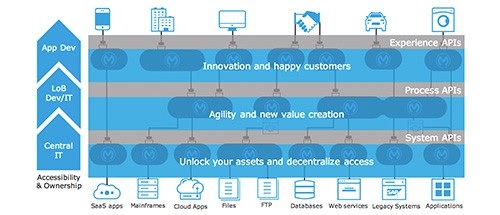
Select the correct Owner-Layer combinations from below options

Show answerHide answer

Correct answer: C

1. App Developers owns and focuses on Experience Layer APIs
2. LOB IT owns and focuses on Process Layer APIs
3. Central IT owns and focuses on System Layer APIs

Explanation

Explanation: Explanation
Correct Answer:
1. App Developers owns and focuses on Experience Layer APIs
2. LOB IT owns and focuses on Process Layer APIs
3. Central IT owns and focuses on System Layer APIs

References:
https://blogs.mulesoft.com/biz/api/experience-api-ownership/
https://blogs.mulesoft.com/biz/api/process-api-ownership/
https://blogs.mulesoft.com/biz/api/system-api-ownership

Question 35 Choose 1

What best describes the Fully Qualified Domain Names (FQDNs), also known as DNS entries, created when a Mule application is deployed to the CloudHub Shared Worker Cloud?

Show answerHide answer

Correct answer: B

The FQDNs are determined by the application name chosen, IRRESPECTIVE of the region

Explanation

Explanation: Explanation
Correct Answer: The FQDNs are determined by the application name chosen,
IRRESPECTIVE of the region
*****************************************
>> When deploying applications to Shared Worker Cloud, the FQDN are always
determined by application name chosen.
>> It does NOT matter what region the app is being deployed to.
>> Although it is fact and true that the generated FQDN will have the region included in it
(Ex: exp-salesorder-api.au-s1.cloudhub.io), it does NOT mean that the same name can be
used when deploying to another CloudHub region.
>> Application name should be universally unique irrespective of Region and Organization
and solely determines the FQDN for Shared Load Balancers

Question 36 Choose 1

Mule applications that implement a number of REST APIs are deployed to their own subnet
that is inaccessible from outside the organization.
External business-partners need to access these APIs, which are only allowed to be
invoked from a separate subnet dedicated to partners - called Partner-subnet. This subnet
is accessible from the public internet, which allows these external partners to reach it.
Anypoint Platform and Mule runtimes are already deployed in Partner-subnet. These Mule
runtimes can already access the APIs.
What is the most resource-efficient solution to comply with these requirements, while
having the least impact on other applications that are currently using the APIs?

Show answerHide answer

Correct answer: A

Implement (or generate) an API proxy Mule application for each of the APIs, then deploy the API proxies to the Mule runtimes

Question 37 Choose 1

A set of tests must be performed prior to deploying API implementations to a staging
environment. Due to data security and access restrictions, untested APIs cannot be
granted access to the backend systems, so instead mocked data must be used for these
tests. The amount of available mocked data and its contents is sufficient to entirely test the
API implementations with no active connections to the backend systems. What type of
tests should be used to incorporate this mocked data?

Show answerHide answer

Correct answer: D

Unit tests (Whitebox)

Explanation

Explanation: Explanation
Correct Answer: Unit tests (Whitebox)
*****************************************
Reference: https://docs.mulesoft.com/mule-runtime/3.9/testing-strategies
As per general IT testing practice and MuleSoft recommended practice, Integration and
Performance tests should be done on full end to end setup for right evaluation. Which
means all end systems should be connected while doing the tests. So, these options are
OUT and we are left with Unit Tests and Functional Tests.
As per attached reference documentation from MuleSoft:
Unit Tests - are limited to the code that can be realistically exercised without the need to
run it inside Mule itself. So good candidates are Small pieces of modular code, Sub Flows,
Custom transformers, Custom components, Custom expression evaluators etc.
Functional Tests - are those that most extensively exercise your application configuration.
In these tests, you have the freedom and tools for simulating happy and unhappy paths.
You also have the possibility to create stubs for target services and make them success or
fail to easily simulate happy and unhappy paths respectively.
As the scenario in the question demands for API implementation to be tested before
deployment to Staging and also clearly indicates that there is enough/ sufficient amount of
mock data to test the various components of API implementations with no active
connections to the backend systems, Unit Tests are the one to be used to incorporate this

Question 38 Choose 1

When must an API implementation be deployed to an Anypoint VPC?

Show answerHide answer

Correct answer: A

When the API Implementation must invoke publicly exposed services that are deployed outside of CloudHub in a customer- managed AWS instance

Question 39 Choose 1

Refer to the exhibit.

A developer is building a client application to invoke an API deployed to the STAGING
environment that is governed by a client ID enforcement policy.
What is required to successfully invoke the API?

Show answerHide answer

Correct answer: C

The client ID and secret obtained from Anypoint Exchange for the API instance in the
STAGING environment

Explanation

Explanation: Explanation
Correct Answer: The client ID and secret obtained from Anypoint Exchange for the API
instance in the STAGING environment
*****************************************
>> We CANNOT use the client ID and secret of Anypoint Platform account or any individual
environments for accessing the APIs
>> As the type of policy that is enforced on the API in question is "Client ID Enforcment
Policy", OAuth token based access won't work.
Right way to access the API is to use the client ID and secret obtained from Anypoint
Exchange for the API instance in a particular environment we want to work on.
References:
Managing API instance Contracts on API Manager
https://docs.mulesoft.com/api-manager/1.x/request-access-to-api-task
https://docs.mulesoft.com/exchange/to-request-access
https://docs.mulesoft.com/api-manager/2.x/policy-mule3-client-id-based-policies

Question 40 Choose 1

What is true about API implementations when dealing with legal regulations that require all data processing to be performed within a certain jurisdiction (such as in the USA or the EU)?

Show answerHide answer

Correct answer: C

They must te deployed to Anypoint Platform runtime planes that are managed by Anypoint Platform control planes, with both planes in the same Jurisdiction

Explanation

Explanation: Explanation
Correct Answer: They must be deployed to Anypoint Platform runtime planes that are
managed by Anypoint Platform control planes, with both planes in the same Jurisdiction.
*****************************************
>> As per legal regulations, all data processing to be performed within a certain jurisdiction.
Meaning, the data in USA should reside within USA and should not go out. Same way, the
data in EU should reside within EU and should not go out.
>> So, just encrypting the data in transit and at rest does not help to be compliant with the
rules. We need to make sure that data does not go out too.
>> The data that we are talking here is not just about the messages that are published to
Anypoint MQ. It includes the apps running, transaction states, application logs, events,
metric info and any other metadata. So, just replacing Anypoint MQ with a locally hosted
ActiveMQ does NOT help.
>> The data that we are talking here is not just about the key/value pairs that are stored in
Object Store. It includes the messages published, apps running, transaction states,
application logs, events, metric info and any other metadata. So, just avoiding using Object
Store does NOT help.
>> The only option left and also the right option in the given choices is to deploy application
on runtime and control planes that are both within the jurisdiction.

Full mock exam

Sit the MCPA-Level-1 exam before exam day

Full-length mocks with the same number of questions and the same time limit as the real MCPA-Level-1 exam. Every attempt draws a new set of questions from the full bank, so you can keep going until you pass comfortably.

Get full MCPA-Level-1 mock exam
  • 65questions per mock
  • 105 mintime limit
  • 151questions in the bank
  • Newmock on every attempt