Exhibit
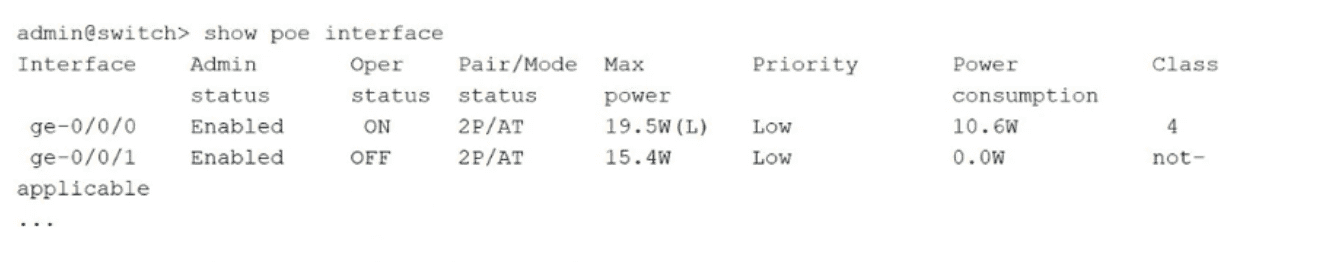
You are deploying a new campus switching environment using various EX Series switch models. The devices attached to one of the new EX Senes switches include IP phones, loT devices, and wireless access points (APs) requiring power over Ethernet (PoE) with varying power requirements. A sample output from one of these switches is shown in the exhibit. In this scenario, which two statements are correct? (Choose two.)
You are deploying a new campus switching environment using various EX Series switch models. The devices attached to one of the new EX Senes switches include IP phones, loT devices, and wireless access points (APs) requiring power over Ethernet (PoE) with varying power requirements. A sample output from one of these switches is shown in the exhibit. In this scenario, which two statements are correct? (Choose two.)
Show answerHide answer
Correct answer: B, D Port ge-0/0/0 is enabled and has its maximum power and device class designations statically configured. The switch is capable of supplying up to 30 W of power to attached PoE devices.
Explanation
Explanation:B. Port ge-0/0/0 is enabled and has its maximum power and device class designations statically configured.
– Correct. The show poe interface output shows Max power = 19.5W (L), where (L) indicates a statically configured limit. Class 4 is also manually assigned, overriding dynamic detection. This static mode is used to preserve total power budget.
D. The switch is capable of supplying up to 30 W of power to attached PoE devices.
– Correct. The attached device on ge-0/0/0 is Class 4, which requires PoE+ (802.3at) capability. PoE+ ports can deliver up to 30 W per port, even if a specific port has been administratively limited to 19.5 W.
Why other options are incorrect
A. 60 W capability
– Incorrect. No evidence supports 60 W (PoE‑bt). Class 4 indicates only PoE+ (30 W max per port).
C. Dynamically learned class/power
– Incorrect. Dynamic learning would show default max power (e.g., 30 W for Class 4) without the (L) flag. The (L) and non‑standard 19.5 W value prove static configuration.
References
Juniper TechLibrary – show poe interface: (L) indicates statically configured maximum power
Juniper CLI Reference – Static PoE management mode overrides dynamic class defaults
IEEE 802.3at – PoE+ Class 4 requires 30 W PSE capability per port