Juniper certification · Exam JN0-650

JN0-650 Mock Exam Page 2

Enterprise Routing and Switching - Professional (JNCIP-ENT)

Free JN0-650 mock exam questions 11–20, each with the answer and an explanation.

20 questions · 28 minutes · free, no sign-up

Free JN0-650 questions

11–20 of 21 free
Question 11 Choose 1
Exhibit

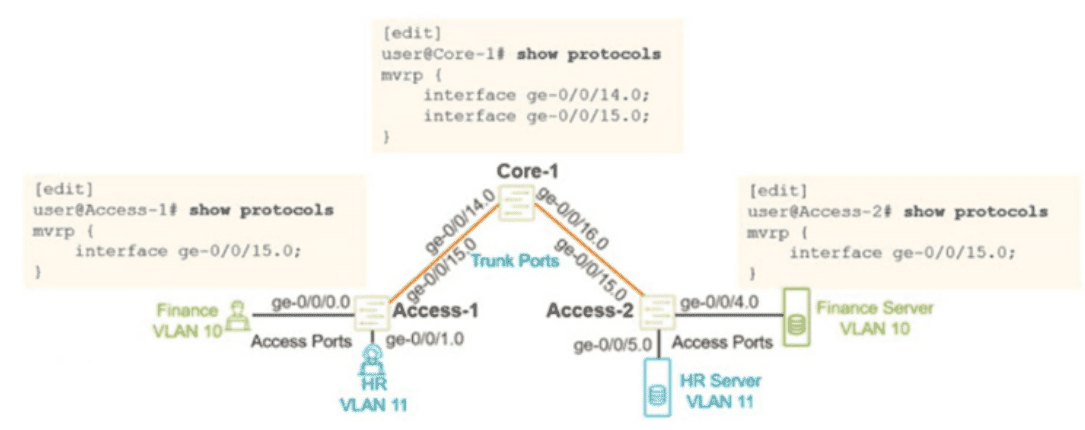
You configured MVRP in your Layer 2 network using the configuration shown in the exhibit. You verified that the appropnate VLANs are configured and applied on the two access switches. You are using RSTP as your loop prevention mechanism. Unfortunately, the users are not able to communicate with their corresponding server attached to the Access- 2 switch. In this scenario, what should you do to solve this problem?
Show answerHide answer

Correct answer: C Configure the ge-070716.0 interface on the Core-1 switch under MVRP.

Explanation

Explanation:

MVRP (Multiple VLAN Registration Protocol) dynamically propagates VLAN registration information across trunk ports. In the exhibit:

Access‑1 has VLAN 10 (Finance) and VLAN 11 (HR) configured on its access ports, and MVRP enabled on trunk interface ge-0/0/15.0 (toward Core‑1).

Access‑2 has VLAN 10 (Finance Server) and VLAN 11 (HR Server) configured, and MVRP enabled on trunk interface ge-0/0/15.0 (toward Core‑1).

Core‑1 has MVRP enabled on ge-0/0/15.0 (toward Access‑1) and also needs MVRP enabled on ge-0/0/14.0 to allow the VLAN declarations from Access‑1 to propagate to Access‑2.

Without MVRP on ge-0/0/14.0 on Core‑1, the VLAN registration information from Access‑1 does not reach Access‑2. The users on Access‑1 cannot communicate with their servers on Access‑2 because the trunk segments are not dynamically propagating the VLAN membership across the entire path.

Why other options are incorrect

A. Configure VSTP instead of RSTP
– Incorrect. The problem is not related to STP type. VSTP (VLAN Spanning Tree Protocol) is used for per‑VLAN STP in mixed‑vendor environments, but RSTP works fine here. The issue is MVRP propagation, not loop prevention.

B. Configure the access interfaces on Access‑2 under MVRP
– Incorrect. MVRP is only needed on trunk ports to propagate VLAN registrations. Access ports (where end hosts connect) do not need MVRP because they are statically assigned to VLANs.

D. Configure the access interfaces on Access‑1 under MVRP
– Incorrect. Access ports on Access‑1 (e.g., ge-0/0/0.0 for Finance, ge-0/0/1.0 for HR) do not need MVRP. Their VLAN membership is statically configured, and they do not propagate VLAN registrations further.

References:

Juniper TechLibrary – MVRP configuration: MVRP must be enabled on all trunk interfaces in the propagation path

JNCIP‑ENT study guide – VLAN registration protocols (MVRP)
Question 12 Choose 2
You are troubleshooting a multicast deployment in a network. Some multicast groups operate in PIM-ASM mode and others operate in PIM-SSM mode. While troubleshooting, you note the following:
- The network uses IGMPv2 for some segments and IGMPv3 for others.
- For group 232.1.1.1, receivers know the exact source IP of the multicast sender
- For group 239.10.10.10. receivers do not know the source address in advance.
Which two statements correctly describe the operational differences between these two modes in Junos OS? (Choose two.)
Show answerHide answer

Correct answer: A, D PIM-ASM supports multiple active sources for a group without requiring receivers to know them in advance, whereas PIM-SSM requires explicit source knowledge PIM-SSM relies on IGMPv3 to signal both the source and the group in the join message, bypassing the RP entirely.

Explanation

Explanation:

A. PIM-ASM supports multiple active sources for a group without requiring receivers to know them in advance, whereas PIM-SSM requires explicit source knowledge.
– Correct. Any-Source Multicast (ASM) allows any source to send to a multicast group, and receivers join the group without knowing the source IP in advance. Source-Specific Multicast (SSM) requires receivers to know both the source IP and the group IP at join time, typically signaled via IGMPv3's INCLUDE mode, which specifies (S,G) instead of just (*,G).

D. PIM-SSM relies on IGMPv3 to signal both the source and the group in the join message, bypassing the RP entirely.
– Correct. SSM uses IGMPv3's capability to report (S,G) membership. When the receiver's DR receives this, it sends a PIM (S,G) join directly toward the source (without ever involving an RP). This eliminates the need for an RP, shared tree, or register process. In contrast, ASM typically uses IGMPv1/v2 (or IGMPv3 in EXCLUDE mode), which only signals (*,G), requiring RP-based shared trees initially.

Why B and C are incorrect

B. In PIM-ASM, the DR first sends a PIM register message to the RP before switching to the shortest-path tree.
– Incorrect as a difference between ASM and SSM. This describes PIM-ASM behavior accurately, but the question asks for operational differences between the two modes. This statement is true only for ASM, but SSM never uses an RP or register messages at all. However, the wording of the question expects contrasting statements about both modes. Since SSM has no RP, this does not correctly describe a difference of the same type for both modes — and more importantly, this is a description of ASM only, not a valid paired difference.

C. PIM-SSM requires an RP for initial joins, whereas PIM-ASM can operate without one.
– Incorrect. This is backwards. PIM-ASM requires an RP for initial joins (via shared tree), while PIM-SSM does not require an RP at all because joins are sent directly toward the source using (S,G) state.

References

Juniper TechLibrary – PIM-SSM overview: "SSM uses IGMPv3 to join (S,G) directly without an RP"

Juniper TechLibrary – PIM-ASM overview: "ASM uses an RP for shared tree and register process"
Question 13 Choose 1
Which statement about LLDP and LLDP-MED operations on EX Series devices is correct?
Show answerHide answer

Correct answer: C EX Series devices support LLDP-MED power negotiation, enabling dynamic allocation of PoE power based on endpoint device needs.

Explanation

Explanation:

C is correct because LLDP-MED (Link Layer Discovery Protocol
- Media Endpoint Discovery) is an extension to standard LLDP specifically designed for communication between network switches and endpoint devices such as IP phones, cameras, and wireless access points . One of its key features is the Power Management TLV (Type-Length-Value), which enables advanced Power over Ethernet negotiation. When an LLDP-MED capable device connects to an EX Series switch, it can communicate its exact power requirements to the switch, allowing dynamic allocation of PoE power based on the device's needs rather than relying on static power classes . This optimizes the switch's power budget and ensures devices receive only the power they actually require.

Why A is incorrect: The statement "LLDP only operates on interfaces configured for Layer 2" is false. LLDP is a Layer 2 protocol that runs over the data-link layer, but it is not restricted to interfaces configured exclusively for Layer 2 switching. LLDP operates on physical interfaces regardless of whether they are configured for Layer 2 or Layer 3 operations . It discovers neighbors and advertises information about the device itself, not about the Layer 2/Layer 3 configuration of the interface.

Why B is incorrect: EX Series devices do not flood LLDP frames across a Layer 2 domain to calculate network topology. LLDP is a neighbor discovery protocol that operates on a point-to-point basis—each device communicates directly with its immediate neighbors only. LLDP frames are not flooded; they are transmitted to a specific multicast MAC address (01:80:C2:00:00:0E) and are not forwarded by switches beyond the directly connected link . Topology calculation using LLDP would require central collection of neighbor information (e.g., via a network management system), not flooding.

Why D is incorrect: LLDP-MED does not focus on discovering network connectivity devices like routers and switches. That is the function of standard LLDP. LLDP-MED is specifically designed for media endpoint devices such as IP phones, video conferencing systems, and other voice/video endpoints . LLDP-MED extends LLDP with additional TLVs for VoIP applications, including network policy discovery (VLAN, CoS, DSCP), power management, inventory management, and location information for emergency services (e.g., E911) .

References:

Juniper Networks Documentation: LLDP-MED power negotiation capabilities on EX Series switches

Cisco Configuration Guide: LLDP-MED Power Management TLV for dynamic power allocation
Question 14 Choose 1
You want to implement a system in your network to simplify VLAN management that can also dynamically create and prune VLANs. How would you accomplish this task?
Show answerHide answer

Correct answer: C Enable MVRP on trunk interfaces.

Explanation

Explanation:

MVRP (Multiple VLAN Registration Protocol) is the IEEE 802.1ak standard that dynamically manages VLAN registration information across a Layer 2 network. When enabled on trunk interfaces, MVRP allows switches to automatically:

Dynamically create VLANs based on declarations from neighboring switches
Prune VLANs when they are no longer needed by any switch in the network
Propagate VLAN membership information only across trunk links that require specific VLANs

This simplifies VLAN management by eliminating the need to manually configure the same VLANs on every switch's trunk ports. When a switch declares a VLAN (because it has an access port in that VLAN), MVRP carries that declaration across trunk interfaces, and only trunk interfaces that need that VLAN will dynamically register and carry its traffic.

Why other options are incorrect

A. Enable GVRP on access interfaces – Incorrect. GVRP (GARP VLAN Registration Protocol) is an older, less robust protocol than MVRP. Even if GVRP were used, access interfaces do not need dynamic VLAN registration because they are statically assigned to VLANs. Dynamic registration is designed for trunk links between switches.

B. Enable MVRP and GVRP on all interfaces– Incorrect. Running both protocols concurrently is unnecessary and may cause conflicts. MVRP is the successor to GVRP and is the recommended protocol for Juniper EX Series switches. Additionally, enabling either protocol on access interfaces serves no practical purpose.

D. Enable MVRP on access interfaces – Incorrect. Access interfaces connect to end devices (servers, workstations) that do not participate in VLAN registration protocols. Enabling MVRP on access interfaces provides no benefit and may cause unnecessary processing overhead.

References:
Juniper TechLibrary – MVRP: "MVRP dynamically registers and deregisters VLANs on trunk interfaces"
IEEE 802.1ak – Multiple Registration Protocol (MRP) and MVRP specifications
JNCIP-ENT study guide – Layer 2 protocols: MVRP for dynamic VLAN management and pruning
Question 15 Choose 3
Which three statements about VSTP are correct? (Choose three.)
Show answerHide answer

Correct answer: A, D, E Separate BPDUs are Hooded for each VSTP enabled VLAN. VSTP supports up to 253 unique spanning tree topologies. A separate spanning tree instance is generated for each VLAN.

Explanation

Explanation:

A. Separate BPDUs are flooded for each VSTP enabled VLAN.
– Correct. VLAN Spanning Tree Protocol (VSTP) operates on a per‑VLAN basis. For each VLAN enabled for VSTP, the switch generates and floods separate BPDUs specific to that VLAN. This allows different VLANs to have different spanning tree topologies, including independent root bridges, port roles, and states.

D. VSTP supports up to 253 unique spanning tree topologies.
– Correct. Juniper EX Series switches support up to 253 VSTP instances (VLANs) simultaneously. This limit accounts for system resource constraints (CPU and memory), as each VSTP instance maintains its own spanning tree state machine, timers, and BPDU processing.

E. A separate spanning tree instance is generated for each VLAN.
– Correct. The core principle of VSTP is to create an independent spanning tree instance per VLAN. Unlike RSTP (which uses a single instance for all VLANs) or MSTP (which maps multiple VLANs to fewer instances), VSTP dedicates one spanning tree topology per VLAN, providing maximum flexibility at the cost of higher resource consumption.

Why B and C are incorrect

B. VSTP is incompatible with RSTP.
– Incorrect. VSTP is actually an extension of RSTP (IEEE 802.1w) and operates on a per‑VLAN basis. VSTP uses the same rapid convergence mechanisms as RSTP, including proposal/agreement handshake and edge port detection. VSTP is fully compatible with RSTP when VLAN consistency is maintained across the Layer 2 domain. The statement confuses "incompatible" with "different scope" (single instance vs. multiple instances).

C. VSTP is enabled by default on EX Series switches.
– Incorrect. By default, Juniper EX Series switches run RSTP (Rapid Spanning Tree Protocol) on all interfaces. VSTP must be explicitly configured under [edit protocols vstp] after disabling RSTP or other spanning tree protocols. VSTP is not the default STP mode.

References:

Juniper TechLibrary – VSTP: "VSTP runs a separate spanning tree instance per VLAN, with up to 253 instances supported"

Juniper EX Series Configuration Guide – Spanning Tree Protocols: RSTP is default, VSTP requires explicit configuration
Question 16 Choose 1
You need to perform maintenance on one of your OSPF routers. You do not want the other OSPF routers on the network to forward traffic to this router dunng the maintenance window Which OSPF configuration parameter would you implement to accomplish this task?
Show answerHide answer

Correct answer: B overload

Explanation

Explanation:

To prevent other OSPF routers from forwarding transit traffic through a router during maintenance, you need to configure the overload feature (also known as stub router or max-metric). When enabled, the router signals to neighbors that it should not be used for transit traffic, while still allowing traffic destined for its directly connected networks.

Why other options are incorrect

A. traffic-engineering
– Incorrect. MPLS traffic engineering is used to influence path selection based on constraints like bandwidth or administrative groups, not to temporarily prevent a router from carrying transit traffic during maintenance. This is a fundamentally different operational purpose.

C. preference
– Incorrect. The preference parameter adjusts the administrative distance of OSPF routes relative to other routing protocols. It does not signal other OSPF routers to avoid using a router for transit traffic. This controls local route selection only.

D. spf-options
– Incorrect. The spf-options stanza configures SPF calculation parameters such as delay timers or rapid updates. It does not provide the overload/stub router advertisement functionality needed to repel transit traffic during maintenance .

References:
Juniper TechLibrary – overload configuration for repelling transit traffic
RFC 3137 – OSPF Stub Router Advertisement (overload mechanism)
Juniper CLI reference – set protocols ospf overload
Question 17 Choose 2
Your OSPF network consists of a mix of 1GbE and 10GbE interfaces. By default, all interfaces have the same cost in your OSPF network. You are asked to ensure that the 10GbE interfaces are more preferred when available In this scenario, which two statements would accomplish this behavior? (Choose two.)
Show answerHide answer

Correct answer: A, D You should define the reference bandwidth as 10G. which will assign the 1GbE interfaces a higher cost You should manually assign the interface metric for each 1GbE interface to be higher than the 10GbE interfaces in your OSPF network.

Explanation

Explanation:

To make 10GbE interfaces preferred over 1GbE in OSPF, you need lower OSPF cost on the faster links because OSPF always prefers the path with lowest cost.

A. Define the reference bandwidth as 10G, which will assign the 1GbE interfaces a higher cost. – Correct.
OSPF cost = reference‑bandwidth / interface speed. Default reference (100M) gives both 1G and 10G a cost of 1 (no preference). Changing reference to 10G makes 1GbE cost = 10,000/1,000 = 10 and 10GbE cost = 10,000/10,000 = 1, so 10GbE is preferred.

D. Manually assign the interface metric for each 1GbE interface to be higher than the 10GbE interfaces. – Correct.
Manual metric overrides automatic calculation. Setting a higher cost (e.g., 10) on 1GbE and a lower cost (e.g., 1) on 10GbE directly ensures faster links are preferred.

Why B and C are incorrect

B. Manually assign higher metric to 10GbE interfaces
– Incorrect. This gives faster links a higher cost than slower links, causing OSPF to prefer the slower 1GbE paths—the opposite of what is required.

C. Define reference bandwidth as 1G
– Incorrect. Formula: 1G reference gives 1GbE cost = 1,000/1,000 = 1 and 10GbE cost = 1,000/10,000 = 0.1 (rounded up to 1). Both become 1, so no preference is achieved. Reference must be higher than the fastest link to create differentiation.

References

Juniper TechLibrary – OSPF cost calculation: reference-bandwidth adjusts per‑interface cost based on link speed

RFC 2328 (OSPFv2) – Section 12.3: Cost is inversely proportional to link speed; lower cost is more preferred
Question 18 Choose 2
Exhibit

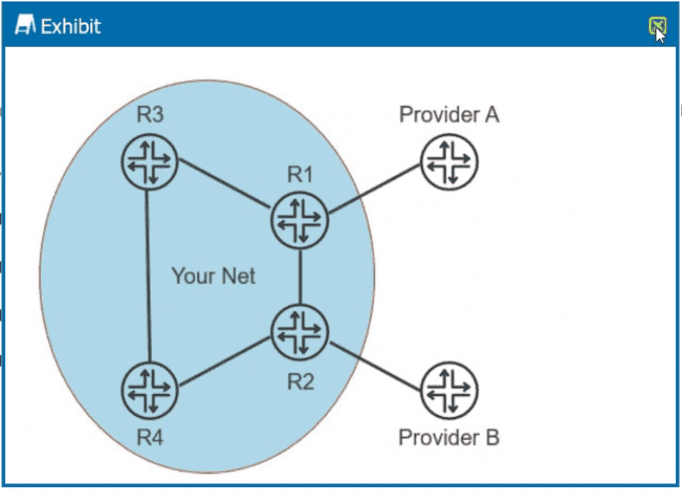
Your network receives the full Internet BGP routing table from two different ISPs. You want your local routers to use Provider A to forward all Internet traffic as long as Provider A is available. Referring to the exhibit, which two actions would satisfy this requirement? (Choose two.)
Show answerHide answer

Correct answer: A, C Use a routing policy to set the local preference attribute value higher for the routes that are learned by R1 Use a routing policy to set the local preference attribute value lower for the routes that are learned by R2.

Explanation

Explanation:

Local Preference (LocalPref) is a BGP attribute used to influence outbound traffic path selection within an autonomous system. A higher LocalPref value is more preferred. To make Provider A (R1) the preferred path for all Internet traffic when available, you must ensure routes from R1 have a higher LocalPref than routes from R2.

A. Use a routing policy to set the local preference attribute value higher for the routes that are learned by R1.
– Correct. Increasing LocalPref on routes from R1 makes them more preferred than routes with default or lower LocalPref from R2.

C. Use a routing policy to set the local preference attribute value lower for the routes that are learned by R2.
– Correct. Decreasing LocalPref on routes from R2 makes them less preferred, so R1 routes (with default or higher LocalPref) win.

Both actions achieve the same goal: routes from R1 have higher relative LocalPref than routes from R2. You can do one or the other, or both.

Why B and D are incorrect

B. Set LocalPref higher for routes learned by R2
– Incorrect. This would make R2 more preferred, directing traffic toward Provider B instead of Provider A.

D. Set LocalPref lower for routes learned by R1 – Incorrect. This would make R1 less preferred, again steering traffic away from Provider A.

References

Juniper TechLibrary – BGP Local Preference: Higher value is more preferred for outbound route selection

RFC 4271 (BGP-4) – Section 5.1.1: Local Preference attribute

JNCIP-ENT study guide – BGP path selection: LocalPref is the first tie-breaker after highest weight (Cisco) or after next-hop reachability (Juniper)
Question 19 Choose 1
You must implement EVPN signaling on an EX Series device that is configured with both underlay and overlay networks. Which network protocol accomplishes this task?
Show answerHide answer

Correct answer: D EBGP overlay network

Explanation

Explanation:

EVPN (Ethernet VPN) signaling requires a control plane protocol to exchange MAC, IP, and Ethernet segment reachability information between VTEPs. On EX Series switches in a VXLAN EVPN deployment, this signaling is performed exclusively by MP‑BGP (Multiprotocol BGP) using the evpn address family (AFI 25, SAFI 70). This BGP session is typically established as an EBGP overlay network between loopback interfaces of VTEPs, independent of the underlay routing protocol.

The underlay (OSPF, IS‑IS, or static) provides only IP reachability between VTEP loopbacks. It does not and cannot carry EVPN routes. The overlay BGP EVPN control plane is mandatory for EVPN to function.

Why A, B, and C are incorrect

A. OSPF underlay network
– Incorrect. OSPF can provide underlay IP connectivity (VTEP loopback routes), but it has no mechanism to carry EVPN NLRI. OSPF is completely unaware of EVPN route types.

B. IS‑IS underlay network
– Incorrect. Same limitation as OSPF: IS‑IS handles only underlay routing. EVPN signaling requires BGP, not IS‑IS.

C. MPLS overlay network
– Incorrect. MPLS is a data plane encapsulation method, not a control plane signaling protocol. While EVPN can run over MPLS instead of VXLAN, BGP is still the signaling protocol. Additionally, EX Series switches typically use VXLAN for EVPN overlays, not MPLS.

References

Juniper TechLibrary – EVPN/VXLAN: "EVPN uses MP‑BGP with address family evpn for control plane signaling"

RFC 7432 (EVPN) – Section 7: BGP EVPN NLRI definition

RFC 8365 (NVO3) – Overlay control plane requirements
Question 20 Choose 1
You have several switches in your network that use Cisco's PVST+ protocol. You want your Juniper switches to interoperate with those devices. In this scenario, which protocol would you use?
Show answerHide answer

Correct answer: C VSTP

Explanation

Explanation:

To enable Juniper switches to interoperate with Cisco switches running PVST+ (Per-VLAN Spanning Tree Plus), you must configure VSTP (VLAN Spanning Tree Protocol) on the Juniper devices.

Cisco's PVST+ and Rapid-PVST+ are proprietary per-VLAN spanning tree protocols that are not IEEE standards . Juniper developed VSTP specifically to provide compatibility with Cisco's PVST+ implementation, allowing both vendors' switches to coexist in the same Layer 2 network . Juniper's official documentation explicitly states: "If your EX Series or QFX Series switch interoperates with a Cisco device running Rapid per VLAN Spanning Tree (Rapid PVST+), we recommend that you enable both VSTP and RSTP on the EX Series or QFX Series interface" .

Why other options are incorrect

A. RPVST+
– Incorrect. RPVST+ (Rapid Per-VLAN Spanning Tree Plus) is Cisco's proprietary protocol. Juniper switches do not run RPVST+ natively; they use VSTP to interoperate with it .

B. MSTP
– Incorrect, though it can work. MSTP (Multiple Spanning Tree Protocol) is an IEEE standard (802.1s) that interoperates with Cisco's MST implementation. However, when Cisco switches run PVST+ (not MST), MSTP and PVST+ have well-documented interoperability issues. The PVST Simulation feature can cause ports to block when receiving differing PVST+ BPDUs because Cisco uses Extended System ID (VLAN ID embedded in Bridge ID), making BPDUs for different VLANs non-identical . While technically possible with careful root bridge configuration, VSTP is the Juniper-recommended and more straightforward solution for PVST+ environments .

D. RSTP
– Incorrect. RSTP (Rapid Spanning Tree Protocol) is VLAN-unaware—it runs a single spanning tree instance for all VLANs. Cisco's PVST+ runs a separate instance per VLAN. These two models are fundamentally incompatible and cannot interoperate directly .

References:

Juniper Networks Documentation – VSTP: Designed for Cisco PVST+ interoperability
Cisco Community – MSTP recommended for mixed environments, VSTP also possible
Network Engineering Stack Exchange – PVST+ vs MSTP compatibility issues
Full mock exam

Sit the JN0-650 exam before exam day

Full-length mocks with the same number of questions and the same time limit as the real JN0-650 exam. Every attempt draws a new set of questions from the full bank, so you can keep going until you pass comfortably.

Get full JN0-650 mock exam
  • 65questions per mock
  • 90 mintime limit
  • 72questions in the bank
  • Newmock on every attempt