Which two statements are correct about security zones? (Choose two.)
Show answerHide answer
Correct answer: B, D Interfaces in the same security zone must share the same routing instance. A security zone can contain multiple interfaces.
Explanation
Explanation:Option B – Correct: Interfaces in the same security zone must share the same routing instance. In Junos OS, a security zone is bound to a single routing instance (e.g., default inet.0 or a specific VRF). All interfaces within that zone use that routing instance for forwarding decisions. This ensures consistent route lookup and security policy application across the zone.
Option D – Correct: A security zone can contain multiple interfaces. Security zones are logical groupings designed to aggregate interfaces with similar security levels. For example, you can place ge-0/0/1.0, ge-0/0/2.0, and ge-0/0/3.0 all into the trust zone. This simplifies policy configuration because rules are applied per zone, not per interface.
Why Option A is incorrect: An interface (logical unit) cannot belong to multiple security zones simultaneously. Junos enforces a strict one-to-one binding between a logical interface and a security zone. Allowing an interface in two zones would create ambiguous traffic classification and conflicting policy enforcement, which Junos prevents by design.
Why Option C is incorrect: This statement directly contradicts Option B. Interfaces in the same zone cannot use separate routing instances. If two interfaces were in different routing instances, they would belong to different zones because the routing instance is part of the zone's identity. Separating routing instances would break internal zone consistency and cause traffic to be treated as inter-zone (requiring policies) rather than intra-zone (permitted by default).
References
Juniper TechLibrary – Security Zones Overview
“Each logical interface can belong to only one security zone. A security zone can contain multiple interfaces. All interfaces in a security zone share the same routing instance.”
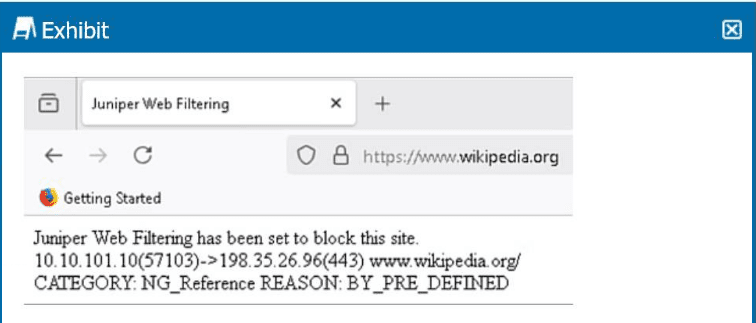 Referring to the exhibit, which two statements are correct? (Choose two.)