ISA certification · Exam ISA-IEC-62443

ISA-IEC-62443 Mock Exam Page 4

ISA/IEC 62443 Cybersecurity Fundamentals Specialist

Free ISA-IEC-62443 questions on IEC 62443 Overview and Terminology, each with the answer and an explanation.

20 questions · 33 minutes · free, no sign-up

IEC 62443 Overview and Terminology questions

31–39 of 39 free
Question 31 Choose 1
Which of the following can be employed as a barrier device in a segmented network?
Available Choices (select all choices that are correct)
Show answerHide answer

Correct answer: A Router

Explanation

Explanation:

A router can be employed as a barrier device in a segmented network because it connects different IP networks and controls the traffic that passes between them. In an Industrial Automation and Control System (IACS), network segmentation is used to divide the network into smaller sections to limit unauthorized communication, reduce the attack surface, and prevent security incidents from spreading between network segments. A barrier device establishes and enforces boundaries between different network segments. It can control communication based on security policies, source and destination IP addresses, protocols, and other traffic characteristics.
A router can perform this function by examining network-layer information and making forwarding decisions according to its routing table and configured access control lists (ACLs). When security policies are applied, a router can restrict communication between network segments and prevent unauthorized devices from accessing protected systems.
For example, an industrial organization may separate its enterprise network from its IACS control network. A router configured with appropriate access control rules can regulate communication between these networks and allow only approved traffic. This helps protect critical industrial devices, such as programmable logic controllers (PLCs), supervisory control and data acquisition (SCADA) systems, and engineering workstations.
In more advanced environments, routers may also provide additional security capabilities, such as packet filtering and integration with firewall functions. However, a basic router should not automatically be considered a complete security control. Its effectiveness depends on its configuration and the security policies enforced.
Therefore, option A is correct because a router can serve as a barrier device by controlling and restricting traffic between network segments.

Why Other Options Are Incorrect:

Option A: Router.
This is correct. A router connects separate IP networks and can enforce communication restrictions through access control lists and traffic-filtering rules. When properly configured, it can act as a barrier between network segments and help prevent unauthorized communication.
Option B: Unmanaged switch.
This is incorrect because an unmanaged switch primarily provides basic Layer 2 connectivity between devices within a local network. It does not normally provide configurable security policies or traffic filtering capabilities needed to enforce security boundaries between network segments. Managed switches, in contrast, can support VLANs, access control lists, and other segmentation features.
Option C: VPN.
This is incorrect in the context of the question because a Virtual Private Network (VPN) primarily provides encrypted communication and secure remote connectivity over an untrusted network. Although VPN gateways can enforce access controls and contribute to network security, a VPN itself is not the intended network barrier device in this question.
Option D: Domain controller.
This is incorrect because a domain controller manages centralized authentication, authorization, and directory services within a domain environment. It helps control user and computer access to network resources but does not normally function as a network traffic barrier between segmented networks.

Reference:
1. ISA/IEC 62443-3-2 — Security Risk Assessment for System Design.
2. ISA/IEC 62443-3-3 — System Security Requirements and Security Levels.
3. NIST SP 800-82 Rev. 3 — Guide to Operational Technology (OT) Security.
4. NIST SP 800-41 Rev. 1 — Guidelines on Firewalls and Firewall Policy.
Question 32 Choose 1
Which layer specifies the rules for Modbus Application Protocol
Available Choices (select all choices that are correct)
Show answerHide answer

Correct answer: D Application layer

Explanation

Explanation:

The Application Layer (Layer 7) of the OSI model specifies the rules and functions of the Modbus Application Protocol. Modbus is an industrial communication protocol used to exchange data between devices such as programmable logic controllers (PLCs), sensors, actuators, remote terminal units (RTUs), and supervisory control systems.
The Modbus Application Protocol defines how devices request and exchange information. It specifies the structure of Modbus application data units (ADUs) and protocol data units (PDUs), including function codes, data addresses, and data values.
Function codes determine the type of operation a device wants to perform. For example, a Modbus client may use a function code to read holding registers, read input registers, or write values to registers in another device. These rules allow industrial devices from different manufacturers to communicate using a common protocol.
For example, a supervisory control system may send a Modbus request to a PLC to read the temperature value stored in a holding register. The PLC processes the request according to the Modbus Application Protocol and returns the requested information. The application protocol defines what the request and response mean, while the underlying communication mechanism handles their transmission.
Modbus can operate over different communication technologies. Modbus TCP uses Ethernet and TCP/IP, while Modbus Serial Line uses serial communication. Although the underlying transport and data-link mechanisms differ, the Modbus Application Protocol defines the common application-level messaging rules.
In IACS cybersecurity, understanding Modbus is important because unauthorized or manipulated Modbus commands may affect industrial equipment and process operations. Security controls should therefore protect Modbus communications against unauthorized access and manipulation.
Therefore, the Application Layer (Layer 7) is correct because it defines the Modbus Application Protocol's communication rules, function codes, and message structure.

Why Other Options Are Incorrect:

Option A: Data link layer
The Data Link Layer (Layer 2) handles communication between devices over a directly connected network link. Its functions include framing, MAC addressing, and media access control. Although Ethernet and serial communication technologies provide lower-layer transport for Modbus, the Data Link Layer does not define the Modbus Application Protocol itself.

Option B: Session layer
The Session Layer (Layer 5) manages communication sessions between applications, including establishing, coordinating, and terminating dialogues. It does not specify Modbus function codes, register operations, or application message formats.

Option C: Presentation layer
The Presentation Layer (Layer 6) is traditionally responsible for data representation, format conversion, encryption, decryption, and compression. It does not define the operational commands and message structure of the Modbus Application Protocol.

Option D: Application layer
This is correct. The Application Layer defines the Modbus Application Protocol, including its function codes, data addressing, request and response formats, and industrial communication operations.


Reference:
1. Modbus Organization — MODBUS Application Protocol Specification V1.1b3.
2. Modbus Organization — MODBUS Messaging on TCP/IP Implementation Guide V1.0b.
3. ISO/IEC 7498-1 — Information Technology: Open Systems Interconnection — Basic Reference Model.
Question 33 Choose 1
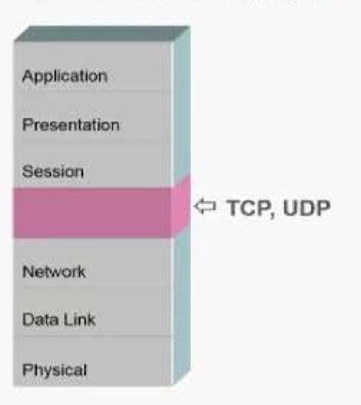
What is the name of the missing layer in the Open Systems Interconnection (OSI) model shown below?

Show answerHide answer

Correct answer: C Transport

Explanation

Explanation:

The correct answer is Transport, which is Layer 4 of the Open Systems Interconnection (OSI) model.
The OSI model is a conceptual framework developed to explain how data moves between devices across a network. It divides network communication into seven layers, with each layer performing a specific function. The Transport Layer is responsible for end-to-end data delivery between applications running on different devices.
The Transport Layer provides important services such as segmentation, reassembly, flow control, and error recovery. It can also manage communication reliability, depending on the protocol being used.
Two major protocols operate at this layer:
1. Transmission Control Protocol (TCP): Provides reliable, connection-oriented communication. It uses acknowledgments, sequencing, and retransmission to help ensure data arrives correctly and in order.
2. User Datagram Protocol (UDP): Provides connectionless communication with lower overhead. It does not guarantee delivery or packet ordering, making it useful for applications such as real-time communication and streaming.
The seven OSI layers, from top to bottom, are:
Layer 7: Application – Provides network services to applications.
Layer 6: Presentation – Handles data formatting, encryption, and compression.
Layer 5: Session – Establishes, manages, and terminates communication sessions.
Layer 4: Transport – Provides end-to-end data delivery.
Layer 3: Network – Handles logical addressing and routing.
Layer 2: Data Link – Handles framing and MAC addressing.
Layer 1: Physical – Transmits raw bits through physical media.
Therefore, Transport (Option C) is the correct answer.

Why Other Options Are Incorrect:

Option A: Control
This is incorrect because Control is not one of the seven official OSI model layers. Network control functions may exist within different protocols and networking technologies, but there is no separate Control Layer in the OSI framework.

Option B: Protocol
This is incorrect because a protocol is a set of rules that governs communication between network devices or systems. Protocols operate at different OSI layers; Protocol itself is not an individual layer.

Option D: User
This is incorrect because User is not an official OSI layer. The Application Layer provides network services used by applications and ultimately supports user-facing network activities, but it is not called the User Layer.

Reference:
ISO/IEC 7498-1 – Information technology – Open Systems Interconnection – Basic Reference Model.
Question 34 Choose 2
Which of the following ISA-99 (IEC 62443) Reference Model levels is named correctly?
Available Choices (select all choices that are correct)
Show answerHide answer

Correct answer: A, C Level 1: Supervisory ControlLevel 3: Operations Management

Explanation

Explanation:

The ISA-99 (IEC 62443) Reference Model uses a hierarchical structure to describe the different levels of an Industrial Automation and Control System (IACS) environment. It helps organizations understand how industrial processes, control systems, and business operations are organized and how information flows between them.
Level 3 is correctly identified as Operations Management. It represents the level responsible for managing and coordinating manufacturing and industrial operations. Activities at this level include production scheduling, workflow management, manufacturing execution, quality management, and coordination of plant operations. Systems such as Manufacturing Execution Systems (MES) commonly operate at this level.
The ISA-95 model, which is closely associated with the industrial automation reference architecture used in ISA-99/IEC 62443 discussions, describes Level 3 as Manufacturing Operations and Control. This level connects the control activities performed at lower levels with business planning and logistics activities at Level 4.
Understanding these levels is important for industrial cybersecurity because each level has different functions, communication requirements, and security risks. For example, Level 3 systems exchange information with Level 2 supervisory control systems and Level 4 business systems. Security controls must protect these communication paths while maintaining the availability and reliability of industrial operations.
Therefore, Option C is correct because Level 3 is associated with Operations Management.

Why Other Options Are Incorrect:

Option A: Level 1: Supervisory Control
This option is incorrect because Level 1 is generally associated with basic control functions, such as controlling individual machines and industrial processes through PLCs and other basic control devices. Supervisory control is typically associated with Level 2, which includes SCADA systems and Human-Machine Interfaces (HMIs).
Option B: Level 2: Quality Control
This option is incorrect because Level 2 is associated with supervisory control and monitoring activities rather than being specifically named Quality Control. It commonly includes SCADA systems, HMIs, and supervisory controllers used to monitor and control industrial processes.
Option D: Level 4: Process
This option is incorrect because Level 4 is associated with Business Planning and Logistics. It includes enterprise-level activities such as business planning, production planning, and logistics management. Process control activities are generally performed at lower levels of the industrial automation hierarchy.

Reference:
1. ISA-95 — Enterprise-Control System Integration, Part 1: Models and Terminology.
2. ISA/IEC 62443-1-1 — Terminology, Concepts, and Models.
3. ISA/IEC 62443 Series — Security for Industrial Automation and Control Systems.
Question 35 Choose 1
Within the National Institute of Standards and Technoloqv Cybersecuritv Framework v1.0 (NIST CSF), what is the status of the ISA 62443 standards?
Available Choices (select all choices that are correct)
Show answerHide answer

Correct answer: A They are used as informative references.

Explanation

Explanation:

Within the National Institute of Standards and Technology Cybersecurity Framework (NIST CSF) Version 1.0, ISA/IEC 62443 standards are used as Informative References. These references help organizations understand how existing cybersecurity standards, guidelines, and best practices can support the implementation of the outcomes described in the NIST Cybersecurity Framework. NIST CSF Version 1.0 includes references to specific ISA 62443 documents, particularly ISA 62443-2-1:2009 and ISA 62443-3-3:2013. These standards are mapped to relevant Framework Core Subcategories to show how their requirements and recommendations can help organizations achieve cybersecurity objectives. For example, ISA 62443-2-1 provides guidance on establishing and maintaining an industrial automation and control systems security program, while ISA 62443-3-3 defines system security requirements and security levels for industrial automation and control systems (IACS). Informative References are not mandatory requirements. Organizations can use them as guidance when selecting and implementing cybersecurity practices according to their operational needs and risk assessments. Therefore, ISA 62443 standards are recognized as informative references within NIST CSF Version 1.0, rather than normative references.

Why Other Options Are Incorrect:

Option B: They are used as normative references.
Normative references are documents that contain requirements that must be followed when applying a particular standard or specification. ISA 62443 standards are not identified as normative references within NIST CSF Version 1.0. Instead, they are included as informative references to provide supporting guidance and demonstrate relationships between cybersecurity practices.
Option C: They are under consideration for future use.
This option is incorrect because ISA 62443 standards were already included in NIST CSF Version 1.0, published in February 2014. They were not merely being considered for future inclusion. The original framework explicitly lists ISA 62443-2-1:2009 and ISA 62443-3-3:2013 in its Informative References.
Option D: They are not used.
This option is incorrect because NIST CSF Version 1.0 explicitly references ISA 62443 documents in multiple Framework Core Subcategories. These references demonstrate how ISA 62443 practices can support cybersecurity outcomes, particularly in industrial automation and control systems environments.

Reference:
1. NIST — Framework for Improving Critical Infrastructure Cybersecurity, Version 1.0 (February 2014), Table 2: Framework Core.
2. NIST — Informative References: What Are They, and How Are They Used?
3. ISA/IEC 62443 — Security for Industrial Automation and Control Systems.
Question 36 Choose 1
Which factor drives the selection of countermeasures?
Available Choices (select all choices that are correct)
Show answerHide answer

Correct answer: B Output from a risk assessment

Explanation

Explanation:

The selection of cybersecurity countermeasures in an Industrial Automation and Control Systems (IACS) environment is primarily driven by the output of a risk assessment. A risk assessment helps an organization identify critical assets, potential threats, existing vulnerabilities, and the possible consequences of successful cyberattacks. This information provides the foundation for deciding which security measures are necessary to reduce identified risks to an acceptable level.
Within the ISA/IEC 62443 framework, risk assessment is an important part of the cybersecurity lifecycle. It helps organizations understand the security requirements of their System under Consideration (SuC), identify relevant risks, and determine appropriate Target Security Levels (SL-T) for zones and conduits.
Based on the assessment results, organizations can select suitable countermeasures, such as access controls, network segmentation, authentication mechanisms, security monitoring, backup procedures, and malware protection. The selected measures should address the identified threats and vulnerabilities while considering operational requirements, safety, availability, and implementation constraints.
For example, if a risk assessment identifies unauthorized communication between industrial network zones as a significant risk, the organization may select network segmentation, firewall rules, and traffic monitoring as appropriate countermeasures.
Therefore, the output of a risk assessment is the primary factor that drives countermeasure selection because it connects identified cybersecurity risks with the security measures needed to address them.

Why Other Options Are Incorrect:

Option A: Foundational requirements
Foundational requirements describe broad security objectives that an IACS should address, such as identification and authentication control, use control, system integrity, data confidentiality, restricted data flow, timely response to events, and resource availability. They help organize security requirements, but they do not independently determine which countermeasures should be selected. The risk assessment identifies the specific protections needed in the environment.
Option C: Security levels
Security levels describe the degree of protection required or achieved against different levels of threats. In ISA/IEC 62443, Target Security Levels (SL-T) help define the desired security objectives, while Achieved Security Levels (SL-A) represent the protection actually implemented. These levels guide security requirements, but the selection of appropriate countermeasures is driven by the risks identified through assessment.
Option D: System design
System design influences how countermeasures are implemented and integrated into the IACS architecture. It considers zones, conduits, network arrangements, devices, and operational requirements. However, the design should be based on the findings of the risk assessment rather than serving as the primary independent factor for selecting countermeasures.

Reference:
1. ISA/IEC 62443-3-2 — Security Risk Assessment for System Design.
2. ISA/IEC 62443-3-3 — System Security Requirements and Security Levels.
3. ISA/IEC 62443-2-1 — Security Management System Requirements for IACS Asset Owners.
Question 37 Choose 1
Which of the following is an example of separation of duties as a part of system development and maintenance?
Available Choices (select all choices that are correct)
Show answerHide answer

Correct answer: A Changes are approved by one party and implemented by another.

Explanation

Explanation:

Why Option A is Correct:
Separation of Duties (SoD) is a fundamental internal control and security principle aimed at preventing fraud, errors, conflicts of interest, and unauthorized modifications to Industrial Automation and Control Systems (IACS). By ensuring that the person or team who approves a system change is different from the party implementing it, organizations establish an essential check-and-balance system. This reduces the risk of malicious modifications, shortcuts, or oversight errors going live without proper verification.

Why the Other Options Are Incorrect:

1. Configuration settings are made by one party and self-reviewed using a checklist:
A self-review lacks independence. Separation of Duties strictly requires an independent second party to verify or approve the work.

2. Developers write and then test their own code:
Having the same individual write and test their code violates independent quality assurance and testing principles. Secure development lifecycles, such as ISA/IEC 62443-4-1, emphasize independent review and testing.

3. Design and implementation are performed by the same team:
While overlapping team roles can occur in small organizations, true architectural governance and independent verification require structural independence between distinct phases or roles to maintain system integrity.

References:
ISA/IEC 62443-3-3 (System Security Requirements and Security Levels) and ISA/IEC 62443-4-1 (Secure Product Development Lifecycle Requirements) address requirements for system management, change control integrity, and independent roles within the development and maintenance lifecycle.
Question 38 Choose 1
Which of the following is the underlying protocol for Ethernet/IP?
Available Choices (select all choices that are correct)
Show answerHide answer

Correct answer: B Common Industrial Protocol

Explanation

Explanation:

EtherNet/IP (Ethernet Industrial Protocol) is an industrial communication protocol that uses the Common Industrial Protocol (CIP) as its underlying application-layer protocol. It is designed to support communication between industrial automation devices, including programmable logic controllers (PLCs), sensors, actuators, drives, and human-machine interfaces (HMIs).
CIP provides a common set of communication services and object models that allow different industrial devices to exchange data and interact with one another. EtherNet/IP carries CIP messages over standard Ethernet and TCP/IP networks, making it possible to integrate industrial automation equipment using widely available Ethernet infrastructure.
EtherNet/IP uses TCP for explicit messaging, which is typically used for configuration, diagnostics, and information exchange. It also uses UDP for implicit messaging, which supports real-time I/O data communication between industrial devices.
One important advantage of EtherNet/IP is its ability to support interoperability among devices from different manufacturers. Because it is based on CIP, devices can use standardized communication objects and services rather than relying entirely on proprietary communication methods.
In industrial cybersecurity, understanding EtherNet/IP and CIP is important because these protocols are commonly used in Industrial Automation and Control Systems (IACS). Their communication traffic must be properly monitored and protected to reduce the risk of unauthorized access, manipulation, and disruption of industrial operations.
Therefore, option B, Common Industrial Protocol (CIP), is the correct answer.

Why Other Options Are Incorrect:

Option A: Building Automation and Control Network (BACnet)
BACnet is a communication protocol primarily designed for building automation systems, such as heating, ventilation, air conditioning (HVAC), lighting, and access control. Although it can operate over Ethernet networks, it is not the underlying protocol used by EtherNet/IP.

Option C: Highway Addressable Remote Transducer (HART)
HART is a communication protocol commonly used in process automation to communicate with field instruments such as pressure, temperature, and flow transmitters. It typically operates over 4–20 mA analog signals with digital communication. Although HART is used in industrial environments, it is not the underlying protocol for EtherNet/IP.

Option D: Object Linking and Embedding (OLE) for Process Control
OPC originally used Microsoft's OLE technology to enable communication and data exchange between industrial automation applications. Modern OPC technologies, particularly OPC Unified Architecture (OPC UA), provide platform-independent industrial communication. However, OPC is not the underlying protocol of EtherNet/IP.

Reference:
1. ODVA – EtherNet/IP Technology: https://www.odva.org/technology-standards/key-technologies/ethernet-ip/
2. ODVA – Common Industrial Protocol (CIP): https://www.odva.org/technology-standards/key-technologies/common-industrial-protocol-cip/
3. IEC 62443 series – Security for Industrial Automation and Control Systems (IACS).
Question 39 Choose 1
What is the name of the protocol that implements serial Modbus over Ethernet?
Available Choices (select all choices that are correct)
Show answerHide answer

Correct answer: D MODBUS/TCP

Explanation

Explanation:

MODBUS/TCP is the protocol used to communicate Modbus messages over Ethernet networks using the TCP/IP communication stack. It allows industrial devices such as programmable logic controllers (PLCs), human-machine interfaces (HMIs), sensors, and supervisory control systems to exchange data over standard Ethernet infrastructure.
Traditional Modbus was originally developed for serial communication, commonly using RS-232 or RS-485 connections. Modbus RTU and Modbus ASCII are examples of serial Modbus communication modes. As industrial networks evolved, Modbus/TCP was introduced to enable Modbus communication over Ethernet and TCP/IP networks.
Modbus/TCP retains the application-level messaging structure of Modbus while adapting its communication mechanism for TCP/IP. It uses TCP port 502 by default and includes a Modbus Application Protocol Data Unit (PDU) within a Modbus TCP Application Data Unit (ADU). The ADU contains an additional MBAP (Modbus Application Protocol) header, which helps identify and manage Modbus transactions.
For example, an HMI connected to an industrial Ethernet network can send a Modbus/TCP request to a PLC to read temperature values from holding registers. The PLC processes the request and returns the requested data through the TCP/IP network.
It is important to understand that Modbus/TCP is not simply serial Modbus signals transmitted directly over Ethernet. Rather, it carries Modbus application messages using TCP/IP. This allows Modbus devices to communicate across Ethernet-based industrial networks without requiring a traditional serial connection.
From a cybersecurity perspective, Modbus/TCP communication should be protected through network segmentation, access restrictions, firewall rules, and monitoring because traditional Modbus/TCP does not provide built-in authentication or encryption.
Therefore, MODBUS/TCP is the correct answer because it implements Modbus application communication over Ethernet using TCP/IP.

Why Other Options Are Incorrect:

Option A: MODBUS/CIP
CIP stands for Common Industrial Protocol and is used by industrial networking technologies such as EtherNet/IP. It is a different industrial communication protocol framework, not the standard name for carrying Modbus messages over Ethernet.

Option B: MODBUS/Ethernet
Although this wording may sound like a general description of Modbus communication over Ethernet, it is not the standardized protocol name used for this purpose. The correct protocol name is Modbus/TCP.

Option C: MODBUS/Plus
Modbus Plus is a proprietary industrial network developed for communication between industrial devices. It is a separate networking technology and should not be confused with Modbus/TCP, which uses standard Ethernet and TCP/IP communication.

Option D: MODBUS/TCP
This is correct. Modbus/TCP carries Modbus application messages over Ethernet networks using the TCP/IP protocol stack. It uses TCP port 502 by default and is widely used in industrial automation environments.


Reference:
1. Modbus Organization — MODBUS Application Protocol Specification V1.1b3.
2. Modbus Organization — MODBUS Messaging on TCP/IP Implementation Guide V1.0b.
3. NIST SP 800-82 Rev. 3 — Guide to Operational Technology (OT) Security.

That's the last free question in IEC 62443 Overview and Terminology

You've seen the free 30% (39 of 132 questions). Full access unlocks every question and full-length ISA-IEC-62443 mock exams (65 questions, 105 minutes), a different mock on every attempt.

Unlock full mock exam
Full mock exam

Sit the ISA-IEC-62443 exam before exam day

Full-length mocks with the same number of questions and the same time limit as the real ISA-IEC-62443 exam. Every attempt draws a new set of questions from the full bank, so you can keep going until you pass comfortably.

Get full ISA-IEC-62443 mock exam
  • 65questions per mock
  • 105 mintime limit
  • 202questions in the bank
  • Newmock on every attempt