ISA certification · Exam ISA-IEC-62443

ISA-IEC-62443 Mock Exam

ISA/IEC 62443 Cybersecurity Fundamentals Specialist

Free ISA-IEC-62443 questions on Risk Management and Security Lifecycle, each with the answer and an explanation.

20 questions · 33 minutes · free, no sign-up

Risk Management and Security Lifecycle questions

1–6 of 6 free
Question 1 Select all that apply
What.are the two elements of the risk analysis category of an IACS? Available Choices (select all choices that are correct)
Show answerHide answer

Correct answer: C Business rationale and risk identification and classification

Explanation

Summary:
This question targets the specific structure of the risk analysis process as defined within the ISA/IEC 62443 framework for an Industrial Automation and Control System (IACS). The standard breaks down the risk analysis category into distinct, sequential elements. The correct answer identifies the two foundational steps that initiate the process: establishing the business context and then systematically identifying and characterizing the risks within that context.

Correct Option:

C. Business rationale and risk identification and classification:
This is the correct answer. According to the ISA/IEC 62443 series, the risk analysis category formally consists of these two elements.

Business Rationale:
This involves defining the scope, the critical assets to be protected, and the business consequences of a security failure (safety, environmental, production, financial). It sets the "why" and the context for the analysis.

Risk Identification and Classification:
This is the process of identifying threats and vulnerabilities and then classifying the resulting risks based on their likelihood and impact, as defined in the business rationale.

Incorrect Option:

A. Risk evaluation and risk identification:
This is incorrect because "risk evaluation" is a later step that involves comparing the estimated risk against risk acceptance criteria to determine if treatment is required. It is a distinct part of the overall risk management process that comes after analysis.

B. Business rationale and risk reduction and avoidance:
This is incorrect because it mixes the initial analysis phase (business rationale) with risk treatment options (reduction and avoidance). Risk treatment is a separate activity that occurs after the analysis is complete.

D. Business recovery and risk elimination or mitigation:
This is incorrect as it combines a disaster recovery concept (business recovery) with risk treatment options (elimination, mitigation). These are not the two core elements of the analysis phase itself.

Reference:
ISA/IEC 62443-2-1:2010, "Establishing an industrial automation and control system security program" defines the elements of a Cybersecurity Management System (CSMS). Clause 4.3.2 details the risk analysis process, explicitly breaking it down into "Business Rationale" and "Risk Identification." This structure is fundamental to the standard's approach to IACS security.
Question 2 Select all that apply
How many element qroups are in the "Addressinq Risk" CSMS cateqorv? Available Choices (select all choices that are correct)
Show answerHide answer

Correct answer: C 4

Explanation

Summary:
This question tests specific knowledge of the structure of a Cyber Security Management System (CSMS) as defined in the ISA/IEC 62443-2-1 standard. The standard organizes the CSMS lifecycle into four high-level categories. The "Addressing Risk" category is further broken down into a specific number of element groups, which represent the key procedural components for managing risk within the IACS environment.

Correct Option:

C. 4:
This is the correct answer. The "Addressing Risk" category in a CSMS, as per ISA/IEC 62443-2-1, consists of four distinct element groups. These are:

Risk Identification

Risk Assessment and Classification

Risk Management

Security Management Plan

Incorrect Option:

A. 2:
This is incorrect. Two element groups would be insufficient to cover the comprehensive process of identifying, assessing, classifying, and managing risk as required by the standard.

B. 3:
This is incorrect. While a simplified risk process might have three steps (e.g., Identify, Assess, Treat), the formal structure defined in the standard for a CSMS specifies four element groups within this category.

D. 5:
This is incorrect. There are not five element groups within the "Addressing Risk" category. The total number of CSMS categories is four, but the "Addressing Risk" category itself contains four element groups.

Reference:
ISA/IEC 62443-2-1:2020, "Establishing an industrial automation and control system security program" defines the CSMS structure. The standard explicitly lists the four element groups that constitute the "Addressing Risk" category, providing the formal basis for this answer.
Question 3 Choose 1
The Risk Analysis category contains background information that is used where?
Available Choices (select all choices that are correct)
Show answerHide answer

Correct answer: A Many other elements in the CSMS

Explanation

Explanation:

In the CSMS model of ISA/IEC 62443-2-1 (2009 edition), the elements are grouped into three categories: Risk Analysis, Addressing Risk with the CSMS, and Monitoring and Improving the CSMS. The Risk Analysis category contains the foundational elements (Business Rationale and Risk Identification, Classification and Assessment). It produces background information such as the business case, the identified assets, threats and vulnerabilities, the consequences, and the risk ratings. This information is then used by many of the other elements in the CSMS. For example:
- It supports the selection and prioritization of security policies, organizational responsibilities and countermeasures.
- It guides the zone and conduit design, personnel security, physical security and network segmentation decisions.
- It informs incident planning, and it is revisited during monitoring and improvement when conditions change.

Because the risk analysis underlies so many activities, its results are not confined to a single element.

Why the other options are incorrect:
B. Elements external to the CSMS: The background information is used within the CSMS to drive its own elements. It is not meant to serve elements outside the CSMS.
C. Only the Assessment element: The information is not restricted to a single element. Risk assessment is part of the Risk Analysis category itself, and its output feeds many other elements.
D. Only the Risk ID element: Risk identification is also part of the Risk Analysis category, and its results are used by many elements, not only itself.

Reference:
ISA/IEC 62443-2-1 (2009), CSMS elements: Risk Analysis category (Business Rationale and Risk Identification, Classification and Assessment)
ISA/IEC 62443-1-1 (security program and risk management concepts)
Question 4 Choose 1
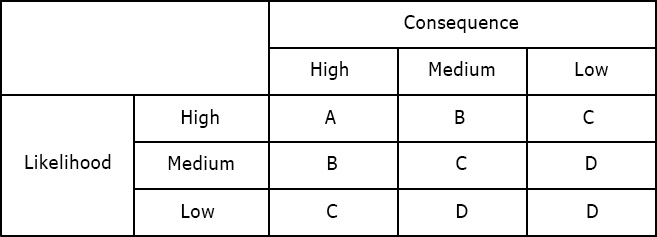
Using the risk matrix below, what is the risk of a medium likelihood event with high consequence?

Show answerHide answer

Correct answer: B Option B

Explanation

Explanation:

The correct answer is Option B because the risk matrix assigns the risk level B to an event with medium likelihood and high consequence.
A risk matrix is a tool used in cybersecurity risk assessment to evaluate and categorize risks based on two main factors: the likelihood of an event occurring and the potential consequence or impact if it occurs.
To identify the correct risk level, locate the Medium row under Likelihood and the High column under Consequence.
At the intersection of these two categories, the matrix displays the risk rating B.
This means that an event with a medium probability of occurring but a high potential impact is assigned risk level B according to the provided matrix. Organizations can use this classification to prioritize risks and determine appropriate cybersecurity countermeasures.
For example, a cyberattack against an industrial control system may have a medium likelihood of occurring but could cause significant production disruption or equipment damage. The matrix classifies this combination as risk level B.
Therefore, Option B is correct because the intersection of medium likelihood and high consequence represents risk level B.

Why Other Options Are Incorrect:

Option A:
This is incorrect because risk level A is assigned to the combination of high likelihood and high consequence, not medium likelihood and high consequence.

Option B:
This is correct because the intersection of medium likelihood and high consequence is marked B in the provided risk matrix.

Option C:
This is incorrect because risk level C appears in combinations such as medium likelihood with medium consequence, or high likelihood with low consequence.

Option D:
This is incorrect because risk level D is assigned to lower-risk combinations, such as medium likelihood with low consequence or low likelihood with medium or low consequence.

Reference:
1. ISA/IEC 62443-3-2 – Security Risk Assessment for System Design.
2. Provided risk matrix – Likelihood and Consequence classification.
Question 5 Choose 1
Whose responsibility is it to determine the level of risk an organization is willing to tolerate?
Available Choices (select all choices that are correct)
Show answerHide answer

Correct answer: A Management

Explanation

Explanation:

Management is responsible for determining the level of cybersecurity risk an organization is willing to tolerate. This level is commonly referred to as risk tolerance. It represents the amount and type of risk an organization is prepared to accept while achieving its business, operational, and security objectives.
In the ISA/IEC 62443 framework, risk management is an important part of establishing and maintaining an effective cybersecurity program for Industrial Automation and Control Systems (IACS). Management provides the direction, authority, and resources needed to ensure that cybersecurity risks are identified, assessed, treated, and monitored appropriately.
Determining risk tolerance requires considering several factors, including business objectives, financial impact, operational availability, regulatory requirements, safety consequences, and potential damage to critical industrial processes.
For example, a manufacturing organization may tolerate a limited interruption to its office IT network but have a very low tolerance for disruptions affecting critical production equipment or safety-related systems. Management establishes the acceptable risk boundaries based on these operational and business priorities.
Management also ensures that cybersecurity decisions are aligned with the organization's overall risk management strategy. After risk tolerance is established, technical teams and other departments can use it to determine appropriate security controls, prioritize risks, and decide which risks require treatment or formal acceptance.
Although departments such as legal, operations, and safety provide valuable input, the overall responsibility for approving the organization's risk tolerance belongs to management.
Therefore, option A is correct because management has the authority and accountability to establish the organization's acceptable level of cybersecurity risk.

Why Other Options Are Incorrect:

Option B: Legal Department
The legal department helps organizations understand cybersecurity-related laws, regulations, contractual obligations, and compliance requirements. It can advise management about the legal consequences of accepting certain risks. However, determining the organization's overall risk tolerance is a management responsibility rather than the exclusive responsibility of the legal department.

Option C: Operations Department
The operations department understands production requirements, industrial processes, system availability, and operational risks. It provides important information when evaluating cybersecurity risks and recommending appropriate controls. However, operational personnel generally work within the risk tolerance established by management rather than independently determining the organization's overall acceptable risk level.

Option D: Safety Department
The safety department focuses on protecting employees, equipment, facilities, and the environment from operational and process-related hazards. It contributes essential safety assessments and recommendations, particularly when cybersecurity incidents could affect industrial safety. However, the responsibility for establishing overall organizational cybersecurity risk tolerance remains with management.

Reference:
1. IEC 62443-2-1 – Security Program Requirements for IACS Asset Owners.
2. IEC 62443-3-2 – Security Risk Assessment for System Design.
Question 6 Choose 1
Multiuser accounts and shared passwords inherently carry which of the following risks?
Available Choices (select all choices that are correct)
Show answerHide answer

Correct answer: C Unauthorized access

Explanation

Explanation:

Multiuser (shared) accounts and shared passwords mean that several people use the same credentials. This creates risks that come directly from the practice:
- Unauthorized access: The more people who know a password, the greater the chance it is leaked, written down, reused or passed to someone who should not have it. Former employees, contractors or anyone who learns it can still log in. It is also hard to revoke access for one person without changing the password for everyone.
- Privilege escalation: Shared accounts are often given broad or administrative rights for convenience. Every user of the account then gets those rights, whether or not their role requires them. An attacker who obtains a shared credential immediately gains the same elevated privileges. This breaks the principle of least privilege.
- No accountability: Actions cannot be traced to an individual, so auditing and incident investigation are weakened (a related risk, though it is not one of the listed options).

Why the other options are incorrect:
B. Buffer overflow: This is a software coding vulnerability in which a program writes more data to memory than it can hold. It has nothing to do with how accounts and passwords are managed.
D. Race conditions: This is a software flaw in which the result depends on the timing or order of concurrent operations. It is not an inherent risk of shared accounts or passwords.

Reference:
ISA/IEC 62443-3-3, SR 1.1 (Human user identification and authentication), SR 1.5 (Authenticator management), SR 2.1 (Authorization enforcement) and SR 2.12 (Non-repudiation)
ISA/IEC 62443-4-2, CR 1.1 (Human user identification and authentication)
ISA/IEC 62443-2-1 (access control and account management in the security program)

That's the last free question in Risk Management and Security Lifecycle

You've seen the free 30% (6 of 20 questions). Full access unlocks every question and full-length ISA-IEC-62443 mock exams (65 questions, 105 minutes), a different mock on every attempt.

Unlock full mock exam
Full mock exam

Sit the ISA-IEC-62443 exam before exam day

Full-length mocks with the same number of questions and the same time limit as the real ISA-IEC-62443 exam. Every attempt draws a new set of questions from the full bank, so you can keep going until you pass comfortably.

Get full ISA-IEC-62443 mock exam
  • 65questions per mock
  • 105 mintime limit
  • 202questions in the bank
  • Newmock on every attempt