An internal auditor submitted a report containing recommendations for management to
enhance internal controls related to investments. To follow up, which of the following is the
most appropriate action for the internal auditor to take?
Show answerHide answer
Correct answer: DConduct appropriate testing to verify management responses.
Explanation
Explanation:
Follow-up on recommendations requires the auditor to verify that corrective action was actually implemented and is working — not merely to accept management's assertions or observe activity. The most appropriate action is to perform appropriate testing (inspection, re-performance, analysis) to confirm the implementation and effectiveness of the corrective measures. This provides objective, reliable evidence that the control weakness has been remediated. It aligns with IIA Standard 2500 (Monitoring Progress), which requires the CAE to establish a system to monitor the disposition of results and confirm that management actions have been taken.
Why the other options are less appropriate:
A — Observe corrective measures: Observation alone provides limited evidence of implementation and effectiveness; it is weaker than actual testing and may not confirm the control operates as intended.
B — Seek a management assurance declaration: A management representation is self-reported evidence and is not sufficient on its own to confirm that corrective action was implemented effectively; the auditor must verify.
C — Follow up during the next scheduled audit: Deferring follow-up to the next scheduled audit may be too late and does not confirm timely remediation; follow-up should occur as part of the established monitoring process (Standard 2500), not passively deferred.
Reference: IIA IPPF — Standard 2500 (Monitoring Progress — "monitor the disposition of results communicated to management," confirming corrective action); Standard 2310 (Identifying Information — reliable evidence).
Question 162Choose 1
An internal auditor is planning to audit the organization's payroll function, which was
recently outsourced. Which of the following is the most appropriate first step for the
auditor?
Show answerHide answer
Correct answer: BUnderstand the objectives and strategies of the new arrangement
Explanation
Explanation:
Before defining objectives, revising scope, or evaluating risk, the auditor must first understand the activity being audited — here, the newly outsourced payroll arrangement. Understanding the objectives and strategies of the arrangement (why it was outsourced, what it is meant to achieve, how the relationship is structured, and what services/controls it involves) provides the necessary foundation for identifying risks, setting engagement objectives, and defining scope (Standard 2201 — Planning Considerations; Standard 2210 — Engagement Objectives).
Why the other options are less appropriate as a *first* step:
A — Review management's organization-wide risk assessment: Management's risk assessment is valuable input, but it is a broader, higher-level document; it should be considered after the auditor understands the specific arrangement. The first step is to understand the activity itself.
C — Revise the scope of the audit engagement: Scope revision comes after understanding the arrangement and its risks — you cannot properly scope an engagement you don't yet understand.
D — Form objectives for the audit engagement: Objectives should be established after understanding the activity and its risks; doing this first would be premature and could produce objectives misaligned with the arrangement's actual risks.
Reference: IIA IPPF — Standard 2200 (Engagement Planning), Standard 2201 (Planning Considerations), Standard 2210 (Engagement Objectives), and Standard 2220 (Engagement Scope).
Question 163Choose 1
Which of the following is an effective approach for internal auditors to take to improve
collaboration with audit clients during an engagement?
1. Obtain control concerns from the client before the audit begins so the internal auditor
can tailor the scope accordingly.
2. Discuss the engagement plan with the client so the client can understand the reasoning
behind the approach.
3. Review test criteria and procedures where the client expresses concerns about the type
of tests to be conducted.
4. Provide all observations at the end of the audit to ensure the client is in agreement with
the facts before publishing the report.
Show answerHide answer
Correct answer: C2 and 3 only
Explanation
Explanation:
Effective collaboration with audit clients balances engagement independence with open communication about the audit approach:
2. Discuss the engagement plan with the client — Explaining the audit approach helps the client understand the reasoning, reduces friction, and improves cooperation, while the auditor retains control of the plan (Standard 2201 — Planning Considerations; Standard 2240 — Work Programs).
3. Review test criteria and procedures where the client expresses concerns about the type of tests — Being willing to discuss and explain criteria/procedures (and adjust where genuinely warranted) fosters cooperation and helps ensure the client understands the basis for testing, without ceding audit judgment.
Why items 1 and 4 are not appropriate:
1. Obtain control concerns from the client before the audit begins so the auditor can tailor the scope accordingly — While input from the client is useful, allowing the client's concerns to drive the tailoring of scope compromises the auditor's independent, risk-based determination of scope. Scope must be set by the auditor based on risk (Standards 2010, 2220), not shaped by the auditee's preferences.
2. Provide all observations only at the end of the audit to ensure agreement before publishing — Holding all observations until the end undermines collaboration and timely correction. The auditor should communicate significant findings during the engagement (interim communication — Standard 2410.A2) to enable early action and validate facts, not withhold them to secure agreement before the report.
Why the other options are incorrect:
A (1 and 2): Includes item 1 (client-driven scope tailoring), which compromises independence.
B (1 and 4): Includes both inappropriate items (client-driven scope and withholding all observations).
D (3 and 4): Includes item 4 (withholding observations), which is inappropriate.
Reference: IIA IPPF — Standard 2201 (Planning Considerations), Standard 2220 (Engagement Scope), Standard 2240 (Work Programs), Standard 2410 (Criteria for Communicating), and Standard 2410.A2 (interim communication); Standards 1100/1130 (Independence and Objectivity).
Question 164Choose 1
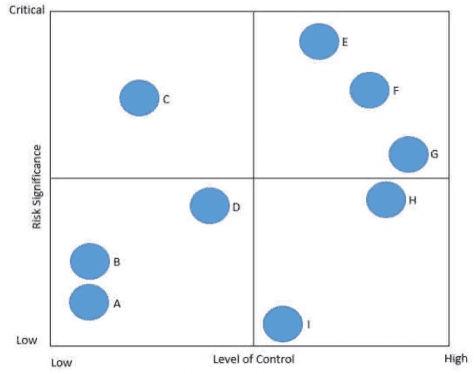
In the following risk control map risks have been categorized based on the level of
significance and the associated level of control. Which of the following statements is true
regarding Risk C?
Show answerHide answer
Correct answer: CThe level of control is inadequate given the level of risk
Explanation
Explanation:
The risk control map plots Risk Significance (vertical axis) against Level of Control (horizontal axis). The key is to read Risk C's position relative to the chart's quadrants:
Vertical position: Risk C sits high on the "Risk Significance" axis — meaning it is a critical/high-significance risk.
Horizontal position: Risk C sits in the left portion of the chart, where the "Level of Control" is low.
When a risk is highly significant but its level of control is low, the control is inadequate relative to the risk. The organization is exposed because the controls in place do not match the severity of the risk. This is the classic "high risk / low control" exposure quadrant, signaling a control gap that requires attention.
Why the other options are incorrect:
A — The level of control is appropriate given the level of risk: Appropriate control would place a high-significance risk in the right side (high control) of the chart — Risk C is on the left (low control), so this is false.
B — The level of control is excessive given the level of risk: Excessive control would apply to a low-significance risk that has high control (top-right area would be well-controlled; excessive would be low risk with very high control). Risk C is high significance, so its low control is not excessive — it is deficient.
D — Not enough information to determine: The map provides both dimensions (significance and level of control), so the adequacy of controls can be assessed directly from the position — no additional information is needed.
Reference: IIA IPPF — Standard 2120 (Risk Management) and Standard 2130 (Control); COSO ERM Framework (risk assessment and risk response — controls should be commensurate with the significance of the risk).
Question 165Choose 1
The audit plan of an internal audit function includes an assurance engagement of the
organization’s cybersecurity protocols. However, the engagement supervisor assigned to
execute the engagement identifies that the internal auditors with competencies in
cybersecurity are scheduled for upcoming leave and are involved in other engagements.
Those auditors would not be available to participate in the cybersecurity engagement.
Which of the following would be the appropriate action for the engagement supervisor?
Show answerHide answer
Correct answer: DSeek advice from the chief audit executive on appropriate actions related to the cybersecurity engagement.
Explanation
Explanation:
Resource allocation and engagement scheduling are responsibilities of the chief audit executive (CAE) under Standard 2030 (Resource Management) and Standard 2230 (Engagement Resource Allocation). When the engagement supervisor identifies that competent auditors will not be available for a scheduled engagement, the supervisor does not have the authority to unilaterally reassign staff, suspend the engagement, or notify the board. The appropriate action is to escalate the issue to the CAE, who can determine the best course — such as rescheduling, reallocating resources, or obtaining outside competent assistance (Standard 1210.A1).
Why the other options are incorrect:
A — Reassign the competent auditors immediately: The supervisor lacks the authority to reassign staff who are committed to other engagements and scheduled leave; resource allocation and prioritization are the CAE's decisions.
B — Notify the board that the engagement cannot be performed: Escalating directly to the board is premature and bypasses the CAE. The board should be informed through the CAE only if the matter cannot be resolved and is significant.
C — Suspend the cybersecurity engagement: Suspending a planned engagement is a significant decision requiring the CAE's judgment; a supervisor cannot unilaterally suspend it.
Reference: IIA IPPF — Standard 2030 (Resource Management), Standard 2230 (Engagement Resource Allocation), and Standard 1210.A1 (obtaining competent assistance when needed).
Question 166Choose 1
A manager has allowed a subordinate employee to have greater control and responsibility
over the tasks that he performs This is an example of which of the following?
Show answerHide answer
Correct answer: BJob enrichment
Explanation
Explanation:
Job enrichment involves giving employees greater control, responsibility, and autonomy over their work — including decision-making authority and accountability for the tasks they perform. By allowing the subordinate to have greater control and responsibility over the tasks he performs, the manager is enriching the job vertically (adding depth), which is the defining characteristic of job enrichment (Herzberg's motivator–hygiene theory).
Why the other options are incorrect:
A — Job enlargement: This adds more tasks of a similar level (horizontal loading) to a job — increasing the *number* of activities, not the *level of responsibility or control*. It does not increase authority.
C — Horizontal loading of the job: This is essentially the same as job enlargement — adding similar-level tasks horizontally. It increases breadth, not depth/responsibility.
D — Job rotation: This involves moving employees between different jobs over time to broaden experience; it does not give greater control/responsibility over the current tasks.
Reference: IIA IPPF — Standard 2110 (Governance) and Standard 2130 (Control) — human resource management and organizational behavior concepts; Herzberg's job enrichment theory (vertical job loading).
Question 167Choose 1
Which of the following would not be a typical activity for the chief audit executive to perform
following an audit engagement?
Show answerHide answer
Correct answer: CDetermine the costs of implementing the recommendations.
Explanation
Explanation:
Following an engagement, the CAE's focus is on monitoring and evaluating management's corrective actions — reporting follow-up results, implementing follow-up procedures to assess residual risk, and evaluating the extent of improvements achieved (Standard 2500 — Monitoring Progress). Determining the costs of implementing recommendations, however, is a management responsibility, not an audit activity. Management decides whether and how to act on recommendations and bears the cost analysis and budgeting for implementation. The CAE must not perform this management function, as it would impair objectivity and independence (Standards 1100 and 1130).
Why the other options are typical CAE follow-up activities:
A — Report follow-up activities to senior management: A core CAE responsibility — communicating the disposition of results and follow-up status (Standard 2500; Standard 2060).
B — Implement follow-up procedures to evaluate residual risk: The CAE establishes the follow-up system and assesses whether residual risk is acceptable after corrective action (Standard 2500).
D — Evaluate the extent of improvements: Confirming whether corrective actions actually improved controls is a key part of monitoring progress (Standard 2500).
Reference: IIA IPPF — Standard 2500 (Monitoring Progress), Standard 2060 (Reporting to Senior Management and the Board), and Standards 1100/1130 (Independence and Objectivity).
Question 168Choose 1
The chief audit executive can illustrate the value of the internal audit activity by reporting
which of the following to the board?
Show answerHide answer
Correct answer: AThe overall performance resulting from the internal audit balanced scorecard
Explanation
Explanation:
To demonstrate the value of the internal audit activity, the CAE should report on performance results using a balanced scorecard — which presents a comprehensive, structured view of the activity's performance across multiple dimensions (e.g., stakeholder satisfaction, internal processes, learning and growth, and financial/resource efficiency). This holistic performance reporting to the board shows how the internal audit activity is adding value and achieving its objectives, aligning with Standard 2030 (Resource Management) and Standard 2060 (Reporting to Senior Management and the Board), which require the CAE to report on the internal audit activity's performance.
Why the other options are less effective for illustrating value:
B — The number of outstanding and overdue management actions: This is a status metric on follow-up, useful but limited — it reflects management's responsiveness, not the internal audit activity's own value or performance.
C — The experience of the organization's internal auditors: Staff experience is an input/resource measure, not an indicator of value delivered or performance achieved.
D — The number of audits in the annual audit plan relative to similar organizations: A benchmarking comparison, useful for context but not a direct demonstration of the internal audit activity's value to the organization.
Reference: IIA IPPF — Standard 2030 (Resource Management), Standard 2060 (Reporting to Senior Management and the Board), and the IIA's guidance on the internal audit balanced scorecard for performance measurement.
Question 169Choose 1
According to IIA guidance, which of the following statements best justifies a chief audit
executive's request for external consultants to complement internal audit activity (IAA)
resources?
Show answerHide answer
Correct answer: AThe organization's audit universe is extensive and diverse.
Explanation
Explanation:
Under IIA Standard 2030 (Resource Management) and Standard 1210.A1 (Proficiency), the CAE may seek external consultants or service providers to complement internal audit resources when the internal audit activity lacks the necessary knowledge, skills, or competencies to cover its audit universe, or when doing so is necessary to achieve the engagement plan. An extensive and diverse audit universe means the internal audit activity must address a wide range of risks and business processes — some requiring specialized expertise the internal staff may not possess. This directly justifies supplementing IAA resources with external specialists to ensure adequate coverage and competent execution. The need is substantive and risk-based — driven by the breadth and variety of areas to be audited.
Why the other options are less justifiable:
B — An increase in unanticipated requests for advisory work: While this can strain resources, it is a workload issue rather than a competence or coverage issue. Unanticipated advisory demand may warrant resource adjustments, but it does not by itself justify external consultants as strongly as the need for specialized competence across a broad, diverse audit universe. Moreover, adding resources solely for unplanned advisory work may raise questions about planning effectiveness.
C — Previous work provided by the external provider has been of great quality and value: Past quality is a selection criterion when choosing a provider, but it is not the *justification* for needing one in the first place. The justification must rest on a resource/competence gap, not on a provider's track record.
D — A benchmarking study found external service providers are common among similarly sized IAAs: Following common practice is not a sufficient justification. Resource decisions must be based on the organization's own needs, risks, and competence requirements — not on what peers do (benchmarking informs, but does not justify, the request).
Reference: IIA IPPF — Standard 2030 (Resource Management) and Standard 1210.A1 (Proficiency — use of external service providers when the internal audit activity lacks the requisite knowledge, skills, and competencies).
Question 170Choose 1
During planning, the chief audit executive submits a risk-and-control questionnaire to
management of the activity under review. Which of the following statements is true
regarding the questionnaire?
Show answerHide answer
Correct answer: DIt would be an efficient way for the internal audit team to determine whether specified
control activities are in place.
Explanation
Explanation:
A risk-and-control questionnaire is a structured tool used during engagement planning to gather information from management about the existence and operation of controls. It allows the internal audit team to efficiently cover multiple controls across the activity and establish, at an early stage, whether specified control activities have been implemented. It is a practical, time-efficient information-gathering technique that helps focus subsequent audit work.
Why the other options are incorrect:
A — Inefficient for addressing multiple controls: Incorrect — questionnaires are actually an efficient way to address many controls at once, since they standardize information gathering.
B — Limits certain team members from being fully involved: Incorrect — questionnaires do not restrict team involvement; they can be used by and shared with the whole team as a planning tool.
C — The most effective way to obtain a detailed understanding of processes and controls: Overstated — a questionnaire confirms *whether* controls exist but does not provide a detailed understanding of how processes actually flow. Walk-throughs, observation, and interviews are better suited to gaining a detailed understanding; questionnaires are efficient but not the "most effective" for depth.
Reference: IIA IPPF — Standard 2201 (Planning Considerations) and Standard 2310 (Identifying Information); Standard 2240 (Work Programs).
Full mock exam
Sit the IIA-CIA-Part2 exam before exam day
Full-length mocks with the same number of questions and the same time limit as the real IIA-CIA-Part2 exam. Every attempt draws a new set of questions from the full bank, so you can keep going until you pass comfortably.