Correct answer: A
Root guard
Explanation
Explanation:
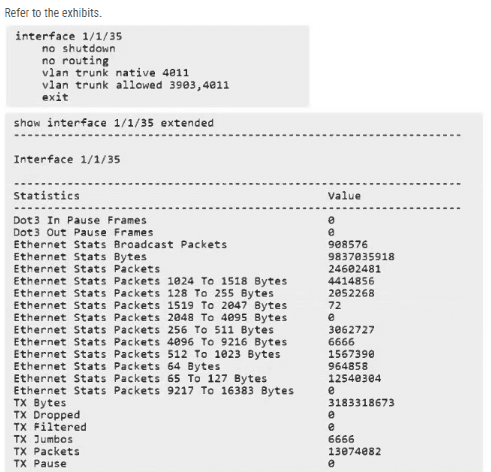
The requirement is to keep the campus network and data center network as isolated/independent spanning tree topologies, but they are physically connected by a single Layer-2 trunk link. Since STP BPDUs are being exchanged across this link, the campus core is seeing the data center core as root — meaning the two networks are effectively merging into a single spanning tree domain, rather than staying isolated as intended.
Root Guard, applied on the campus-side port(s) of that link, is designed exactly for this situation: it enforces that a specific port can never become a root port — meaning the switch will never accept superior BPDUs (i.e., claims of being a better/lower root bridge) arriving on that port. If a superior BPDU is received (as would happen if the data center core is advertising itself as root), Root Guard puts that port into a "root-inconsistent" (blocking) state, preventing the campus switch from accepting the data center as its root bridge, while still allowing the link to pass data once the BPDU consistency issue is resolved, or by design for boundary enforcement. This effectively preserves the campus network's own independent STP topology and root bridge.
This is the standard best-practice mechanism for maintaining STP domain boundaries on links between two administratively separate networks (e.g., campus vs. data center), ensuring one side can never dictate root bridge election for the other.
Why not the others:
B. BPDU filter:
This suppresses BPDU transmission/processing entirely on a port, effectively removing STP protection on that link. This is dangerous on an inter-core trunk carrying multiple VLANs, since it could create loops if the topology isn't otherwise fully controlled — not the correct tool for boundary/root isolation.
C. Admin edge (edge port / PortFast):
This is meant for access ports connecting to end-user devices (not other switches), enabling the port to skip the STP listening/learning states for fast connectivity. It is not intended for switch-to-switch core links, and does not address root bridge isolation.
D. BPDU guard:
This is used on edge ports to immediately err-disable the port if any BPDU is received at all (protecting against unauthorized switches being plugged into access ports). Applying this on a core inter-switch trunk would completely shut down that critical link the moment BPDUs are exchanged — not appropriate for a legitimate switch-to-switch connection carrying real STP traffic.
Since the goal is to block the data center from being seen as root while keeping the link operational for actual traffic, Root Guard (A) is the correct, purpose-built solution.