CompTIA certification · Exam CS0-004

CS0-004 Mock Exam

CompTIA Cybersecurity Analyst CySA+ V4

Free CS0-004 questions on Vulnerability Management, each with the answer and an explanation.

20 questions · 39 minutes · free, no sign-up

Vulnerability Management questions

1–7 of 7 free
Question 1 Choose 1
An incident response team identifies a malicious uniform resource locator (URL) associated with a required business process and performs the following activities:
• Access to the URL has been restricted only to the necessary users through firewall rules and Cloud Security Group rules.
• Additional monitoring has been enabled for traffic related to that site and the allowed users.
• All application servers that need to access that site have been patched with the latest security and software updates.
Application owners have been notified of the severity and need to remediate this reported issue.
Which of the following best describes the overall mitigation the security team is performing?
Show answerHide answer

Correct answer: C Compensating controls

Explanation

Explanation:

The incident response team has identified a malicious URL that is associated with a required business process, meaning the organization cannot simply block or remove access to it without disrupting operations. Instead of directly eliminating the risk, which may not be possible immediately, the team implements multiple alternative security measures to reduce exposure. These include restricting access through firewall and cloud security group rules, enabling additional monitoring, patching application servers, and notifying application owners. Since the underlying issue cannot be fully removed without affecting business functions, the team is applying compensating controls to reduce the associated risk while allowing operations to continue.

C. Compensating controls
– Compensating controls are alternative security measures implemented when the primary or preferred control is not feasible, immediately available, or practical. In this scenario, the malicious URL cannot simply be eliminated because it is required for business operations. The team therefore uses multiple safeguards, including access restrictions, enhanced monitoring, server patching, and owner notification, to reduce the residual risk. These measures compensate for the limitation of not being able to remove the underlying risk directly. Therefore, Option C is correct.

Why Other Options Are Incorrect:

A. Patching solutions
– Patching the application servers is one of the security actions being performed, but it does not represent the overall risk mitigation strategy. Patching primarily addresses software vulnerabilities and security flaws within systems. In this scenario, multiple controls are being used because the malicious URL cannot be completely removed. Therefore, patching alone does not best describe the approach.

B. Configuration management
– Configuration management involves establishing, maintaining, and monitoring approved system configurations and security baselines. Although changing firewall or cloud security group rules can be part of configuration management, the scenario focuses on using alternative safeguards to reduce risk when the preferred action is not feasible. Therefore, configuration management is not the best answer.

D. Attack surface management
– Attack surface management focuses on discovering, inventorying, assessing, and reducing an organization's exposed digital assets and potential attack paths. Restricting access may reduce the attack surface, but the scenario is specifically about mitigating a known risk that cannot be completely eliminated because of business requirements. Therefore, the overall approach is better described as compensating controls.

References:

CompTIA CySA+ CS0-004 Exam Objectives – Covers vulnerability management, risk mitigation, security controls, and the use of compensating controls when preferred controls cannot be implemented.
Question 2
A systems administrator is reviewing the output of a vulnerability scan.
INSTRUCTIONS -
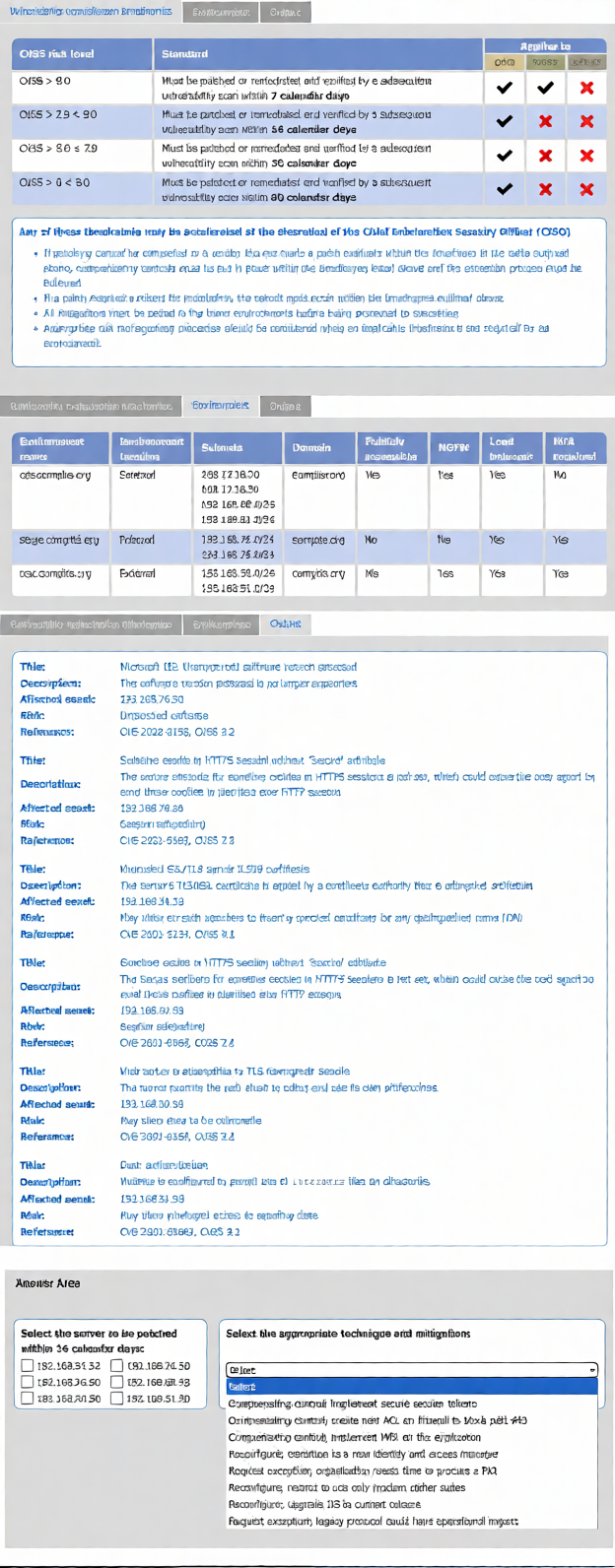
Review the information in each tab.
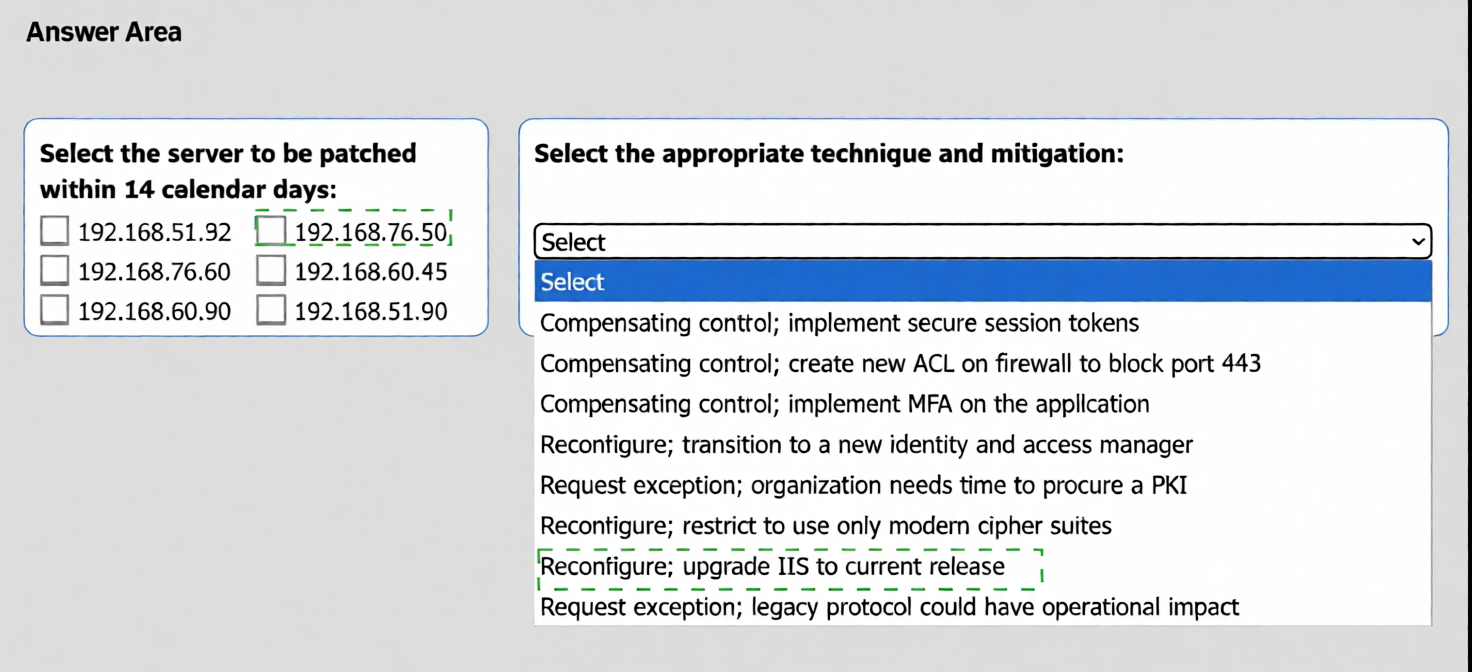
Based on the organization’s environment architecture and remediation standards, select the server to be patched within 14 days and select the appropriate technique and mitigation.
If at any time you would like to bring back the initial state of the simulation, please click the Reset All button.

Show answerHide answer

Explanation


Explanation:

The organization's remediation standards define patching timelines based on CVSS scores: CVSS greater than 9.0 requires remediation within 7 days, CVSS greater than 6.9 and less than 9.0 requires remediation within 36 days, and CVSS less than 7.0 requires remediation within 60 days. There is no specific 14-day category, so the server requiring attention within 14 calendar days must fall into the highest-severity category. The vulnerability scan identifies 192.168.31.32 with a critical CVSS score of 9.8, making it the most urgent system to patch. The scan also identifies weak TLS/SSL cipher configurations, so restricting the server to modern cipher suites is the most appropriate mitigation.

Select the server to be patched within 14 calendar days:

192.168.31.32
– This server has critical vulnerabilities with a CVSS score of 9.8. Under the organization's remediation policy, vulnerabilities above 9.0 must be addressed within 7 days. Therefore, this server falls within the 14-calendar-day requirement and represents the highest remediation priority.

Select the appropriate technique and mitigation:

Reconfigure; restrict to use only modern cipher suites
– The scan identifies weak TLS/SSL cipher suites and insecure cryptographic configurations. Reconfiguring the server to permit only modern, secure cipher suites directly addresses the finding by disabling outdated or weak cryptographic algorithms and enforcing stronger TLS configurations. This approach addresses the identified weakness without unnecessarily disrupting the required business service.

Why Other Server Options Are Incorrect:

192.168.76.50, 192.168.60.90, and 192.168.51.90
– These servers have vulnerabilities with lower CVSS scores that fall into less urgent remediation categories under the organization's policy. Vulnerabilities below 7.0 require the longer 60-day remediation period, while vulnerabilities in the applicable medium range require 36 days. Therefore, these systems do not represent the server that must be patched within 14 calendar days.

Why Other Mitigation Options Are Incorrect:

Compensating controls, such as session tokens, firewall ACLs, or MFA
– These controls can improve session security, restrict network access, or strengthen authentication, but they do not directly correct weak cryptographic configurations. The identified vulnerability specifically requires stronger TLS/SSL cipher configuration.

Transition to a new identity manager or upgrade IIS
– These actions may provide broader security or platform improvements, but they do not directly address the specific weak cipher suites identified by the vulnerability scan. Reconfiguring the cryptographic settings is the more precise remediation.

Request an exception for PKI or a legacy protocol
– There is no indication that a legacy protocol must remain enabled for business requirements. Requesting an exception would leave the identified cryptographic weakness in place rather than correcting it. Procuring PKI infrastructure also does not directly resolve weak cipher suite configuration.

References:

CompTIA CySA+ CS0-004 Exam Objectives – Covers vulnerability assessment, vulnerability prioritization, remediation, and the use of vulnerability information to determine appropriate security actions.
Question 3 Choose 1
A public threat intelligence report includes indicators of compromise (IoCs) for threat actors. The threat actors are exploiting a zero-day vulnerability that the vendor has not fixed. Which of the following techniques should be used until a patch is available?
Show answerHide answer

Correct answer: C Continuous monitoring

Explanation

Explanation:

A zero-day vulnerability is a software flaw that is being exploited before an official vendor patch is available. Because the organization cannot immediately eliminate the underlying vulnerability, it must rely on compensating safeguards and strong detection capabilities to reduce the risk of successful exploitation. The most appropriate action is to maintain heightened visibility over affected systems, networks, and applications. This includes enhanced logging, traffic monitoring, and searching for indicators of compromise (IoCs) identified through threat intelligence. Continuous monitoring helps detect exploitation attempts quickly, allowing the security team to contain affected systems and begin incident response before significant damage occurs.

C. Continuous monitoring
– Continuous monitoring provides persistent visibility into systems, networks, applications, and security events. When a zero-day cannot yet be patched, monitoring can help identify suspicious activity, anomalous behavior, and known IoCs associated with exploitation. The security team can use indicators such as IP addresses, domains, file hashes, and behavioral patterns from threat intelligence to identify potential compromise. This provides early warning and supports rapid containment and response while the underlying vulnerability remains unpatched. Therefore, Option C is correct.

Why Other Options Are Incorrect:

A. Sinkholing
– Sinkholing redirects malicious traffic, such as connections to known malware command-and-control infrastructure, to a controlled system. It can help disrupt malicious communications and provide visibility into infected systems, but it depends on identifying traffic that can be redirected. It does not directly protect systems from exploitation of an unknown zero-day vulnerability or remove the underlying vulnerability.

B. Eradication techniques
– Eradication focuses on removing a confirmed threat from compromised systems, such as deleting malware, removing persistence mechanisms, or eliminating malicious accounts. It is generally performed after malicious activity or compromise has been detected. In this scenario, the organization needs a proactive detection and monitoring capability while the zero-day remains unpatched. Therefore, eradication is not the best answer.

D. Evidence acquisition
– Evidence acquisition involves collecting and preserving digital evidence for forensic investigation, incident analysis, or potential legal purposes. Although evidence collection may become necessary after suspicious activity is detected, it does not provide the continuous visibility needed to identify zero-day exploitation attempts in the first place. Therefore, it is not the most appropriate technique for this scenario.

References:

CompTIA CySA+ CS0-004 Exam Objectives – Covers security monitoring, threat detection, vulnerability management, and incident response activities used to identify and mitigate cybersecurity threats.
Question 4 Choose 1
Which of the following is the most likely reason an organization might implement compensating controls?
Show answerHide answer

Correct answer: A A vulnerability does not have a patch, and the system is mission critical.

Explanation

Explanation:

Compensating controls are alternative security measures used when the primary or preferred control, such as patching, a configuration change, or a software upgrade, cannot be implemented because of operational, technical, or business constraints. A common example is a vulnerability affecting a mission-critical system that cannot be patched immediately because patching could cause unacceptable downtime, compatibility problems, or other business disruption. In such situations, the organization cannot immediately eliminate the vulnerability, so it uses measures such as network segmentation, application allowlisting, enhanced monitoring, or stricter access controls to reduce the risk to an acceptable level until a permanent solution is available.

A. A vulnerability does not have a patch, and the system is mission critical.
– This is the most appropriate scenario for implementing compensating controls. When a vulnerability affects a mission-critical system and no patch is currently available, or the available patch cannot be safely deployed, alternative safeguards can reduce the likelihood or impact of exploitation. Network segmentation, access restrictions, enhanced monitoring, and application allowlisting can provide additional protection while the organization waits for a permanent remediation. Therefore, Option A is correct.

Why Other Options Are Incorrect:

B. A vulnerability has been fixed, tested, and deployed to production.
– If the vulnerability has already been successfully remediated and the fix is deployed in production, the primary security control is in place. Compensating controls are generally not required to address that vulnerability because the original security weakness has been corrected.

C. A vulnerability is being actively exploited in the wild, but the organization does not use the affected system.
– If the organization does not use the affected software or system and therefore has no exposure to the vulnerability, there is no corresponding organizational risk requiring compensating controls. The fact that the vulnerability is being exploited elsewhere does not by itself create a risk to systems that are not affected or exposed.

D. A vulnerability was detected, but the organization has determined the result is a false positive.
– A false positive means the reported vulnerability does not actually exist in the affected environment. Because there is no confirmed vulnerability to mitigate, compensating controls are not required. The finding can be documented and appropriately closed according to the organization's vulnerability management process.

References:

CompTIA CySA+ CS0-004 Exam Objectives – Covers vulnerability management, risk mitigation, security controls, and the use of compensating controls when primary controls cannot be implemented.
Question 5 Choose 1
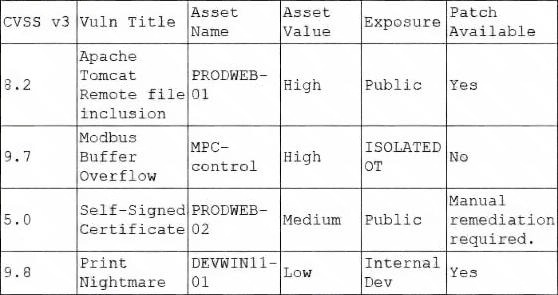
An analyst reviews a summarized vulnerability report through a governance, risk, and compliance (GRC) reporting tool. The following report correlates asset information from the configuration management database (CMDB) against detected vulnerabilities:

Which of the following servers should the analyst prioritize based on the target value, the risk, and the likelihood of exploitation?
Show answerHide answer

Correct answer: D PRODWEB-01

Explanation

Explanation:

When prioritizing vulnerabilities, an analyst should consider several factors, including asset criticality, vulnerability severity, exposure, exploitability, and the availability of remediation. The highest priority generally goes to vulnerabilities that combine high-value assets, critical severity, public exposure, and active exploitation. In this scenario, PRODWEB-01 has a CVSS score of 9.8, is a high-value production web server, is publicly accessible, and has an available patch. Although other systems also contain critical vulnerabilities, their lower asset value or network isolation reduces their overall risk compared with a critical vulnerability affecting an internet-facing production system.

D. PRODWEB-01
– PRODWEB-01 represents the highest overall risk because it combines a CVSS score of 9.8, high asset value, public-facing exposure, and a vulnerability for which a patch is available. A successful compromise of an internet-facing production web server could directly affect important business services and provide attackers with an entry point into the environment. The combination of severity, exposure, and asset criticality makes this the most urgent vulnerability to remediate. Therefore, Option D is correct.

Why Other Options Are Incorrect:

A. PRODWEB-02
– PRODWEB-02 has a self-signed certificate issue with a CVSS score of 5.0, which is a medium-severity finding. Although the server is public-facing, the issue is primarily a certificate and trust configuration weakness rather than a critical vulnerability such as remote code execution. Its overall risk is therefore lower than the critical vulnerability affecting PRODWEB-01.

B. MPC-Control
– MPC-Control contains a critical CVSS 9.7 Modbus buffer overflow vulnerability, making it a serious security concern. However, the system is located within an isolated OT network, which significantly reduces its direct exposure to external attackers. Its critical severity still requires attention, but its isolation lowers its immediate exploitation risk compared with the publicly accessible PRODWEB-01.

C. DEVWIN11-01
– DEVWIN11-01 has PrintNightmare with a CVSS score of 9.8, and the vulnerability is actively exploited in the wild. However, this system is a ow-value development system located on an internal development network. It should still be patched promptly, but its lower asset criticality and lack of public exposure make it a lower overall priority than the critical vulnerability affecting the high-value, public-facing PRODWEB-01.

References:

CompTIA CySA+ CS0-004 Exam Objectives – Covers vulnerability management, risk assessment, vulnerability prioritization, and the use of contextual factors when determining remediation priorities.
Question 6 Choose 1
A security analyst runs an Nmap scan against a host with multiple open ports using the following command:
nmap 10.10.10.1 -p-
The following output is obtained after the scan:
Starting Nmap 7.95 ( https://nmap.org ) at 2025-07-15 15:55 UTC
Note: Host seems down.
Nmap done: 1 IP address (0 hosts up) scanned in 3.16 seconds
Which of the following is the most accurate way to scan the target IP for open ports?
Show answerHide answer

Correct answer: C nmap -p- -Pn 10.10.10.1

Explanation

Explanation:

The Nmap scan returned "Note: Host seems down" and reported 0 hosts up. This commonly occurs when Nmap's host discovery probes receive no response from the target. Firewalls, host-based filtering, or network segmentation can prevent responses to these probes, causing Nmap to assume the host is unavailable and skip further scanning. The -Pn option bypasses host discovery and tells Nmap to treat the target as available for scanning. The -p- option specifies all TCP ports from 1 through 65,535, allowing the analyst to perform a comprehensive port scan despite the lack of host discovery responses.

C. nmap -p- -Pn 10.10.10.1
– This command is correct because -Pn skips Nmap's host discovery process and treats the target as being online, allowing the port scan to proceed even when the host does not respond to discovery probes. The -p- option scans all 65,535 TCP ports instead of checking only commonly used ports. Therefore, this command is the most appropriate choice for determining which ports are open on the target. Option C is correct.

Why Other Options Are Incorrect:

A. nmap 10.10.10.1 -p80, 443, 445, 9999, 135, 22, 21 -b --traceroute
– This command scans only a specific list of ports rather than all TCP ports. It also does not include -Pn, so Nmap may still determine that the host is down and skip the port scan. The -b option performs an FTP bounce scan and is not appropriate for this requirement, while --traceroute does not address the host discovery problem.

B. nmap -sn -p- 10.10.10.1
– The sn option performs host discovery without performing a port scan. Therefore, it does not provide the required information about open ports. The command would essentially repeat the host discovery stage that already failed to identify the target as available. It does not solve the problem of scanning a host that does not respond to discovery probes.

D. nmap 10.10.10.1/24 -p- -R -O --script=ssl-enum-ciphers
– This command targets an entire /24 subnet rather than the single host specified in the scenario. It also includes DNS resolution, OS detection, and SSL cipher enumeration, none of which are necessary for the basic requirement. Most importantly, it does not include -Pn, so the original host discovery issue may still prevent the desired port scan from occurring.

References:

CompTIA CySA+ CS0-004 Exam Objectives – Covers the use of security tools and network scanning techniques to identify hosts, ports, services, and potential security issues.
Question 7 Choose 1
A vulnerability analyst conducts a web application scan on an asset sitting behind a load balancer configured as a pass through:
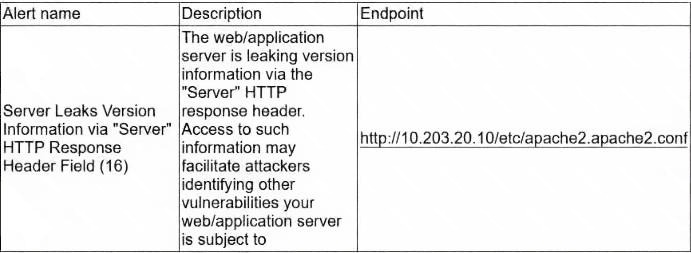
http://10.203.20.10 The analyst launches the Zed Attack Proxy (ZAP) utility, conducts a scan, and receives the following alert:

Which of the following should the analyst propose as a remediation to the finding while keeping the site operational?
Show answerHide answer

Correct answer: C Ensure the web application is configured to suppress the "Server" header.

Explanation

✅ Explanation:

The vulnerability alert indicates that the web server is leaking version information via the "Server" HTTP response header. This header is sent by the web server (e.g., Apache, Nginx, IIS) to the client in every HTTP response and typically includes the software name and version number (e.g., Server: Apache/2.4.52 (Ubuntu)). While this is not a direct exploit, it provides attackers with valuable reconnaissance information, enabling them to identify known vulnerabilities specific to that version and tailor their attacks accordingly. The remediation is to suppress or remove the "Server" header from HTTP responses, preventing information disclosure while keeping the site fully operational.

C. Ensure the web application is configured to suppress the "Server" header.
– This is the correct remediation. The web server or application can be configured to either remove the "Server" header entirely or customize it to a generic value (e.g., Server: webserver). This eliminates the information leakage without impacting site functionality. In Apache, this can be done using the ServerTokens directive; in Nginx, using server_tokens off; and in IIS, using URL Rewrite rules. This directly addresses the finding while keeping the site operational.

❌ Why Other Options Are Incorrect:

A. Ensure the HTTP endpoint is protected with a network firewall with geoblocking.
– Geoblocking restricts access based on geographic location, which may reduce exposure but does not address the information leakage. The "Server" header is still sent to allowed users, so the vulnerability remains. Additionally, geoblocking is a compensating control, not a remediation of the finding.

B. Ensure the load balancer is configured with OCSP stapling.
– OCSP stapling is a technique used to improve TLS certificate validation performance and privacy. It is completely unrelated to HTTP header information disclosure and does not affect the "Server" header.

D. Ensure the web server host-based firewall is configured to block HTTP incoming traffic.
– Blocking HTTP incoming traffic would make the web application inaccessible to users, violating the requirement to "keep the site operational." This is not a viable remediation.

📚 References:

CompTIA CySA+ CS0-004 Exam Objectives – Domain 2.0 (Vulnerability Management) – Understand information disclosure vulnerabilities and their remediation, including suppressing version information in HTTP headers.

That's the last free question in Vulnerability Management

You've seen the free 30% (7 of 24 questions). Full access unlocks every question and full-length CS0-004 mock exams (85 questions, 165 minutes), a different mock on every attempt.

Unlock full mock exam
Full mock exam

Sit the CS0-004 exam before exam day

Full-length mocks with the same number of questions and the same time limit as the real CS0-004 exam. Every attempt draws a new set of questions from the full bank, so you can keep going until you pass comfortably.

Get full CS0-004 mock exam
  • 85questions per mock
  • 165 mintime limit
  • 82questions in the bank
  • Newmock on every attempt