CompTIA certification · Exam CS0-004

CS0-004 Mock Exam

CompTIA Cybersecurity Analyst CySA+ V4

Free CS0-004 questions on Incident Response and Management, each with the answer and an explanation.

20 questions · 39 minutes · free, no sign-up

Incident Response and Management questions

1–5 of 5 free
Question 1 Choose 1
A security operations center (SOC) manager makes significant updates to the incident response plan and wants to test these updates with all stakeholders collaboratively. Which of the following is the best way to accomplish this task?
Show answerHide answer

Correct answer: B Tabletop exercise

Explanation

✅ Explanation:

The SOC manager wants to test significant updates to the incident response plan  collaboratively with all stakeholders. This requires a discussion-based, low-pressure activity where participants can walk through the updated plan, identify gaps, clarify roles, and improve coordination without actually executing technical actions. A  tabletop exercise is a facilitated, discussion-based session where stakeholders review a hypothetical incident scenario and verbally walk through their response steps. It is the ideal method for collaboratively testing procedural updates, communication plans, and decision-making processes.

B. Tabletop exercise
– This is the correct answer. Tabletop exercises are discussion-based, collaborative sessions where stakeholders review and practice incident response procedures in a low-stress environment. They are specifically designed to test plan updates, identify gaps, and improve coordination among all participants.

❌ Why Other Options Are Incorrect:

A. Red-teaming event
– Red teaming involves an adversarial team simulating a real attack against the organization's defenses. It is technical, not collaborative, and does not focus on testing procedural updates with all stakeholders in a discussion-based format.

C. Security awareness training
– Security awareness training is designed to educate employees on security best practices, not to test incident response plan updates. It is broad and not stakeholder-specific.

D. Penetration test
– A penetration test is a technical assessment that exploits vulnerabilities to test system security. It does not collaboratively test incident response procedures or involve all stakeholders in a discussion-based format.

References:

CompTIA CySA+ CS0-004 Exam Objectives – Domain 3.0 (Incident Response) – Understand the use of tabletop exercises to test and validate incident response plans.

NIST SP 800-61 Rev. 2 (Computer Security Incident Handling Guide) – Recommends using tabletop exercises and walkthroughs to validate incident response procedures and improve team coordination.
Question 2 Choose 1
A security analyst reruns infrastructure as code (IaC) to tear down and rebuild a new environment after a ransomware attack. Which of the following describes this phase?
Show answerHide answer

Correct answer: E Recovery

Explanation

✅ Explanation:

The security analyst is rerunning infrastructure as code (IaC) to tear down and rebuild a new environment after a ransomware attack. This activity involves restoring systems, data, and services to a known secure state after the threat has been eliminated. In the incident response lifecycle, this corresponds to the  recovery phase, where the organization restores normal operations, rebuilds compromised systems, and validates that systems are clean before returning to production. Using IaC to rebuild environments ensures consistency, repeatability, and reduces the risk of reintroducing the malware.

E. Recovery
– Recovery is the phase of incident response focused on restoring affected systems, data, and services to normal operation. Rebuilding environments using IaC after a ransomware attack is a recovery activity.

❌ Why Other Options Are Incorrect:

A. Analysis
– Analysis involves investigating the incident to understand the attack vector, impact, and scope. It occurs during the detection and investigation phase, before recovery.

B. Post-incident
– Post-incident refers to activities after the incident is fully resolved, such as lessons-learned reviews and documentation. The described activity occurs during the active restoration of systems.

C. Detection
– Detection involves identifying and confirming the incident through monitoring and alerts. Rebuilding environments is a response activity, not detection.

D. Containment
– Containment involves isolating affected systems to prevent the spread of the attack. Rebuilding systems occurs after containment and eradication, not during containment.

📚 References:

CompTIA CySA+ CS0-004 Exam Objectives – Domain 3.0 (Incident Response) – Understand the incident response phases, including recovery, containment, and post-incident activities.

NIST SP 800-61 Rev. 2 (Computer Security Incident Handling Guide) – Defines recovery as restoring systems to normal operation after an incident.
Question 3 Choose 1
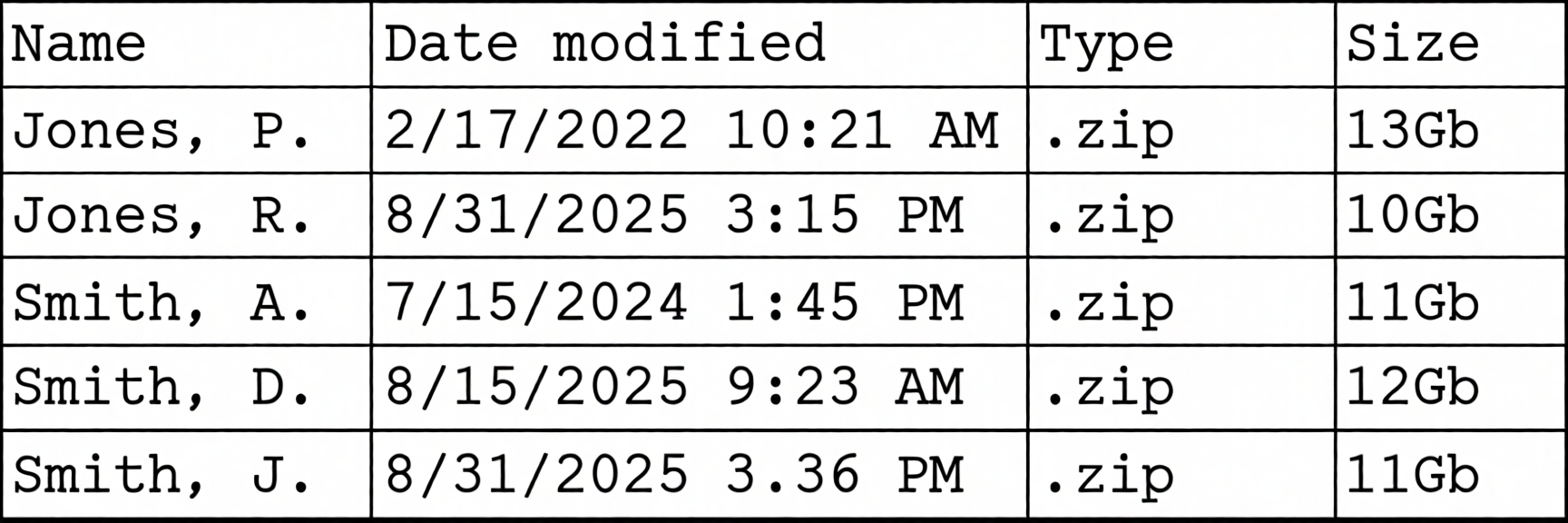
A security analyst receives a notice about a possible data breach. The report identifies unapproved, current access dates for files found in the following personnel archives:

Which of the following actions should the analyst take first?
Show answerHide answer

Correct answer: E Establish a legal hold.

Explanation

✅ Explanation:

The analyst has identified unapproved, current access dates for files in personnel archives, which indicates a possible data breach involving sensitive employee records. The first priority in any potential breach scenario is to  preserve evidence for forensic investigation and potential legal proceedings. By establishing a legal hold, the analyst ensures that all relevant data, including the affected files, logs, and metadata, are preserved in their current state and not altered, deleted, or overwritten. This is a critical step to maintain the integrity of evidence and comply with legal and regulatory requirements.

E. Establish a legal hold.
– This is the correct first action. A legal hold suspends normal data retention and deletion policies to preserve evidence. It ensures that the files, logs, and other relevant artifacts are protected from modification or destruction, which is essential for forensic analysis and potential litigation.

❌ Why Other Options Are Incorrect:

A. Perform log correlation.
– Log correlation is important for understanding the scope and timeline of the breach, but it should not be the first step. Evidence preservation takes precedence to ensure that logs and data are not lost during the investigation.

B. Reset user credentials.
– Resetting credentials may be necessary later to contain the breach, but doing so prematurely could alert the attacker and destroy evidence. Containment should follow evidence preservation and investigation.

C. Restore files from backup.
– Restoring files alters the state of the data and could destroy evidence. Restoration is part of recovery, not initial response.

D. Establish a timeline.
– Establishing a timeline is an investigative activity that relies on preserved evidence. It is important but should follow evidence preservation.

References:

CompTIA CySA+ CS0-004 Exam Objectives – Domain 3.0 (Incident Response) – Understand the importance of evidence preservation, including legal holds, during data breach investigations.

NIST SP 800-61 Rev. 2 (Computer Security Incident Handling Guide) – Recommends preserving evidence as a priority during incident response.
Question 4 Choose 1
Which of the following phases of the incident response process will permanently remove an attacker’s access to corporate resources?
Show answerHide answer

Correct answer: A Eradication

Explanation

✅ Explanation:

During an incident, once the attacker's presence has been confirmed, the incident response team must take steps to remove the threat from the environment. Containment is the phase where the team limits the spread of the attack by isolating affected systems. However, containment does not permanently remove the attacker's access—it only stops active movement and prevents further damage. Eradication is the phase that follows containment and is specifically focused on permanently removing the attacker's access by eliminating the root cause, such as deleting malware, removing backdoors, disabling compromised accounts, and closing exploited vulnerabilities. Without eradication, the attacker can regain access once containment is lifted.

A. Eradication
– Eradication is the phase of incident response that removes the threat from the environment, including the attacker's access, persistence mechanisms, malware, and vulnerabilities. It is the only phase that permanently eliminates the adversary's foothold.

❌ Why Other Options Are Incorrect:

B. Containment
– Containment isolates affected systems to prevent the attack from spreading, but it does not remove the attacker's access. The attacker may still have persistence mechanisms that allow them to return if not eradicated.

C. Denial of service
– Denial of service (DoS) is a type of attack, not a phase of incident response. It does not relate to removing attacker access.

D. Detection
– Detection is the phase where the incident is identified and confirmed. It occurs before containment and eradication, and does not remove the attacker's access.

📚 References:

CompTIA CySA+ CS0-004 Exam Objectives – Domain 3.0 (Incident Response) – Understand the incident response lifecycle, including the eradication phase and its role in permanently removing threats.

NIST SP 800-61 Rev. 2 (Computer Security Incident Handling Guide) – Defines eradication as the phase that removes the components of the incident from the environment.
Question 5 Choose 1
A security operations center analyst receives an alert from the security information and event management system. The analyst quickly reviews the alert and sees a workstation infected with malware. The analyst then uses the endpoint detection and response tool to isolate the workstation from the network. Which of the following best describes the steps that occurred in this scenario?
Show answerHide answer

Correct answer: C Detection, analysis, and containment

Explanation

✅ Explanation:

The scenario describes a sequence of actions taken by the SOC analyst in response to an alert. First, the analyst receives an alert from the SIEM (this is detection—identifying a potential security event). Second, the analyst quickly reviews the alert and confirms that a workstation is infected with malware (this is analysis—validating the alert, understanding the scope, and confirming the threat). Third, the analyst uses the EDR tool to isolate the workstation from the network (this is containment—limiting the spread of the infection by severing the compromised system's network connectivity). The sequence accurately maps to the first three phases of the incident response lifecycle: Detection, Analysis, and Containment.

C. Detection, analysis, and containment – This is the correct sequence. The SIEM alert triggered the initial detection, the analyst's review and confirmation of malware constituted analysis, and the network isolation via EDR was containment.

❌ Why Other Options Are Incorrect:

A. Analysis, containment, and eradication
– This sequence misses the initial detection step and incorrectly places analysis first. The scenario starts with a SIEM alert (detection), not analysis. Eradication (removing the malware) is not mentioned.

B. Analysis, eradication, and recovery
– This is incorrect because detection occurred first, and the analyst did not perform eradication (e.g., deleting malware, patching) or recovery (restoring systems) in the described actions.

D. Isolation, mitigation, and analysis
– This sequence is out of order and misses detection. The analyst received an alert before isolating the system, and mitigation is a broader term that includes containment, but the specific sequence is detection → analysis → containment.

📚 References:

CompTIA CySA+ CS0-004 Exam Objectives – Domain 3.0 (Incident Response) – Understand the incident response lifecycle, including detection, analysis, and containment.

NIST SP 800-61 Rev. 2 (Computer Security Incident Handling Guide) – Defines incident response phases: Detection, Analysis, Containment, Eradication, Recovery, and Post-Incident.

That's the last free question in Incident Response and Management

You've seen the free 30% (5 of 18 questions). Full access unlocks every question and full-length CS0-004 mock exams (85 questions, 165 minutes), a different mock on every attempt.

Unlock full mock exam
Full mock exam

Sit the CS0-004 exam before exam day

Full-length mocks with the same number of questions and the same time limit as the real CS0-004 exam. Every attempt draws a new set of questions from the full bank, so you can keep going until you pass comfortably.

Get full CS0-004 mock exam
  • 85questions per mock
  • 165 mintime limit
  • 82questions in the bank
  • Newmock on every attempt