Note: This question is part of a series of questions that present the same scenario. Each
question in the series contains a unique solution that might meet the stated goals. Some
question sets might have more than one correct solution, while others might not have a
correct solution.
After you answer a question in this section, you will NOT be able to return to it. As a result,
these questions will not appear in the review screen.
You have an Azure pipeline that is used to deploy a web app. The pipeline includes a test
suite named TestSuite1. TestSuite1 is used to validate the operations of the web app. TestSuite1 fails intermittently.
You identify that the failures are unrelated to changes in the source code and execution
environment.
You need to minimize troubleshooting effort for the TestSuite1 failures.
Solution: You increase code coverage.
Does this meet the goal?
Show answerHide answer
Correct answer: BNo
Question 122Choose 1
You have an Azure DevOps project named Project1 and an Azure subscription named
Sub1. Sub1 contains an Azure SQL database named DB1.
You need to create a release pipeline that uses the Azure SQL Database Deployment task
to update DB1.
Which artifact should you deploy?
Show answerHide answer
Correct answer: Ba DACPAC
Explanation
Explanation:
Use Azure SQL Database Deployment task in a build or release pipeline to deploy to Azure
SQL DB using a DACPAC or run scripts using SQLCMD.
Question 123Choose 1
Note: This question is part of a series of questions that present the same scenario. Each
question in the series contains a unique solution that might meet the stated goals. Some
question sets might have more than one correct solution, while others might not have a
correct solution.
After you answer a question in this section, you will NOT be able to return to it. As a result,
these questions will not appear in the review screen.
You manage a project in Azure DevOps.
You need to prevent the configuration of the project from changing over time.
Solution: Implement Continuous Integration for the project.
Does this meet the goal?
Show answerHide answer
Correct answer: BNo
Explanation
Instead implement Continuous Assurance for the project.
Question 124Choose 1
After you answer a question in this section, you will NOT be able to return to it. As a result,
these questions will not appear in the review screen.
You use Azure Pipelines to build and test a React js application.
You have a pipeline that has a single job.
You discover that installing JavaScript packages from npm takes approximately five
minutes each time you run the pipeline.
You need to recommend a solution to reduce the pipeline execution time.
Solution: You recommend enabling parallel jobs for the pipeline.
Does this meet the goal?
Show answerHide answer
Correct answer: BNo
Explanation
Explanation:
Instead enable pipeline caching.
Note:
npm-cache is a command line utility that caches dependencies installed via npm, bower,
jspm and composer.
It is useful for build processes that run [npm|bower|composer|jspm] install every time as
part of their build process. Since dependencies don't change often, this often means slower
build times. npm-cache helps alleviate this problem by caching previously installed
dependencies on the build machine.
Question 125Choose 3
You have an Azure DevOps project named Project1 and an Azure subscription named
Sub1. Sub1 contains an Azure virtual machine scale set named VMSS1. VMSS1 hosts a
web application named WebApp1.
WebApp1 uses stateful sessions.
The WebApp1 installation is managed by using the Custom Script extension. The script
resides in an Azure Storage account named sa1.
You plan to make a minor change to a UI element of WebApp1 and to gather user
feedback about the change.
You need to implement limited user testing for the new version of WebApp1 on VMSS1.
Which three actions should you perform? Each correct answer presents part of the
solution.
NOTE: Each correct selection is worth one point.
Show answerHide answer
Correct answer: B, C, DRedeploy VMSS1Upload a custom script file to sa1.Modify the Custom Script extension settings of VMSS1.
Question 126Choose 1
Your company has an Azure DevOps project that produces Node Package Manager (npm)
packages. Multiple projects consume the packages.
You need to minimize the amount of disk space used by older packages in Azure Artifacts.
What should you modify?
Show answerHide answer
Correct answer: Athe retention settings of the project's pipeline
Explanation
Explanation: To minimize the amount of disk space used by older packages in Azure
Artifacts, you should modify the retention settings of the project's release. This can be done
by navigating to the project's release settings and adjusting the retention policy. For more
information, please refer to the Microsoft documentation.
Question 127Choose 1
Your company has a release pipeline in an Azure DevOps project.
You plan to deploy to an Azure Kubernetes Services (AKS) cluster by using the Helm
package and deploy task.
You need to install a service in the AKS namespace for the planned deployment.
Which service should you install?
Show answerHide answer
Correct answer: DTiller
Explanation
Explanation:
Before you can deploy Helm in an RBAC-enabled AKS cluster, you need a service account
and role binding for the Tiller service.
Question 128Choose 1
You plan to deploy a solution that will include multiple microservices.
You need to recommend a deployment strategy for the microservices. The solution must
meet the following requirements:
Enable users to test new features by using a specific URL.
Minimize the effort required to promote a test version to production.
Minimize the effort required to revert production code to the previous version.
Which strategy should you recommend?
Show answerHide answer
Correct answer: AA/B
Question 129Choose 2
You manage an Azure web app that supports an e-commerce website.
You need to increase the logging level when the web app exceeds normal usage patterns.
The solution must minimize administrative overhead. Which two resources should you include in the solution? Each correct answer presents part
of the solution.
NOTE: Each correct selection is worth one point.
Show answerHide answer
Correct answer: A, Ban Azure Automation run bookan Azure Monitor alert that has a dynamic threshold
Explanation
Explanation:
A: You can use Azure Monitor to monitor base-level metrics and logs for most services in
Azure. You can call Azure Automation run books by using action groups or by using classic
alerts to automate tasks
based on alerts.
B: Metric Alert with Dynamic Thresholds detection leverages advanced machine learning
(ML) to learn metrics' historical behavior, identify patterns and anomalies that indicate
possible service issues. It
provides support of both a simple UI and operations at scale by allowing users to configure
alert rules through the Azure Resource Manager API, in a fully automated manner.
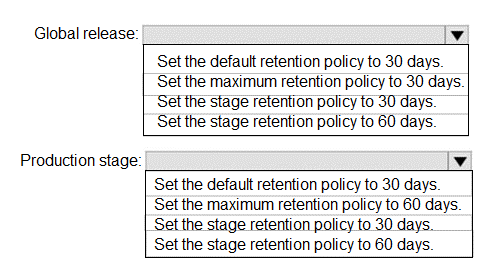
How should you configure the release retention policy for the investment planning
applications suite? To answer, select the appropriate options in the answer area.
NOTE: Each correct selection is worth one point.
Show answerHide answer
Explanation
Based on the image content you've provided, I need to make some logical assumptions since the full question context isn't visible. The image shows two configuration sections:
Global release settings:
Default retention policy: 30 days
Maximum retention policy: 30 days
Stage retention policy: Two options (30 days and 60 days)
Production stage settings:
Default retention policy: 30 days
Maximum retention policy: 60 days
Stage retention policy: Two options (30 days and 60 days)
From typical Azure DevOps release retention policy configuration:
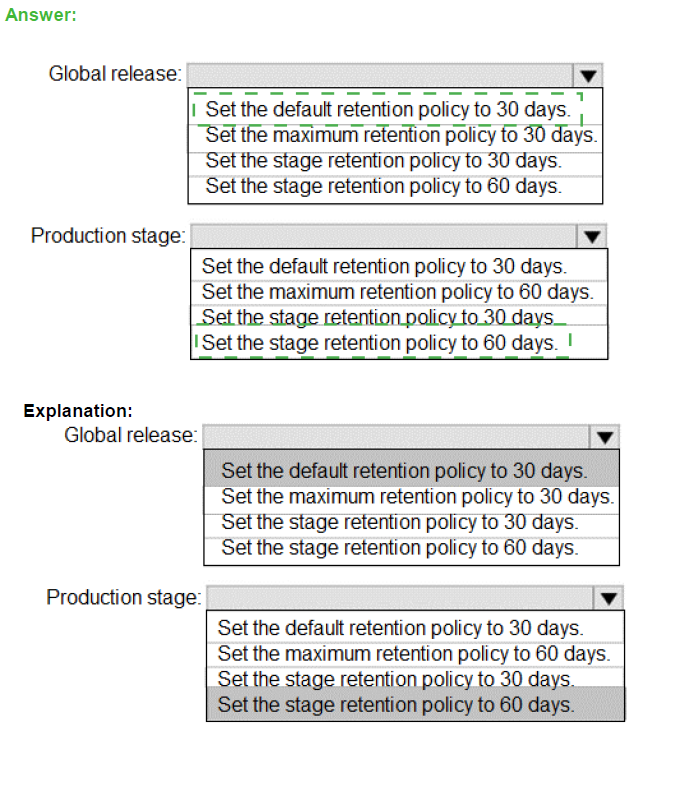
Answer:
For Global release:
Default retention policy: 30 days
Maximum retention policy: 30 days (maximum cannot exceed global maximum)
For Production stage: Default retention policy: 30 days (inherits from global)
Maximum retention policy: 60 days (can exceed global maximum for production)
Stage retention policy: 60 days (since production typically needs longer retention)
Explanation:
In Azure DevOps, retention policies can be set at both global and stage levels. The production stage often requires longer retention for compliance or rollback purposes, so it makes sense to set it to 60 days while keeping other stages at 30 days. The production stage can have a higher maximum than the global setting for critical environments.
Full mock exam
Sit the AZ-400 exam before exam day
Full-length mocks with the same number of questions and the same time limit as the real AZ-400 exam. Every attempt draws a new set of questions from the full bank, so you can keep going until you pass comfortably.