Microsoft certification · Exam AZ-400

AZ-400 Mock Exam

Microsoft Azure DevOps Solutions (beta)

Free AZ-400 questions on Topic 1: Litware inc. Case Study: 1, each with the answer and an explanation.

20 questions · 33 minutes · free, no sign-up

Topic 1: Litware inc. Case Study: 1 questions

1–4 of 4 free
Question 1
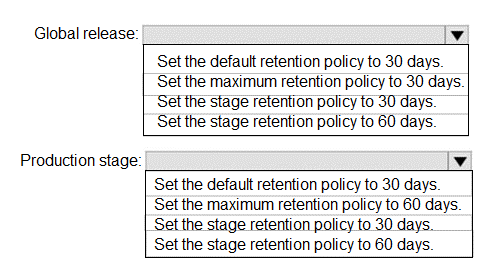
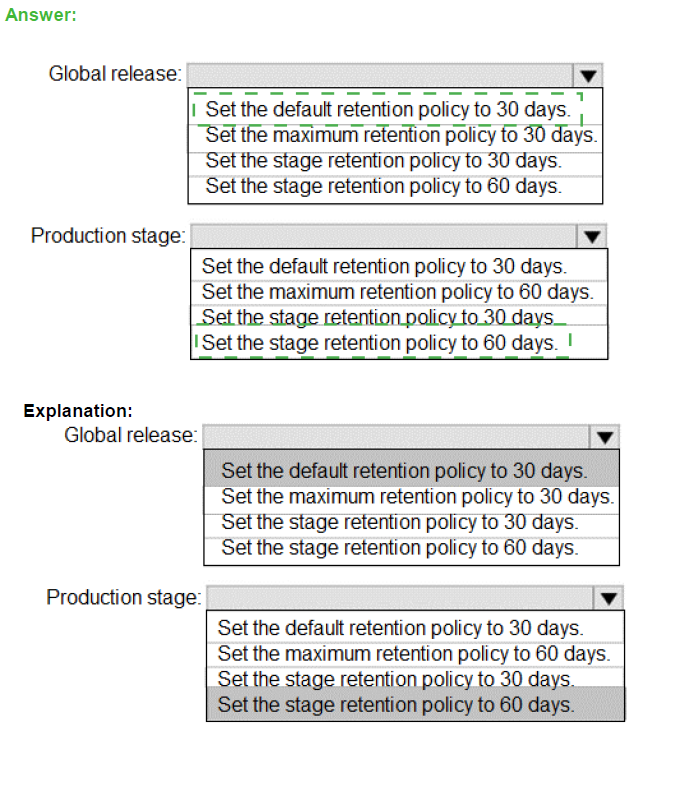
How should you configure the release retention policy for the investment planning applications suite? To answer, select the appropriate options in the answer area. NOTE: Each correct selection is worth one point.

Show answerHide answer

Explanation


Based on the image content you've provided, I need to make some logical assumptions since the full question context isn't visible. The image shows two configuration sections:

Global release settings:
Default retention policy: 30 days

Maximum retention policy: 30 days

Stage retention policy: Two options (30 days and 60 days)

Production stage settings:
Default retention policy: 30 days

Maximum retention policy: 60 days

Stage retention policy: Two options (30 days and 60 days)

From typical Azure DevOps release retention policy configuration:

Answer:

For Global release:
Default retention policy: 30 days

Maximum retention policy: 30 days (maximum cannot exceed global maximum)

For Production stage:
Default retention policy: 30 days (inherits from global)

Maximum retention policy: 60 days (can exceed global maximum for production)

Stage retention policy: 60 days (since production typically needs longer retention)

Explanation:
In Azure DevOps, retention policies can be set at both global and stage levels. The production stage often requires longer retention for compliance or rollback purposes, so it makes sense to set it to 60 days while keeping other stages at 30 days. The production stage can have a higher maximum than the global setting for critical environments.
Question 2 Choose 1
Which branching strategy should you recommend for the investment planning applications suite?
Show answerHide answer

Correct answer: D feature isolation

Explanation

Explanation:
This question requires selecting a branching strategy for an application suite based on typical development practices. Without full context from the series, I must make a reasonable assumption. For enterprise applications requiring parallel development of features with isolation and integration control, a strategy that organizes work around features is common. This allows teams to develop independently while maintaining code quality through integration practices.

Correct Option:

D. feature isolation
Feature isolation (or feature branching) involves creating a separate branch for each new feature or user story.

This strategy allows developers to work in isolation without disrupting the main codebase, enabling parallel development of multiple features.

Features are integrated back to the main branch via pull requests, maintaining code quality through reviews and automated builds.

This approach balances isolation for development with controlled integration, which is suitable for application suites where different teams may work on different features simultaneously.

Incorrect Option:

A. release isolation:
This typically refers to release branching, where a branch is created to stabilize a release while development continues on the main branch. This is more about managing releases than organizing ongoing feature development.

B. main only:
Also known as trunk-based development, where all developers commit directly to the main branch. While this promotes continuous integration, it doesn't provide the isolation needed for feature development without potentially disrupting the main branch.

C. development isolation:
This isn't a standard branching strategy term. It might refer to having a dedicated development branch separate from main, but this doesn't specify how individual features are managed.

Reference:
Microsoft Learn - "Adopt a Git branching strategy" documentation discusses common strategies including feature branching for isolating work on specific features until they're ready for integration, which aligns with typical enterprise application development needs.
Question 3 Choose 1
You are using GitHub as a source code repository. You create a client-side Git hook on the commit-msg event. The hook requires that each commit message contain a custom work item tag. You need to make a commit that does not have a work item tag. Which git commit parameter should you use?
Show answerHide answer

Correct answer: B --no-verify

Explanation

Explanation: The commit-msg hook is invoked by git-commit and git-merge, and can be bypassed with the --no-verify option.
Question 4
How should you confrere the release retention policy for the investment planning depletions suite? To answer, select the appropriate options in the answer area.
NOTE: Each correct selection is worth one point.
Show answerHide answer

Explanation


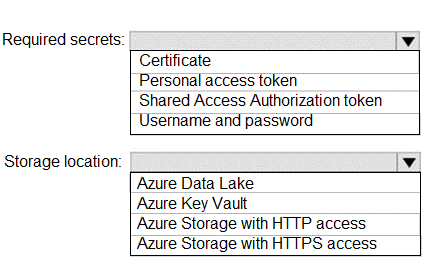
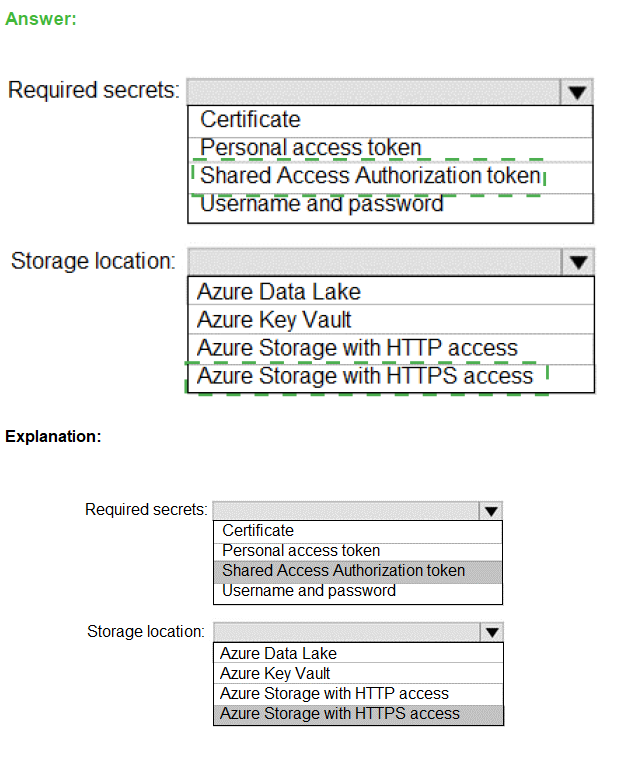
Every request made against a storage service must be authorized, unless the request is for a blob or container resource that has been made available for public or signed access. One option for authorizing a request is by using Shared Key.
Scenario: The mobile applications must be able to call the share pricing service of the existing retirement fund management system. Until the system is upgraded, the service will only support basic authentication over HTTPS.
The investment planning applications suite will include one multi-tier web application and two iOS mobile application. One mobile application will be used by employees; the other will be used by customers.

That's the last free question in Topic 1: Litware inc. Case Study: 1

You've seen the free 30% (4 of 15 questions). Full access unlocks every question and full-length AZ-400 mock exams (65 questions, 105 minutes), a different mock on every attempt.

Unlock full mock exam
Full mock exam

Sit the AZ-400 exam before exam day

Full-length mocks with the same number of questions and the same time limit as the real AZ-400 exam. Every attempt draws a new set of questions from the full bank, so you can keep going until you pass comfortably.

Get full AZ-400 mock exam
  • 65questions per mock
  • 105 mintime limit
  • 488questions in the bank
  • Newmock on every attempt