In a self-driving car company, ML engineers want to develop a model for dynamic pathing.
Which of following approaches would be optimal for this task?
Show answerHide answer
Correct answer: BReinforcement learning
Explanation
Explanation: Reinforcement learning is a type of machine learning that involves learning
from trial and error based on rewards and penalties. Reinforcement learning can be used to
develop models for dynamic pathing, which is the problem of finding an optimal path from
one point to another in an uncertain and changing environment. Reinforcement learning
can enable the model to adapt to new situations and learn from its own actions and
feedback. For example, a self-driving car company can use reinforcement learning to train
its model to navigate complex traffic scenarios and avoid collisions .
Question 12Choose 1
Which of the following is NOT an activation function?
Show answerHide answer
Correct answer: AAdditive
Explanation
Explanation: An activation function is a function that determines the output of a neuron in
a neural network based on its input. An activation function can introduce non-linearity into a
neural network, which allows it to model complex and non-linear relationships between
inputs and outputs. Some of the common activation functions are:
Sigmoid: A sigmoid function is a function that maps any real value to a value
between 0 and 1. It has an S-shaped curve and is often used for binary
classification or probability estimation.
Hyperbolic tangent: A hyperbolic tangent function is a function that maps any real
value to a value between -1 and 1. It has a similar shape to the sigmoid function
but is symmetric around the origin. It is often used for regression or classification
problems.
ReLU: A ReLU (rectified linear unit) function is a function that maps any negative
value to 0 and any positive value to itself. It has a piecewise linear shape and is
often used for hidden layers in deep neural networks.
Additive is not an activation function, but rather a term that describes a property of some
functions. Additive functions are functions that satisfy the condition f(x+y) = f(x) + f(y) for
any x and y. Additive functions are linear functions, which means they have a constant
slope and do not introduce non-linearity.
Question 13Choose 3
Which of the following items should be included in a handover to the end user to enable
them to use and run a trained model on their own system? (Select three.)
Show answerHide answer
Correct answer: C, D, ELink to a GitHub repository of the codebase
README document
Sample input and output data files
Explanation
Explanation: A handover is the process of transferring the ownership and responsibility of
an ML system from one party to another, such as from the developers to the end users. A
handover should include all the necessary information and resources that enable the end
users to use and run a trained model on their own system. Some of the items that should
be included in a handover are:
Link to a GitHub repository of the codebase: A GitHub repository is an online
platform that hosts the source code and version control of an ML system. A link to
a GitHub repository can provide the end users with access to the latest and most
updated version of the codebase, as well as the history and documentation of the
changes made to the code.
README document: A README document is a text file that provides an overview
and instructions for an ML system. A README document can include information
such as the purpose, features, requirements, installation, usage, testing,
troubleshooting, and license of the system.
Sample input and output data files: Sample input and output data files are data
files that contain examples of valid inputs and expected outputs for an ML system.
Sample input and output data files can help the end users understand how to use
and run the system, as well as verify its functionality and performance.
Question 14Choose 3
Which of the following are true about the transform-design pattern for a machine learning
pipeline? (Select three.)
It aims to separate inputs from features
Show answerHide answer
Correct answer: A, B, DIt encapsulates the processing steps of ML pipelines.
It ensures reproducibility.
It seeks to isolate individual steps of ML pipelines.
Explanation
Explanation: The transform-design pattern for ML pipelines aims to separate inputs from
features, encapsulate the processing steps of ML pipelines, and represent steps in the
pipeline with a DAG. These goals help to make the pipeline modular, reusable, and easy to
understand. The transform-design pattern does not seek to isolate individual steps of ML
pipelines, as this would create entanglement and dependency issues. It also does not
transform the output data after production, as this would violate the principle of separation
of concerns.
Question 15Choose 1
Which of the following is a common negative side effect of not using regularization?
Show answerHide answer
Correct answer: AOverfitting
Explanation
Explanation: Overfitting is a common negative side effect of not using regularization.
Regularization is a technique that reduces the complexity of a model by adding a penalty
term to the loss function, which prevents the model from learning too many parameters that
may fit the noise in the training data. Overfitting occurs when the model performs well on
the training data but poorly on the test data or new data, because it has memorized the
training data and cannot generalize well.
Question 16Choose 2
Which two of the following decrease technical debt in ML systems? (Select two.)
Explanation: Technical debt is a metaphor that describes the implied cost of additional
work or rework caused by choosing an easy or quick solution over a better but more
complex solution. Technical debt can accumulate in ML systems due to various factors,
such as changing requirements, outdated code, poor documentation, or lack of testing.
Some of the ways to decrease technical debt in ML systems are:
Documentation readability: Documentation readability refers to how easy it is to
understand and use the documentation of an ML system. Documentation
readability can help reduce technical debt by providing clear and consistent
information about the system’s design, functionality, performance, and
maintenance. Documentation readability can also facilitate communication and
collaboration among different stakeholders, such as developers, testers, users,
and managers.
Refactoring: Refactoring is the process of improving the structure and quality of
code without changing its functionality. Refactoring can help reduce technical debt
by eliminating code smells, such as duplication, complexity, or inconsistency.
Refactoring can also enhance the readability, maintainability, and extensibility of
code.
Question 17Choose 1
Given a feature set with rows that contain missing continuous values, and assuming the
data is normally distributed, what is the best way to fill in these missing features?
Show answerHide answer
Correct answer: CFill in missing features with the average of observed values for that feature in the entire
dataset.
Explanation
Explanation: Missing values are a common problem in data analysis and machine
learning, as they can affect the quality and reliability of the data and the model. There are
various methods to deal with missing values, such as deleting, imputing, or ignoring them. One of the most common methods is imputing, which means replacing the missing values
with some estimated values based on some criteria. For continuous variables, one of the
simplest and most widely used imputation methods is to fill in the missing values with the
mean (average) of the observed values for that variable in the entire dataset. This method
can preserve the overall distribution and variance of the data, as well as avoid introducing
bias or noise.
Question 18Choose 1
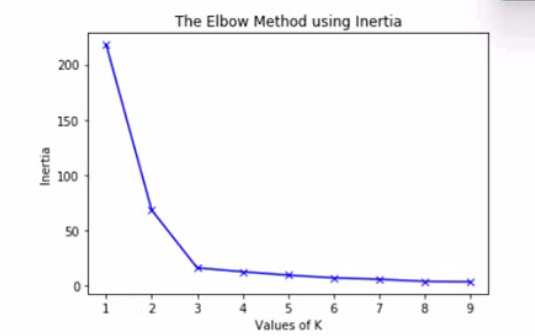
The graph is an elbow plot showing the inertia or within-cluster sum of squares on the yaxis
and number of clusters (also called K) on the x-axis, denoting the change in inertia as
the clusters change using k-means algorithm.
What would be an optimal value of K to ensure a good number of clusters?
Show answerHide answer
Correct answer: B3
Explanation
Explanation: The optimal value of K is the one that minimizes the inertia or within-cluster
sum of squares, while avoiding too many clusters that may overfit the data. The elbow plot
shows a sharp decrease in inertia from K = 1 to K = 2, and then a more gradual decrease
from K = 2 to K = 3. After K = 3, the inertia does not change much as K increases.
Therefore, the elbow point is at K = 3, which is the optimal value of K for this data.
Question 19Choose 1
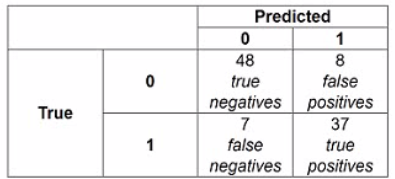
The following confusion matrix is produced when a classifier is used to predict labels on a
test dataset. How precise is the classifier?
Show answerHide answer
Correct answer: B37/(37+8)
Explanation
Explanation: Precision is a measure of how well a classifier can avoid false positives
(incorrectly predicted positive cases). Precision is calculated by dividing the number of true
positives (correctly predicted positive cases) by the number of predicted positive cases
(true positives and false positives). In this confusion matrix, the true positives are 37 and
the false positives are 8, so the precision is 37/(37+8) = 0.822.
Question 20Choose 2
When should you use semi-supervised learning? (Select two.)
Show answerHide answer
Correct answer: C, ELabeling data is challenging and expensive.
There is a large amount of unlabeled data to be used for predictions.
Explanation
Explanation: Semi-supervised learning is a type of machine learning that uses both
labeled and unlabeled data to train a model. Semi-supervised learning can be useful when:
Labeling data is challenging and expensive: Labeling data requires human
intervention and domain expertise, which can be costly and time-consuming.
Semi-supervised learning can leverage the large amount of unlabeled data that is
easier and cheaper to obtain and use it to improve the model’s performance.
There is a large amount of unlabeled data to be used for predictions: Unlabeled
data can provide additional information and diversity to the model, which can help
it learn more complex patterns and generalize better to new data. Semi-supervised
learning can use various techniques, such as self-training, co-training, or
generative models, to incorporate unlabeled data into the learning process.
Full mock exam
Sit the AIP-210 exam before exam day
Full-length mocks with the same number of questions and the same time limit as the real AIP-210 exam. Every attempt draws a new set of questions from the full bank, so you can keep going until you pass comfortably.