Find out if you're ready for AIP-210. Take the free timed mock exam and get your score in minutes, or study the free AIP-210 questions below with answers and explanations.
Which of the following sentences is TRUE about the definition of cloud models for machine
learning pipelines?
Show answerHide answer
Correct answer: DSoftware as a Service (SaaS) can provide AI practitioner data science services such as
Jupyter notebooks.
Explanation
Explanation: Cloud models are service models that provide different levels of abstraction
and control over computing resources in a cloud environment. Some of the common cloud
models for machine learning pipelines are:
Software as a Service (SaaS): SaaS provides ready-to-use applications that run
on the cloud provider’s infrastructure and are accessible through a web browser or
an API. SaaS can provide AI practitioner data science services such as Jupyter
notebooks, which are web-based interactive environments that allow users to
create and share documents that contain code, text, visualizations, and more.
Platform as a Service (PaaS): PaaS provides a platform that allows users to
develop, run, and manage applications without worrying about the underlying
infrastructure. PaaS can provide some services within an application such as
payment applications to create efficient results.
Infrastructure as a Service (IaaS): IaaS provides access to fundamental computing
resources such as servers, storage, networks, and operating systems. IaaS can
provide CPU, memory, disk, network and GPU resources that can be used to run
machine learning models and applications.
Data as a Service (DaaS): DaaS provides access to data sources that can be
consumed by applications or users on demand. DaaS can host the databases
providing backups, clustering, and high availability.
Question 2Choose 1
Which of the following is a privacy-focused law that an AI practitioner should adhere to
while designing and adapting an AI system that utilizes personal data?
Show answerHide answer
Correct answer: AGeneral Data Protection Regulation (GDPR)
Explanation
Explanation: The General Data Protection Regulation (GDPR) is a privacy-focused law
that an AI practitioner should adhere to while designing and adapting an AI system that
utilizes personal data. The GDPR applies to any organization that processes personal data
of individuals in the European Union (EU), regardless of where the organization is located.
The GDPR grants individuals rights over their personal data, such as the right to access,
rectify, erase, restrict, or object to its processing. The GDPR also imposes obligations on
organizations that process personal data, such as the duty to obtain consent, conduct data
protection impact assessments, implement data protection by design and by default, and
ensure accountability and transparency. The GDPR also addresses some specific issues
related to AI, such as automated decision-making, profiling, and data portability.
Question 3Choose 1
Which of the following best describes distributed artificial intelligence?
Show answerHide answer
Correct answer: CIt relies on a distributed system that performs robust computations across a network of
unreliable nodes.
Explanation
Explanation: Distributed artificial intelligence (DAI) is a subfield of artificial intelligence that
studies how multiple intelligent agents can coordinate and cooperate to achieve a common
goal or solve a complex problem. DAI relies on a distributed system that performs robust
computations across a network of unreliable nodes, such as sensors, robots, or humans.
DAI can handle large-scale, dynamic, and uncertain environments that are beyond the
capabilities of a single agent.
Question 4Choose 1
When working with textual data and trying to classify text into different languages, which approach to representing features makes the most sense?
Show answerHide answer
Correct answer: BBag of bigrams (2 letter pairs)
Explanation
Explanation: A bag of bigrams (2 letter pairs) is an approach to representing features for
textual data that involves counting the frequency of each pair of adjacent letters in a text.
For example, the word “hello” would be represented as {“he”: 1, “el”: 1, “ll”: 1, “lo”: 1}. A bag
of bigrams can capture some information about the spelling and structure of words, which
can be useful for identifying the language of a text. For example, some languages have
more common bigrams than others, such as “th” in English or “ch” in German .
Question 5Choose 1
You and your team need to process large datasets of images as fast as possible for a
machine learning task. The project will also use a modular framework with extensible code
and an active developer community. Which of the following would BEST meet your needs?
Show answerHide answer
Correct answer: ACaffe
Explanation
Explanation: Caffe is a deep learning framework that is designed for speed and
modularity. It can process large datasets of images efficiently and supports various types of
neural networks. It also has a large and active developer community that contributes to its
code base and documentation. Caffe is suitable for image processing tasks such as
classification, segmentation, detection, and recognition.
Question 6Choose 1
A classifier has been implemented to predict whether or not someone has a specific type of
disease. Considering that only 1% of the population in the dataset has this disease, which
measures will work the BEST to evaluate this model?
Show answerHide answer
Correct answer: CPrecision and recall
Explanation
Explanation: Precision and recall are two measures that can evaluate the performance of
a classifier, especially when the data is imbalanced. Precision is the ratio of true positives
(correctly predicted positive cases) to all predicted positive cases. Recall is the ratio of true
positives to all actual positive cases. Precision and recall can help assess how well the
classifier can identify the positive cases (the disease) and avoid false negatives (missed
diagnosis) or false positives (unnecessary treatment).
Question 7Choose 1
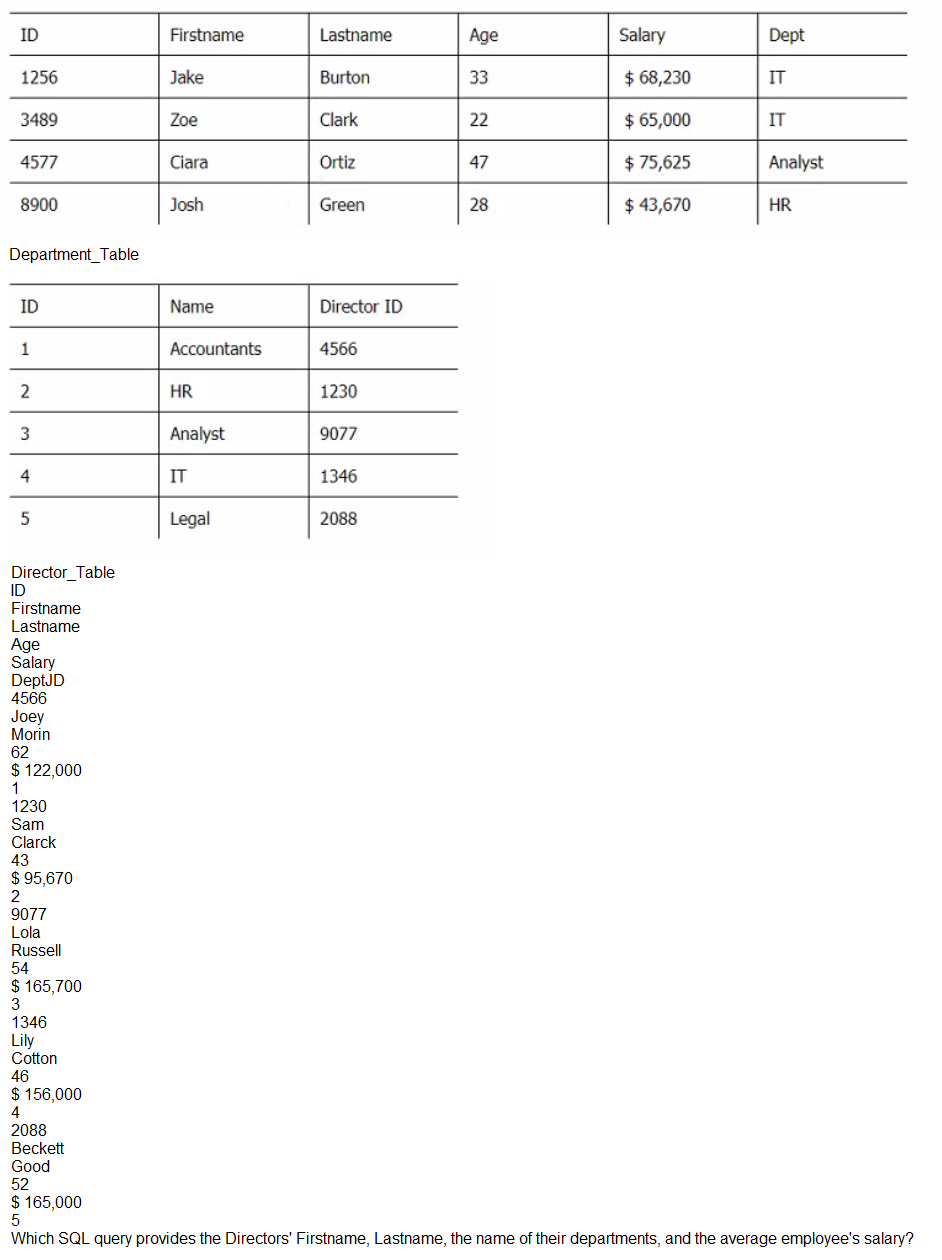
Below are three tables: Employees, Departments, and Directors.
Employee_Table
Show answerHide answer
Correct answer: DSELECT m.Firstname, m.Lastname, d.Name, AVG(e.Salary) as Dept_avg_Salary
FROM Employee_Table as e
RIGHT JOIN Department_Table as d on e.Dept = d.Name
INNER JOIN Directorjable as m on d.ID = m.DeptID
GROUP BY m.Firstname, m.Lastname, d.Name
Explanation
Explanation: This SQL query provides the Directors’ Firstname, Lastname, the name of
their departments, and the average employee’s salary by joining the three tables using the
appropriate join types and conditions. The RIGHT JOIN between Employee_Table and
Department_Table ensures that all departments are included in the result, even if they
have no employees. The INNER JOIN between Department_Table and Directorjable
ensures that only departments with directors are included in the result. The GROUP BY
clause groups the result by the directors’ names and departments’ names, and calculates
the average salary for each group using the AVG function.
Question 8Choose 1
Which of the following is the definition of accuracy?
Show answerHide answer
Correct answer: B(True Positives + True Negatives) / Total Predictions
Explanation
Explanation: Accuracy is a measure of how well a classifier can correctly predict the class
of an instance. Accuracy is calculated by dividing the number of correct predictions (true
positives and true negatives) by the total number of predictions. True positives are
instances that are correctly predicted as positive (belonging to the target class). True
negatives are instances that are correctly predicted as negative (not belonging to the target
class).
Question 9Choose 1
Which of the following methods can be used to rebalance a dataset using the rebalance
design pattern?
Show answerHide answer
Correct answer: DWeighted class
Explanation
Explanation: Weighted class is a technique to rebalance a dataset by assigning different
weights to each class, according to their frequency in the dataset. The weights are
inversely proportional to the class frequency, meaning that rare classes have higher
weights and common classes have lower weights. This helps to reduce the bias towards
the majority class and improve the model performance on the minority class.
Question 10Choose 1
Which of the following occurs when a data segment is collected in such a way that some
members of the intended statistical population are less likely to be included than others?
Show answerHide answer
Correct answer: BSampling bias
Explanation
Explanation: Sampling bias occurs when a data segment is collected in such a way that
some members of the intended statistical population are less likely to be included than
others. This can result in a sample that is not representative of the population and may lead
to inaccurate or misleading conclusions. Sampling bias can be caused by various factors,
such as non-random sampling methods, non-response, self-selection, or convenience
sampling.
Full mock exam
Sit the AIP-210 exam before exam day
Full-length mocks with the same number of questions and the same time limit as the real AIP-210 exam. Every attempt draws a new set of questions from the full bank, so you can keep going until you pass comfortably.