You have a Microsoft Foundry project that contains a customer support agent grounded in
internal documentation.
After a recent update, users report the following issues:
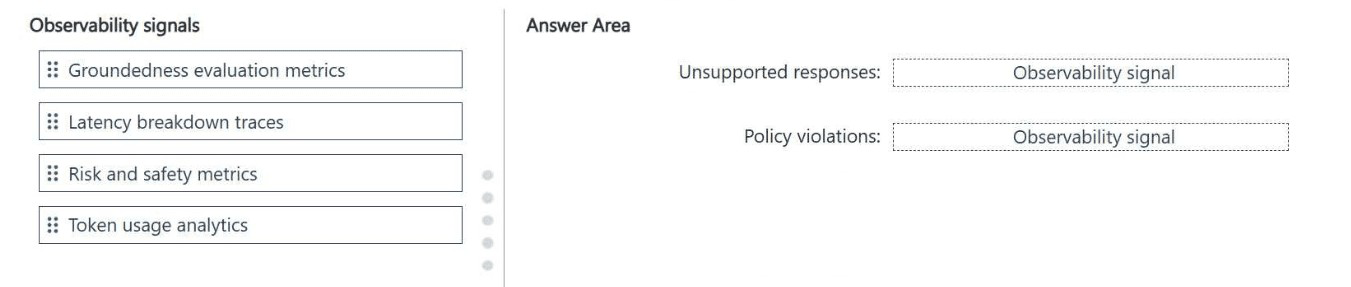
• Some answers are unsupported by retrieved documents.
• A small number of responses are flagged for policy violations.
You need to evaluate each issue.
Which observability signals should you use for each issue? To answer, drag the appropriate observability signals to the correct issues. Each observability signal may be used once, more than once, or not at all. You may need to drag the split bar between panes
or scroll to view content.
NOTE: Each correct selection is worth one point.
After a recent update, users report the following issues:
• Some answers are unsupported by retrieved documents.
• A small number of responses are flagged for policy violations.
You need to evaluate each issue.
Which observability signals should you use for each issue? To answer, drag the appropriate observability signals to the correct issues. Each observability signal may be used once, more than once, or not at all. You may need to drag the split bar between panes
or scroll to view content.
NOTE: Each correct selection is worth one point.
Show answerHide answer
Explanation
Explanation:
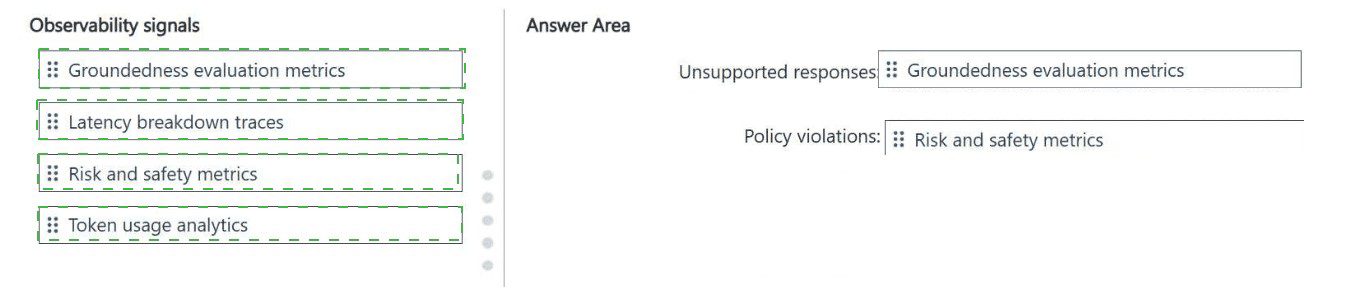
This question tests your understanding of Azure AI Foundry's observability signals and which evaluators are appropriate for diagnosing specific issues in a RAG-based (Retrieval-Augmented Generation) customer support agent. The two distinct issues—unsupported answers and policy violations—map to two different evaluator categories: quality/performance and risk/safety.
✔️ Correct Options
Unsupported responses: Groundedness evaluation metrics.
Groundedness measures how consistent the generated response is with respect to the retrieved context . When answers are unsupported by retrieved documents, this indicates a groundedness issue—the model is fabricating or hallucinating content not found in the source material. This is a quality and performance evaluator designed specifically for RAG scenarios .
Policy violations: Risk and safety metrics.
Risk and safety evaluators assess potential risks associated with AI-generated content, including harmful or inappropriate content . This category includes evaluators for hate and unfairness, sexual content, violent content, and self-harm-related content that detect policy violations . These metrics measure whether content violates safety thresholds and Responsible AI principles.
❌ Incorrect Options
Latency breakdown traces.
Traces are used for operational observability—debugging complex agent behaviors, identifying performance bottlenecks, and understanding multi-step reasoning chains . Latency breakdown does not evaluate content quality or safety.
Token usage analytics.
Token usage is an operational metric for monitoring consumption and cost . It does not assess whether responses are grounded in retrieved documents or whether content violates safety policies.
🔧 Reference
→ Microsoft Learn: Evaluation and monitoring metrics for generative AI
Confirms that risk and safety evaluators identify harmful/inappropriate content, while groundedness evaluators measure response alignment with context.
→ Microsoft Learn: Understand observability - Training
Defines groundedness as measuring consistency with retrieved context and risk/safety evaluators as assessing harmful content risks.