Microsoft certification · Exam AI-103

AI-103 Mock Exam Page 3

Developing AI Apps and Agents on Azure

Free AI-103 mock exam questions 21–28, each with the answer and an explanation.

20 questions · 40 minutes · free, no sign-up

Free AI-103 questions

21–28 of 28 free
Question 21 Choose 1
You have a Microsoft Foundry project that contains three agents as shown in the following table.

Name
Description
TriageAgent
Classifies incoming customer requests
PolicyAgent
Answers policy questions by searching internal content
ActionAgent
Creates or updates tickets by calling an HTTP API
You need to orchestrate the agents to ensure that the customer requests meet the following requirements:

• Support a deterministic, step-based process that uses conditional branching and shared state across the agents.
• Optionally trigger a ticket action based on the triage result.
The solution must minimize development effort.
What should you include in the solution?
Show answerHide answer

Correct answer: C a workflow

Explanation

Explanation:

This question tests your understanding of orchestration patterns in Microsoft Foundry Agent Service. Since the requirement calls for a deterministic, step-based process with conditional branching, shared state, and minimal development effort, you need a built-in orchestration mechanism rather than custom coordination logic.

✅ Correct Option: C. a workflow
Workflows in Foundry Agent Service orchestrate the full lifecycle of multi-agent processes, including handling tool calls, updating conversation state, managing retries, and logging outputs, all through a declarative, step-based structure. Workflows natively support conditional branching and shared state across agents, letting TriageAgent, PolicyAgent, and ActionAgent work in a deterministic sequence without custom orchestration code, directly minimizing development effort.

❌ Incorrect Option: A. separate agent runs coordinated in the application code
This approach requires writing and maintaining custom logic in your application to manage branching, state passing, and sequencing between agents. It increases development effort significantly and lacks the built-in deterministic control that workflows provide out of the box.

❌ Incorrect Option: B. a multi-agent group chat session
Group chat sessions are designed for open-ended, conversational collaboration between agents rather than deterministic, step-based execution. This pattern doesn't guarantee predictable conditional branching or structured shared state, making it unsuitable for the described requirement.

❌ Incorrect Option: D. threads and runs without a workflow
Threads and runs manage conversation history and individual agent executions, but without a workflow layer, there's no built-in mechanism for conditional branching or shared state across multiple agents. This would require extra custom code, increasing rather than minimizing development effort.

🔧 Reference:
→ Microsoft Learn: What is Microsoft Foundry Agent Service? — confirms that workflows orchestrate multi-agent lifecycles, including state management and conditional logic, with minimal custom code.
Question 22 Choose 1
Note: This section contains one or more sets of questions with the same scenario and problem. Each question presents a unique
solution to the problem. You must determine whether the solution meets the stated goals. More than one solution in the set might
solve the problem. It is also possible that none of the solutions in the set solve the problem. After you answer a question in this section, you will NOT be able to return. As a result, these questions do not appear on the Review Screen.
You have a Microsoft Foundry project that contains an agent. The agent generates summaries from retrieved policy documents.
Users report that some responses omit required regulatory clauses, even when the clauses are present in the retrieved content.
You need to improve response completeness.
Solution: You run an evaluation flow that scores responses for completeness and blocks responses that fall below a defined threshold.
Does this meet the goal?
Show answerHide answer

Correct answer: B No

Explanation

Explanation:

The scenario involves an agent that generates summaries from policy documents but sometimes omits required regulatory clauses present in the retrieved content. The goal is to improve response completeness.

✅ Correct Option:

B. No
Running an evaluation flow to score and block low-completeness responses acts as a quality gate. It prevents poor outputs from reaching users but does not address or improve the underlying summarization behavior of the agent.

❌ Incorrect Option:

A. Yes
This solution does not fully meet the goal. While it mitigates risk, it relies on rejection rather than fixing the root cause (e.g., better retrieval, instructions, or grounding).

🔧 Reference:
→ Microsoft Learn - Evaluate agents in Microsoft Foundry – Covers evaluation flows for scoring metrics like completeness.

→ Microsoft Learn - Improving agent response quality – Recommends combining evaluations with prompt/instruction improvements for completeness issues.
Question 23
Your company is piloting a customer support agent in a Microsoft Foundry project name Project1. Project1 is connected to an existing Application Insights resource, and the company's support team reviews runs in the Traces tab.
The Foundry Agent Service is configured to perform the following actions: • Retrieve the Application Insights connection string by calling
project_client.telemetry.get_application_insights_connection_string().
• Call configure_azure_monitor(connection_string=...) to enable telemetry.
A separate LangChain service configured to use OpenTelemetry and has the following configurations:
• Uses AzureAIOpenTelemetryTracer(connection_string=...,
enable_content_recording=False)
• Passes the tracer by using config={"callbacks":[azure_tracer]}
Company policy has the following requirements:
• Telemetry from LangChain and OpenTelemetry must be distinguishable within the same Application Insights resource.
• Secrets and credentials must NOT be stored in prompts, tool arguments, or span attributes.
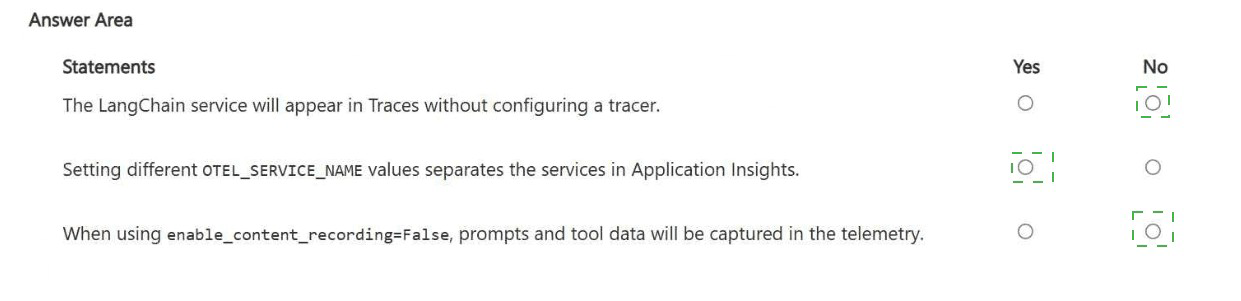
For each of the following statements, select Yes if the statement is true. Otherwise, select No.
NOTE: Each correct selection is worth one point.

Show answerHide answer

Explanation


Explanation:

This question tests your understanding of OpenTelemetry tracing configuration for LangChain services in Azure AI Foundry. The scenario requires distinguishing telemetry from different services within the same Application Insights resource and ensuring secrets are not recorded in traces.

✔️ Correct Options

Statement 1: No
The LangChain service will NOT appear in Traces without configuring a tracer. To collect telemetry, you must explicitly configure the AzureAIOpenTelemetryTracer and attach it to your agent via callbacks . While Foundry provides server-side tracing for hosted agents without code changes, LangChain services require client-side instrumentation using the langchain-azure-ai integration package to emit OpenTelemetry spans .

Statement 2: Yes
Setting different OTEL_SERVICE_NAME values separates services in Application Insights. The service.name resource attribute uniquely identifies a service in OpenTelemetry, enabling effective filtering and analysis of telemetry data . You can set this via the OTEL_SERVICE_NAME environment variable, which separates traces from different services within the same Application Insights resource .

Statement 3: No
When using enable_content_recording=False, prompts and tool data will NOT be captured in telemetry. Setting enable_content_recording=False is explicitly designed to redact message content and tool call arguments from traces . This satisfies the company policy requirement that secrets and credentials must NOT be stored in prompts or tool arguments.

🔧 Reference
→ Trace LangChain and LangGraph apps with Foundry - Microsoft Learn
Confirms that enable_content_recording=False redacts message content and tool arguments, and that a tracer must be configured for LangChain traces.
Question 24 Choose 1
You have a Microsoft Foundry project that contains an agent and an image generation model deployment. The agent generates original images from user-supplied product photos. You need to ensure that the generated images maintain the product identity and visual characteristics of the provided photo. What should you do?
Show answerHide answer

Correct answer: C Include a prompt and input image in the request.

Explanation

Explanation:

This question tests your understanding of how to configure image generation models within a Microsoft Foundry project to achieve "image-to-image" generation, a specific capability where a new image is generated based on a provided text description and a guidance image.

✅ C. Include a prompt and input image in the request:
To ensure the generated image maintains the identity and characteristics of the user-supplied product photo, you must provide that original photo as a guiding input along with the description of how to change it. This technique, known as image-to-image generation, forces the model to use the visual structure, style, and content of the input image as a strong baseline, applying the changes requested in the text prompt while strictly preserving the underlying subject identity. Without the input image, the model would only have text to go by and would generate an entirely original, likely unrelated image.

❌ A. Set the input_fidelity parameter to high:
Some advanced image models might have parameters that control how closely they stick to a specific guide, but a general parameter named input_fidelity is not a standard configuration across common Azure-hosted generative models. The fundamental requirement to preserve identity in this context is to first provide the guidance image in the request.

❌ B. Apply a groundedness detection filter:
A groundedness detection filter is a safety and content validation tool. It checks if an image's generated content is strictly "grounded" in or derivable from its source. It does not control or guide the model's actual creative generation process; it can only identify and potentially filter a finished image that it deems unrelated.

❌ D. Decrease the value of the temperature parameter:
Temperature is a standard generation parameter that controls the randomness or creativity of the output. While lowering the temperature makes the model more deterministic and less likely to generate wild variations, it is primarily a concept used with language models (LLMs). For image models, temperature affects creativity, but setting it low cannot preserve a specific input identity if that input identity has not been provided in the first place.

🔧 Reference:
→ Microsoft Learn: Generate and Edit Images - Azure OpenAI Service confirms that editing an image (which includes maintaining its core characteristics) requires providing both the original image and the text description for the transformation.
Question 25 Choose 1
Note: This section contains one or more sets of questions with the same scenario and problem. Each question presents a unique
solution to the problem. You must determine whether the solution meets the stated goals. More than one solution in the set might
solve the problem. It is also possible that none of the solutions in the set solve the problem. After you answer a question in this section, you will NOT be able to return. As a result, these questions do not appear on the Review Screen.
You have a multimodal Al generative model that accepts image uploads and uses extracted image text to generate responses.
You discover that users can upload unsafe images and embed hidden instructions into images to manipulate the model.
You need to implement controls to mitigate the risk.
Solution: You configure protected material detection.
Does this meet the goal?
Show answerHide answer

Correct answer: B No

Explanation

Explanation:

This question tests AI safety controls for multimodal systems and protection against prompt injection risks. The issue involves hidden instructions embedded inside uploaded images that manipulate model behavior. The required control should specifically detect or mitigate malicious prompt content rather than address unrelated content risks.

🟢 Correct Option:

B. No
Protected material detection is designed to identify copyrighted or protected content, such as text, code, or other material that should not be reproduced without authorization. It does not analyze hidden instructions or prompt injection attempts embedded within images. Since the problem is malicious manipulation through embedded prompts, protected material detection does not mitigate the stated security risk.

🔴 Incorrect options:

A. Yes
This option is incorrect because protected material detection focuses on identifying copyrighted or restricted content rather than detecting prompt injection attacks. Hidden instructions within images require controls specifically intended for prompt manipulation and indirect attack prevention.

🔧 Reference:
⇒ Microsoft Prompt Shields documentation
Confirms that prompt shields help detect and mitigate prompt injection attacks and indirect instructions.

⇒ Microsoft Protected Material Detection documentation
Confirms that protected material detection identifies copyrighted or protected content rather than prompt injection risks.
Question 26
You have a Microsoft Foundry project that contains a workflow for a customer support triage process.
You have an Ask a question node that stores user responses in a local variable named Var01.
You need to create the following Power Fx expressions:
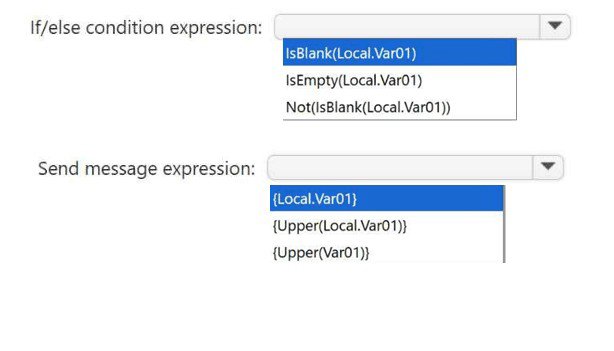
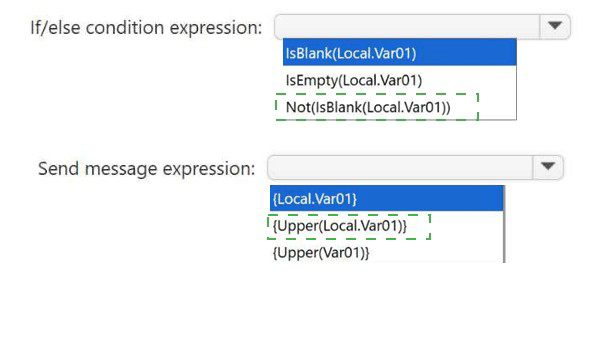
An if/else condition expression that ensures that Var01 contains a value A Send message expression that returns the stored user response in uppercase How should you configure the expressions? To answer, select the appropriate options in the answer area.
NOTE: Each correct selection is worth one point.

Show answerHide answer

Explanation


Explanation:

This question tests your understanding of writing Power Fx expressions inside a Microsoft Foundry workflow to validate and transform data captured from an Ask a question node. The scenario requires checking that a variable holds a value and then formatting that value for output.

✅ Correct Option: Not(IsBlank(Local.Var01))
This expression evaluates whether Var01 is empty and then reverses that result, so the condition returns true only when the variable actually contains a value. Since the requirement is to ensure Var01 contains a value before proceeding, wrapping IsBlank in Not() is the correct way to build this validation in the if/else node.

✅ Correct Option: {Upper(Local.Var01)}
The Upper function converts stored text to uppercase, and referencing it as Local.Var01 correctly points to the local variable that holds the user's response from the Ask a question node. Wrapping the expression in curly braces embeds it directly into the Send message text, which is the documented pattern for outputting a transformed variable value in a workflow message.

❌ Incorrect Option: IsBlank(Local.Var01)
This expression alone returns true when the variable is empty, which is the opposite of what's needed. Using it directly in the if/else condition would route the flow incorrectly, treating an empty response as the success path instead of validating that a value exists.

❌ Incorrect Option: IsEmpty(Local.Var01)
IsEmpty is intended for checking whether a table or collection has no records, not for validating scalar text variables like Var01. Applying it here doesn't match the data type or the intended validation logic, making it unsuitable for this scenario.

❌ Incorrect Option: {Upper(Var01)}
This expression omits the Local. scope prefix, which is required to correctly reference a variable defined within the workflow. Without this prefix, the expression fails to resolve to the stored user response, so the message wouldn't return the expected uppercase value.

🔧 Reference:
→ Microsoft Learn: Build a workflow in Microsoft Foundry — confirms the Power Fx syntax for referencing local variables with Local. prefix and using Upper() and IsBlank() functions in workflow nodes.
Question 27 Choose 1
You have a Microsoft Foundry project named Project1.
Project1 contains an application that processes PDF vendor invoices.
You need to configure Azure Document Intelligence in Foundry Tools to generate a Markdown output that preserves the sections
and table structure of the PDFs. The solution must minimize development effort. What should you do?
Show answerHide answer

Correct answer: D Set the output_content_format=ContentFormat. MARKDOWN value.

Explanation

Explanation:

The question tests your understanding of Azure Document Intelligence's output configuration for preserving document structure. The goal is to generate Markdown output that maintains sections and tables from PDF invoices while minimizing development effort. The output_content_format parameter is the direct and explicit configuration for this requirement.

✔️ Correct Option

D. Set the output_content_format=ContentFormat.MARKDOWN value.
This is the correct configuration to generate Markdown output that preserves original document structure. The Layout API supports the outputContentFormat=markdown parameter, which produces semantically structured content that maintains paragraphs, headings, tables, and other document elements in their proper hierarchy . Tables are preserved with full HTML table markup (< table >, < tr >, < th >, < td >) for maximum fidelity and compatibility . This directly meets the requirement to preserve sections and table structure.

❌ Incorrect Options

A. Increase the confidence threshold.
Confidence threshold controls the minimum confidence score for extracted elements and filters out low-confidence detections . It does not control output format or preserve structure; it only affects which detected elements are included.

B. Configure output=figures when you analyze the PDF.
This option is not a valid Document Intelligence configuration parameter. Figure elements are automatically preserved in the Markdown output using < figure > tags when output_content_format=markdown is set . Setting an output=figures parameter would not generate the required Markdown output.

C. Configure content=markdown when you analyze the document.
While the parameter name includes "content", the correct syntax is output_content_format=markdown, not content=markdown . Using the incorrect parameter name would result in the configuration being ignored or an error.

🔧 Reference
→ Microsoft Learn: Understanding Document Intelligence Layout API Markdown Output Format - Foundry Tools
Confirms specifying outputContentFormat=markdown preserves paragraphs, headings, tables, and other document elements in their proper hierarchy.
Question 28 Choose 1
You have an application that processes scanned PDF invoices. The invoices have varied layouts and include multipage tables.
You have a pipeline that uses optical character recognition (OCR) and extracts totals and invoice numbers. The results are often
incorrect because the document structure is ignored.
You need to implement a solution that provides OCR, layout analysis, and template- generalizing field extraction. The solution must
NOT require training a custom model. The solution must minimize administrative effort. What should you include in the solution?
Show answerHide answer

Correct answer: B Azure Content Understanding in Foundry Tools

Explanation

Explanation:

This question tests document processing capabilities for complex scanned documents. The requirement includes OCR, layout analysis, and extraction of fields from invoices with varying formats and multipage tables, while avoiding custom model training and minimizing administration effort.

🟢 Correct Option:

B. Azure Content Understanding in Foundry Tools
Azure Content Understanding provides built-in OCR, document layout analysis, and generalized field extraction capabilities for complex documents. It can process varying document structures, tables, and multipage content without requiring custom model training. Since it handles unstructured and semi-structured content using predefined capabilities, it minimizes both development and administrative effort while improving extraction accuracy.

🔴 Incorrect options:

A. an Azure Machine Learning model
This option is incorrect because Azure Machine Learning would typically require building, training, and maintaining a custom model. The scenario explicitly states that the solution should avoid custom model training and minimize administrative overhead.

C. Azure Language in Foundry Tools
Azure Language services focus on natural language processing tasks such as sentiment analysis, entity recognition, and text understanding. They do not provide document-specific OCR and layout analysis features needed for extracting structured invoice data.

🔧 Reference:
⇒ What is Azure Content Understanding in Foundry Tools?
Confirms support for OCR, layout understanding, and extraction from unstructured content.

⇒ Azure AI Foundry Tools documentation
Confirms integration of document understanding capabilities for AI workflows.

That's the last free question

You've seen the free 30% (28 of 95 questions). Full access unlocks every question and full-length AI-103 mock exams (60 questions, 120 minutes), a different mock on every attempt.

Unlock full mock exam
Full mock exam

Sit the AI-103 exam before exam day

Full-length mocks with the same number of questions and the same time limit as the real AI-103 exam. Every attempt draws a new set of questions from the full bank, so you can keep going until you pass comfortably.

Get full AI-103 mock exam
  • 60questions per mock
  • 120 mintime limit
  • 95questions in the bank
  • Newmock on every attempt