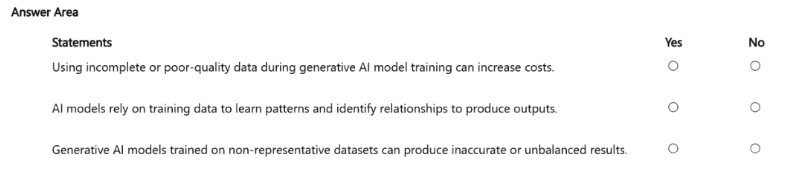
- For each of the following statements, select Yes if the statement is true. Otherwise, select No.
NOTE: Each correct selection is worth one point.
NOTE: Each correct selection is worth one point.
Show answerHide answer
Explanation
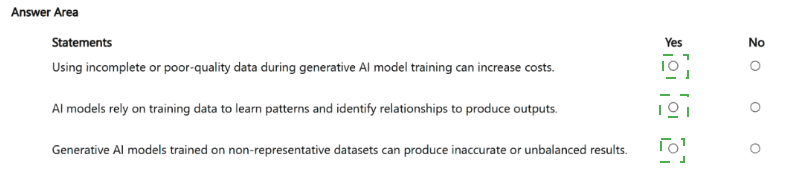
Explanation:
Statement 1: Data Quality vs. Training Costs (Yes)
Why it is correct: Generative AI training requires massive computational resources. Poor-quality or incomplete data introduces noise, forcing models to take longer to converge or leading to failed training runs. This significantly increases cloud compute (GPU/TPU) consumption and engineering labor costs.
Why "No" is incorrect: Ignoring data quality is not cost-neutral; fixing underlying data errors after training through extensive fine-tuning or reinforcement learning is far more expensive than preprocessing data correctly.
Statement 2: Foundation of AI Mechanics (Yes)
Why it is correct: Machine learning models do not use traditional, hard-coded logical rules. Instead, they ingest training data to mathematically map statistical patterns, semantic structures, and correlations. They use these learned relationships to predict outputs.
Why "No" is incorrect: Without data to parse patterns, an AI model possesses no foundational knowledge base or algorithmic architecture to generate contextually relevant text, code, or images.
Statement 3: Representative Datasets and Bias (Yes)
Why it is correct: A model's output is directly constrained by its input data. If training datasets lack demographic or situational diversity, the model fails to generalize properly, leading to systemic bias, high error rates in underrepresented scenarios, and false fabrications.
Why "No" is incorrect: Skewed training data does not balance out naturally during generation; it actively amplifies historical biases and statistical gaps present in the source corpus.
References
Microsoft Corporate Governance: Responsible AI Standard (v2) – Highlights the pillars of Fairness and Inclusiveness, mandating that deployment teams ensure training data is diverse, highly representative, and thoroughly scrubbed of historical imbalances to prevent algorithmic bias.
Microsoft Azure Architecture Framework: AI & Machine Learning Data Fundamentals – Explicitly states that upstream data quality, formatting, and completeness dictate downstream computational efficiency and directly minimize the risk of wasted cloud consumption expenditure.