Cisco certification · Exam 350-701

350-701 Mock Exam Page 2

Implementing and Operating Cisco Security Core Technologies (SCOR 350-701)

Free 350-701 questions on Topic 2: Exam Pool B, each with the answer and an explanation.

20 questions · 27 minutes · free, no sign-up

Topic 2: Exam Pool B questions

11–20 of 36 free
Question 11 Choose 2

What are two characteristics of Cisco DNA Center APIs? (Choose two)

Show answerHide answer

Correct answer: D, E

They quickly provision new devices

They view the overall health of the network

Question 12 Choose 1

Which Dos attack uses fragmented packets to crash a target machine?

Show answerHide answer

Correct answer: C

teardrop

Explanation

A teardrop attack is a denial-of-service (DoS)
attack that involves sending fragmented packets to a targetmachine. Since the machine
receiving such packets cannot reassemble them due to a bug in TCP/IPfragmentation
reassembly, the packets overlap one another, crashing the target network device. This
generally happens on older operating systems such as Windows 3.1x, Windows 95,
Windows NT and versions of the Linux kernel prior to 2.1.63.

Question 13 Choose 1
Which attack type attempts to shut down a machine or network so that users are not able to access it?
Show answerHide answer

Correct answer: A smurf

Explanation

Explanation:
The question describes a Denial-of-Service (DoS) attack, which aims to make a machine or network resource unavailable to its intended users.

A) smurf is CORRECT.
A Smurf attack is a specific, historical type of distributed denial-of-service (DDoS) attack. It works by sending a large number of Internet Control Message Protocol (ICMP) echo request (ping) packets to a network's broadcast address. The packets are spoofed to appear as if they came from the victim's IP address. Every machine on the network then replies to the victim, overwhelming it with traffic and causing a denial of service.

Why the other options are incorrect:

B) bluesnarfing is INCORRECT.
Bluesnarfing is an attack against Bluetooth-enabled devices. It involves unauthorized access to and theft of information (like contacts, emails, etc.) from a wireless device. Its goal is data theft, not shutting down a network.

C) MAC spoofing is INCORRECT.
MAC spoofing involves changing a device's Media Access Control (MAC) address to impersonate another device on the local network. This is typically used to bypass network access controls or for session hijacking, not to cause a denial of service.

D) IP spoofing is INCORRECT.
IP spoofing is the technique of creating IP packets with a forged source IP address. It is a method used in many other attacks (including the Smurf attack) to hide the attacker's identity or to exploit trust relationships. However, IP spoofing by itself does not constitute a denial-of-service attack; it is a component of one.

Reference:

CISSP/Cybersecurity Fundamentals: Denial-of-Service attacks are a core category, with the Smurf attack being a classic example of an ICMP-based amplification attack.

Cisco Security Certifications: The SCOR exam blueprint includes knowledge of common network attacks, including various DoS and DDoS techniques like the Smurf attack.
Question 14 Choose 1
In an IaaS cloud services model, which security function is the provider responsible for managing?
Show answerHide answer

Correct answer: D

hypervisor OS hardening

Explanation

Explanation:
In an IaaS model (like AWS EC2, Azure VMs, Google Compute Engine), the cloud provider is responsible for the security of the cloud, while the customer is responsible for security in the cloud.

Let's break down the responsibilities:

D) hypervisor OS hardening is CORRECT.
The hypervisor is the fundamental software that creates and runs virtual machines. The physical security of the data centers, the security of the underlying network infrastructure, and the hardening and security of the hypervisor itself are all the core responsibility of the cloud provider (e.g., AWS, Azure, Google). The customer has no access to or control over this layer.

Why the other options are incorrect (these are customer responsibilities in IaaS)

A) Internet proxy is INCORRECT.
Controlling and filtering outbound internet traffic from virtual machines is the customer's responsibility. This can be fulfilled by deploying a virtual firewall or proxy appliance within the customer's virtual network.

B) firewalling virtual machines is INCORRECT.
While the cloud provider offers network-level security groups or ACLs as a basic service, the configuration and management of these firewalls to create a secure architecture for the VMs is the customer's responsibility. More advanced, next-generation firewalling is always a customer responsibility, typically deployed as a virtual appliance.

C) CASB (Cloud Access Security Broker) is INCORRECT.
A CASB is a security policy enforcement point placed between cloud service consumers and providers. It is used to monitor activity and enforce security policies for cloud services (often SaaS). Deploying and managing a CASB is the responsibility of the customer, not the IaaS provider.

Summary of IaaS Responsibility:

Provider Responsibility:
Physical security, network infrastructure, hypervisor.

Customer Responsibility:
Operating system of the VMs, application security, data, identity and access management (IAM), and network security rules/firewalls within the virtual network.

Reference:

AWS Shared Responsibility Model: Clearly states that AWS is responsible for the "Security of the Cloud," including "Compute, Storage, Database, Networking" infrastructure and the "Virtualization layer."

Microsoft Azure Shared Responsibility Model: Similarly defines that Microsoft is responsible for the "Physical hosts, Network, and Datacenter," which includes securing the hypervisor and host OS.
Question 15 Choose 1

Which algorithm provides asymmetric encryption?

Show answerHide answer

Correct answer: C

RSA

Question 16 Choose 2
Which two cryptographic algorithms are used with IPsec? (Choose two)
Show answerHide answer

Correct answer: C, E HMAC-SHA1/SHA2AES-CBC

Explanation

Explanation:
IPsec uses two main types of cryptographic algorithms:

Encryption algorithms to provide confidentiality.

Integrity algorithms to provide data integrity and authentication.

Let's break down the correct answers:

C) HMAC-SHA1/SHA2 is CORRECT.
This is an integrity algorithm. HMAC (Hash-based Message Authentication Code) is the mechanism used within IPsec's Authentication Header (AH) and Encapsulating Security Payload (ESP) protocols to ensure that packets have not been tampered with in transit. SHA-1 and the more secure SHA-2 family (SHA-256, SHA-384) are the specific hash functions used within HMAC.

E) AES-CBC is CORRECT.
This is an encryption algorithm. AES (Advanced Encryption Standard) is the most common symmetric encryption cipher used in modern IPsec implementations. CBC (Cipher Block Chaining) is a specific mode of operation for AES. While other modes like AES-GCM are becoming more popular (as they provide both encryption and integrity in one step), AES-CBC is a widely supported and valid algorithm for IPsec.

Why the other options are incorrect:

A) AES-BAC is INCORRECT.
"BAC" is not a valid mode of operation for the AES algorithm.

B) AES-ABC is INCORRECT.
"ABC" is not a valid mode of operation for the AES algorithm.

D) Triple AMC-CBC is INCORRECT.
This appears to be a misspelling or distractor. The correct algorithm is 3DES-CBC (Triple Data Encryption Standard in Cipher Block Chaining mode). While 3DES was used in the past, it is now considered weak and deprecated in favor of AES.

Reference:

IETF RFCs for IPsec: Foundational RFCs like RFC 4303 (ESP) and RFC 4305 (Cryptographic Algorithm Implementation Requirements) specify the use of AES and HMAC-SHA for encryption and integrity, respectively.

Cisco IPsec VPN Configuration Guides: The configuration commands for creating IPsec transform sets explicitly list these algorithms (e.g., esp-aes, esp-sha-hmac).
Question 17 Choose 1
An engineer is configuring 802.1X authentication on Cisco switches in the network and is using CoA as a mechanism. Which port on the firewall must be opened to allow the CoA traffic to traverse the network?
Show answerHide answer

Correct answer: B UDP 1700

Explanation

Explanation:
This question involves the integration of network access control across different network segments, specifically allowing a central policy server to communicate with network access devices (switches) that may be behind a firewall.

Let's break down the key terms and each option:

CoA (Change of Authorization):
This is a RADIUS packet type defined in RFC 5176. It allows a RADIUS server (like Cisco ISE) to dynamically send a command to a network device (like a switch, router, or wireless controller) to change the authorization status of a user session after the initial authentication. Examples include re-authenticating a user, disconnecting a user, or bouncing a port.

Why Option B (UDP 1700) is Correct:
The standard destination port for a CoA packet is UDP 1700. For CoA to work, the firewall must permit traffic from the RADIUS server to the network access device on this port. There is also a related port, UDP 1700, used for Disconnect Messages (DM), which are similar but used to immediately terminate a session.

Why the Other Options are Incorrect:

Why Option A (TCP 6514) is Incorrect:
TCP 6514 is the default port for the RADIUS over TLS (RadSec) protocol. This is used for secure, TCP-based communication of RADIUS packets between servers and clients, but it is not the standard port for CoA.

Why Option C (TCP 49) is Incorrect:
TCP 49 is the port for the TACACS+ protocol. TACACS+ is primarily used for administrative access to network devices (AAA for device management), not for 802.1X user authentication or CoA commands, which are part of the RADIUS protocol family.

Why Option D (UDP 1812) is Incorrect:
UDP 1812 is the standard port for the initial RADIUS Authentication packets. This is the port used when the switch (the NAS) first contacts the RADIUS server to authenticate a user. CoA is a separate, subsequent communication initiated by the server back to the switch, and it uses its own dedicated port (UDP 1700).

Reference:
This falls under the Secure Network Access, Visibility, and Enforcement domain. A critical part of deploying a solution like Cisco ISE is ensuring proper network connectivity for all its functions. Understanding that CoA uses UDP port 1700 is essential for firewall rules to enable dynamic policy enforcement, such as quarantining a device or requiring re-authentication.
Question 18 Choose 1
What is the function of SDN southbound API protocols?
Show answerHide answer

Correct answer: B to enable the controller to make changes

Explanation

Explanation
In a Software-Defined Networking (SDN) architecture, the communication between different layers is defined by APIs (Application Programming Interfaces).

Southbound APIs are the protocols that the SDN Controller uses to communicate down to the network devices (switches, routers) in the data plane. Their primary function is to push configuration and instructions from the controller to the devices, enabling centralized, dynamic control of the entire network.

Examples of southbound API protocols include OpenFlow, OPFLEX, and NETCONF. These protocols allow the controller to install flow entries, modify routing tables, and configure interfaces on the network elements.

Therefore, the function is "to enable the controller to make changes" to the network infrastructure.

Why the other options are incorrect:

A. to allow for the dynamic configuration of control plane applications:
This describes the function of Northbound APIs. Northbound APIs sit between the controller and the business applications (or network services), allowing those applications to dynamically request network resources from the controller.

C. to enable the controller to use REST:
REST is a common architecture for Northbound APIs, not Southbound APIs. Southbound APIs typically use lower-level, device-specific protocols like OpenFlow.

D. to allow for the static configuration of control plane applications:
This is incorrect. The entire purpose of SDN and its APIs is to move away from static, device-by-device configuration and toward dynamic, centralized control. Southbound APIs are the mechanism for this dynamic control.

Reference:
The roles of northbound and southbound interfaces are a fundamental concept in SDN.

As defined in the Cisco Digital Network Architecture (DNA) Center and general SDN literature, the Southbound Interface is the "controller-to-device communication channel" used to "push configuration and policy to network devices." This aligns perfectly with enabling the controller to make changes.
Question 19

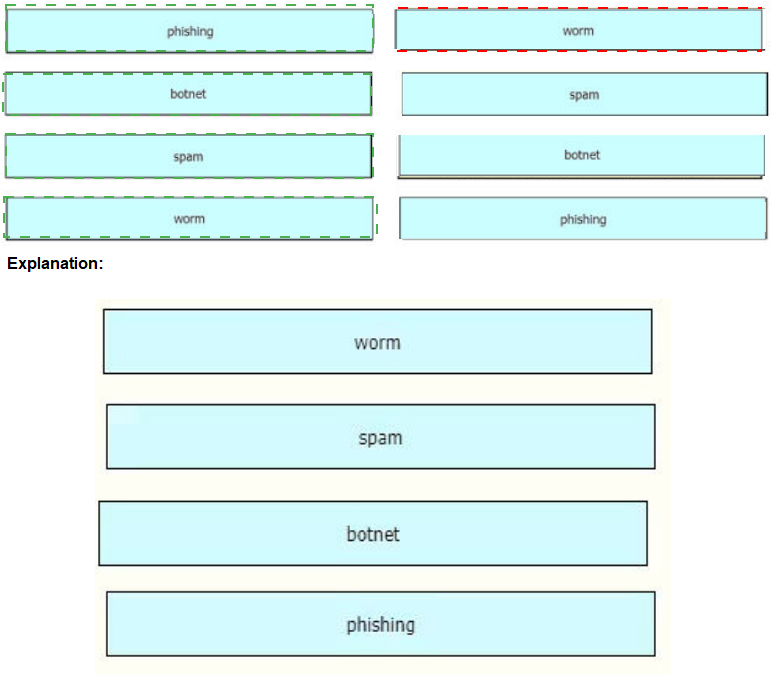
Drag and drop the common security threats from the left onto the definitions on the right.
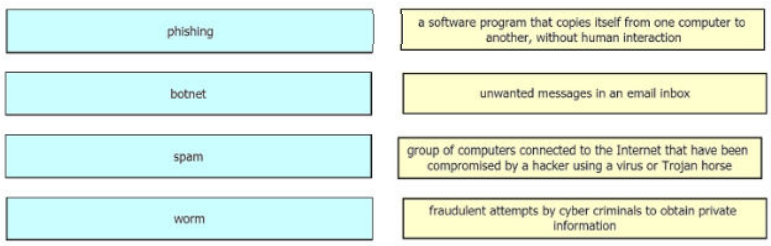
Show answerHide answer

Explanation

Question 20 Choose 1
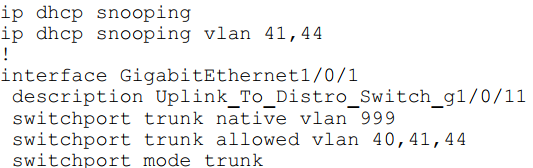
Refer to the exhibit.

An organization is using DHCP Snooping within their network. A user on VLAN 41 on a new switch is complaining that an IP address is not being obtained. Which command should be configured on the switch interface in order to provide the user with network connectivity?
Show answerHide answer

Correct answer: D ip dhcp snooping trust

Explanation

Explanation:
DHCP Snooping is a security feature that acts as a firewall between untrusted hosts and trusted DHCP servers.

How it works:
By default, DHCP Snooping treats all switch ports as untrusted. An untrusted port will block all DHCP server messages, such as DHCPOFFER and DHCPACK packets. This prevents rogue DHCP servers on the network.

The Problem:
The interface GigabitEthernet1/0/1 is the uplink to the distribution switch, which is almost certainly the path to the legitimate DHCP server. Because this port is untrusted, it is blocking the DHCP server's replies, which is why the user in VLAN 41 cannot obtain an IP address.

The Solution:
The uplink port that connects to the legitimate DHCP server (or to a network segment containing the server) must be configured as trusted. The command ip dhcp snooping trust applied to the uplink interface allows DHCP server responses to pass through the switch, enabling clients to receive their IP addresses.

Why the other options are incorrect:

A) ip dhcp snooping verify mac-address is INCORRECT.
This command enables a check to see if the source MAC address in an Ethernet frame matches the client MAC address in the DHCP request. It's a good security practice on access ports, but it does not solve the core problem of the DHCP server's responses being blocked on the uplink.

B) ip dhcp snooping limit 41 is INCORRECT.
This is not a valid command. The rate-limiting command is ip dhcp snooping limit rate.

C) ip dhcp snooping vlan 41 is INCORRECT.
This command is already configured globally for the switch (as seen in the running config: ip dhcp snooping vlan 41,44). It enables DHCP Snooping for the specified VLANs but does not define trusted interfaces. Applying it again on the interface would be incorrect syntax and would not solve the problem.

Reference:
Cisco IOS Security Configuration Guide: "Configuring DHCP Snooping": The official documentation states, "You must configure the connection between the switch and the DHCP server as trusted... You must configure all other ports as untrusted."
Full mock exam

Sit the 350-701 exam before exam day

Full-length mocks with the same number of questions and the same time limit as the real 350-701 exam. Every attempt draws a new set of questions from the full bank, so you can keep going until you pass comfortably.

Get full 350-701 mock exam
  • 90questions per mock
  • 120 mintime limit
  • 721questions in the bank
  • Newmock on every attempt