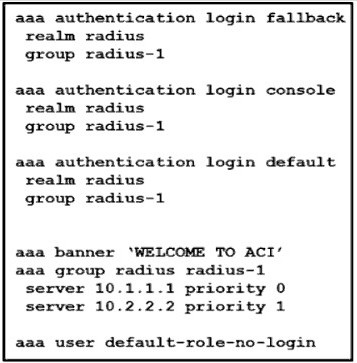
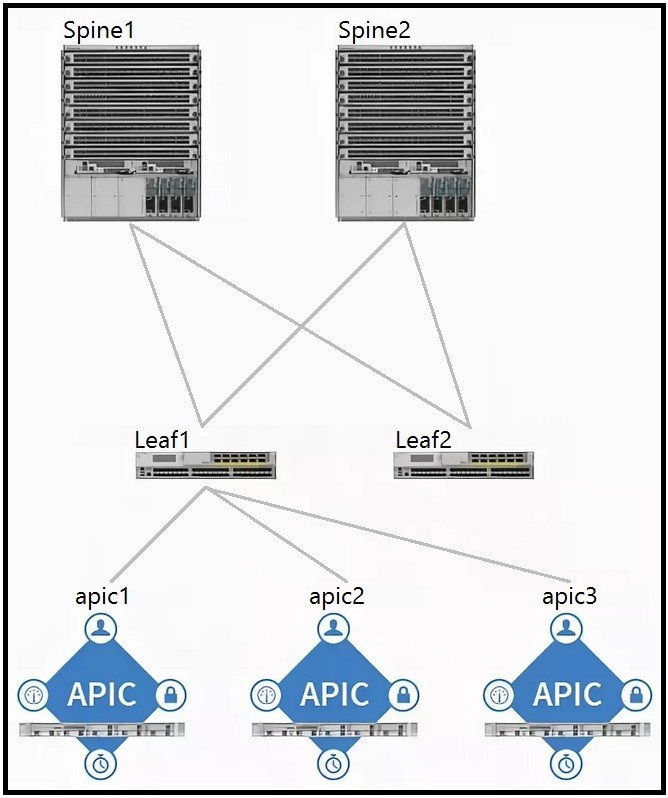
Refer to the exhibit

Which two objects are created as a result of the configuration? (Choose two.)
Which two objects are created as a result of the configuration? (Choose two.)
Show answerHide answer
Correct answer: C, E bridge domainVRF
Explanation
Explanation:The exhibit shows a configuration for an External Bridged Network (L2Out) connection. According to Cisco documentation, when creating a Layer 2 external connection, the configuration requires the creation of a VRF and a Bridge Domain to define the Layer 3 context and the Layer 2 domain that will be extended outside the fabric . The bridge domain is associated with the L2Out, and the VRF provides the routing context.
Correct Option:
C. bridge domain:
The bridge domain is a required object for L2Out configuration. It defines the Layer 2 domain that is being extended to the external network. The L2Out is associated with a specific bridge domain, allowing endpoints in that BD to communicate with external devices .
E. VRF:
The VRF (Virtual Routing and Forwarding) instance is also created as part of this configuration. The bridge domain references the VRF to provide the Layer 3 context for the tenant network. The VRF defines the routing domain for the endpoints in the bridge domain .
Incorrect Option:
A. application profile:
While an application profile is a common construct in ACI, it is not a direct result of creating an L2Out connection. Application profiles are used to group EPGs and define contracts, but the L2Out configuration itself does not create an application profile.
B. attachable AEP:
An Attachable Entity Profile (AEP) is used for access policies to define which VLANs and policies are applied to physical ports. While an AEP may be referenced or created for the physical connectivity of the L2Out, it is not a direct object created by the L2Out configuration itself .
D. endpoint group:
While an External EPG (l2extInstP) is created as part of the L2Out configuration, the option "endpoint group" typically refers to a standard application EPG. The L2Out creates an External Network object (External EPG), not a standard EPG. The question asks for objects created as a result of the configuration, and the core objects are the VRF and Bridge Domain.
Reference:
Cisco APIC REST API Configuration Guide — "Tenant External Bridged Networks": The configuration requires creating a VRF and a bridge domain. The bridge domain element subnets reference the corresponding Layer 3 context (VRF)