Salesforce certification · Exam Salesforce-Platform-Integration-Architect

Salesforce-Platform-Integration-Architect Mock Exam Page 4

Salesforce Platform Integration Architect (Plat-Arch-204)

Free Salesforce-Platform-Integration-Architect mock exam questions 31–36, each with the answer and an explanation.

20 questions · 35 minutes · free, no sign-up

Free Salesforce-Platform-Integration-Architect questions

31–36 of 36 free
Question 31 Choose 1
A large business-to-consumer (B2C) customer is planning to implement Salesforce CRM to become a customer-centric enterprise. Below is the B2C customer's current system landscape diagram.
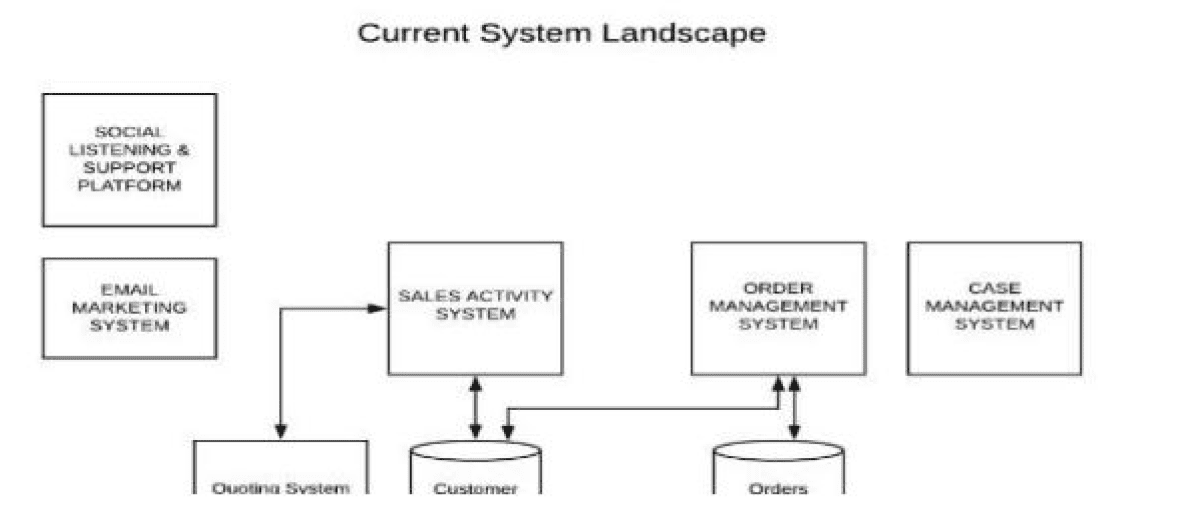
The goals for implementing Salesforce include:
Develop a 360-degree view of the customer.
Leverage Salesforce capabilities for marketing, sales, and service processes.
Reuse Enterprise capabilities built for quoting and order management processes.
Which three systems from the current system landscape can be retired with the implementation of Salesforce?
Show answerHide answer

Correct answer: C Email Marketing, Sales Activity, and Case Management

Explanation

Explanation:

The key to this question is matching the stated goals against which systems Salesforce natively replaces versus which systems must be reused and integrated with based on the explicit requirement.

The goals state:

Develop a 360-degree view of the customer
This is achieved by consolidating customer data into Salesforce.

Leverage Salesforce capabilities for marketing, sales, and service processes
This directly signals that Salesforce, through Marketing Cloud or Pardot capabilities, Sales Cloud, and Service Cloud, will replace the systems handling marketing, sales, and service or case functions.

Reuse enterprise capabilities built for quoting and order management processes
This explicitly states that the Quoting System and Order Management System should be kept and integrated with rather than replaced, because the company wants to leverage its existing enterprise investments in these capabilities.

Mapping this to the diagram:
Email Marketing System → replaced by Salesforce marketing capabilities → retire
Sales Activity System → replaced by Salesforce Sales Cloud → retire
Case Management System → replaced by Salesforce Service Cloud → retire

Social Listening & Support Platform → not explicitly called out in the goals; typically retained and integrated as a specialized tool rather than replaced by a core CRM function identified in the requirements.

Quoting System → explicitly called out to be reused, not retired

Order Management System → explicitly called out to be reused, not retired

Why not the others:

A. Order Management, Case Management, Email Marketing — Incorrect

Order Management is explicitly called out in the goals as a system whose capabilities should be reused and integrated, not retired.

B. Sales Activity, Order Management, Case Management — Incorrect

This has the same issue. Order Management should be retained according to the stated goal of reusing existing enterprise quoting and order management capabilities.

Key Exam Takeaway

When a scenario provides explicit business and architecture goals, map each system in the landscape diagram against those goals rather than assuming Salesforce will replace every existing system.

Here, the goals explicitly identify Quoting and Order Management as capabilities to integrate with and reuse, not decommission. This reflects a common enterprise architecture pattern in which Salesforce serves as the customer engagement and CRM layer while existing backend systems of record remain in place.

Reference
Salesforce Integration Patterns and Practices — Enterprise Architecture Considerations, including the CRM system-of-engagement model and integration with backend systems of record.
Question 32 Choose 1
Universal Containers (UC) is currently managing a custom monolithic web service that runs on an on-premise server. This monolithic web service is responsible for Point-to-Point (P2P) integrations between Salesforce and a legacy billing application, a cloud-based ERP, and a data lake. UC has found that the tight interdependencies are causing failures. What should an integration architect recommend to decouple the systems and improve performance?
Show answerHide answer

Explanation

Explanation:

The core problem described is architectural: a monolithic web service handling multiple P2P integrations (Salesforce ↔ billing, Salesforce ↔ ERP, Salesforce ↔ data lake) has created tight interdependencies, meaning a failure or change in one integration point can cascade and impact the others. This is a classic symptom of monolithic, point-to-point integration architecture — lack of isolation, fragile coupling, and poor scalability/resilience.

The recommended fix is to decompose the monolith into smaller, independent, purpose-specific services (a microservices approach) — each service handling one integration concern (e.g., a Billing integration service, an ERP integration service, a Data Lake integration service). This achieves:

Decoupling: A failure in the billing integration no longer takes down the ERP or data lake integrations
Independent scalability: Each service can be scaled, deployed, and maintained on its own release cycle
Improved performance: Smaller, focused services are easier to optimize, troubleshoot, and don't compete for shared resources/threads within a single monolithic process
Better fault isolation: Failures are contained to the specific integration domain rather than cascading across the whole system

This directly addresses the stated problem — tight interdependencies causing failures — by breaking the tight coupling at the architectural level.

Why not the others:
A (Use Bulk API for integrating back into Salesforce) — The Bulk API is useful for high-volume data loads to improve throughput/performance for large datasets, but it doesn't address the root cause here: the tight coupling and interdependency between the three separate integrations within a single monolithic service. Switching an API type doesn't decouple the systems.

B (Move the service from on-premise to cloud) — This is an infrastructure/hosting change, not an architectural change. Moving a monolith to the cloud might improve availability, scalability of compute, or reduce on-prem maintenance burden, but the fundamental problem of tight coupling between the three integrations within the same codebase/service remains unchanged — a monolith in the cloud is still a monolith. This doesn't solve the stated issue of interdependency-caused failures.

Key exam takeaway:
When a question describes monolithic integration architecture causing cascading failures or tight coupling, the answer almost always points toward decomposition into microservices / modular services — this is a fundamental integration architecture principle (isolate concerns, reduce blast radius, enable independent scaling and deployment) tested repeatedly on this exam.

Reference:
Salesforce Integration Patterns and Practices — "Enterprise Integration Patterns" / Microservices Architecture principles.
Question 33 Choose 1
Northern Trail Outfitters (NTO) has recently changed its Corporate Security Guidelines. The guidelines require that all cloud applications pass through a secure firewall before accessing on-premise resources. NTO is evaluating middleware solutions to integrate cloud applications with on-premise resources and services. Which consideration should an integration architect evaluate before choosing a middleware solution?12
Show answerHide answer

Correct answer: A An API Gateway component is deployable behind a Demilitarized Zone (DMZ) or perimeter network.

Explanation

Explanation

A. An API Gateway component is deployable behind a DMZ or perimeter network — Correct

The key requirement is that cloud applications must pass through a secure firewall before accessing on-premise resources.

This is primarily a network architecture and perimeter-security requirement, not simply an authentication requirement.

An API Gateway can be positioned in a DMZ/perimeter network, creating a controlled boundary between cloud-facing integrations and the internal on-premise network:

Cloud Applications → API Gateway in DMZ → Firewall → On-Premise Resources

This allows NTO to expose only the required integration endpoints while keeping internal resources behind the corporate firewall.

Salesforce architecture guidance emphasizes that remote/on-premise systems should be protected with appropriate firewall mechanisms and discusses gateways/reverse proxies as security components for controlling traffic between cloud and on-premise environments.

Why the other options are incorrect

B. Middleware can interface directly with databases via an ODBC connection string — Incorrect

Direct database connectivity may be a useful technical capability, but it does not address the stated security requirement.

The question specifically says that all cloud applications must pass through a secure firewall before accessing on-premise resources. Direct database connectivity does not inherently provide the required network boundary or DMZ architecture.

Therefore, database/ODBC support is not the primary consideration for this requirement.

C. Middleware enforces OAuth — Incorrect

OAuth is important for authentication/authorization, particularly for API-based integrations. Salesforce architecture guidance recommends OAuth 2.0 for authorization when integrating with external systems.

However, OAuth does not determine where the middleware is deployed in relation to the firewall.

The requirement is specifically about ensuring that cloud-to-on-premise traffic crosses a controlled security boundary. That makes the middleware's ability to support a DMZ/perimeter deployment the relevant consideration.
Question 34 Choose 1
A new Salesforce program requires data updates between internal systems and Salesforce. Which relevant detail should an integration architect seek to solve for integration architecture needs?
Show answerHide answer

Correct answer: C Timing aspects, real-time/near real-time (synchronous or asynchronous), batch and update frequency

Explanation

Explanation:

Why C is correct:
When designing an integration architecture, determining the timing and data flow characteristics is foundational. An integration architect must immediately establish whether data synchronization needs to happen synchronously (real-time request-reply for immediate user feedback) or asynchronously (fire-and-forget, batch, or event-driven for high-volume or decoupled processing). These timing constraints directly dictate the integration patterns (e.g., REST API vs. Bulk API vs. Platform Events) and technology components required.

Why A is incorrect:
While encryption needs are relevant to security, options like User Experience (UX) design, community structures, and license choices lean heavily into functional platform configuration and UX/Architecture design rather than the core plumbing of data movement between internal systems and Salesforce.

Why B is incorrect:
Integration skills, subject matter expert (SME) availability, and program governance pertain to project management, resource allocation, and operating models, not the technical design parameters of the integration architecture itself.

Reference:
Salesforce Pattern: Integration Patterns and Practices / Data Integration Strategies
Salesforce Documentation: Choosing the Right Integration Pattern
Question 35 Choose 1
Northern Trail Outfitters has a registration system that is used for workshops offered at its conferences. Attendees use Salesforce Community to register for workshops, but the scheduling system manages workshop availability based on room capacity. It is expected that there will be a big surge of requests for workshop reservations when the conference schedule goes live. Which integration pattern should be used to manage the influx in registrations?
Show answerHide answer

Correct answer: A Remote Process Invocation Fire and Forget

Explanation

Explanation

When the conference schedule goes live, a large surge of simultaneous registration requests is expected from the Salesforce Community. The external scheduling system is the system of record for room capacity and must ultimately accept or reject each reservation.

Remote Process Invocation – Fire and Forget is the appropriate pattern because:

Salesforce (or the Community) can immediately accept the registration request, publish it (via Platform Event, Outbound Message, or a call to middleware), and return control to the user without waiting for the scheduling system.

Middleware can queue the requests and process them at a controlled rate that the scheduling system can handle.

The pattern protects Salesforce from concurrent long-running callout limits and protects the external system from being overwhelmed.

Confirmation (or rejection) can be sent back later asynchronously (e.g., via Platform Event, email, or a subsequent status update in the Community).

This decouples the high-volume front-end experience from the capacity-constrained back-end system.

Why the other options are less suitable

B. Batch Data Synchronization
Batch is for periodic bulk data movement, not for handling an interactive registration surge. Users expect near-real-time feedback on their reservation attempt.

C. Remote Process Invocation Request and Reply
A synchronous request-reply callout for every registration would hold Salesforce transaction threads open while waiting for the scheduling system. Under a sudden surge this quickly hits concurrent request / callout limits and creates a poor user experience if the external system slows down.
Question 36 Choose 1
Northern Trail Outfitters (NTO) has recently changed its Corporate Security Guidelines. The guidelines require that all cloud applications pass through a secure firewall before accessing on-premise resources. NTO is evaluating middleware solutions to integrate cloud applications with on-premise resources and services. Which consideration should an integration architect evaluate before choosing a middleware solution?
Show answerHide answer

Correct answer: A The middleware solution is capable of establishing a secure API Gateway between cloud applications and on-premise resources.

Explanation

Explanation:

NTO’s updated Corporate Security Guidelines mandate that all cloud applications must pass through a secure firewall before they can reach any on-premise resources or services. This is a classic hybrid-cloud security requirement: traffic originating outside the corporate network cannot have unrestricted or direct access to internal systems.

When evaluating middleware for cloud-to-on-premise integration, the architect must therefore confirm that the middleware can sit in (or create) a controlled, secure path that satisfies the firewall rule. A secure API Gateway capability does exactly that:

It acts as the controlled entry/exit point.
All cloud-initiated traffic is forced through the gateway (and therefore through the firewall policies).
The gateway can enforce authentication, authorization, encryption, rate limiting, protocol translation, and logging before any request reaches the on-premise systems.

This design keeps the architecture compliant with the new security guideline while still enabling the required integrations.

Why the other options are incorrect

B. The middleware solution enforces the OAuth security protocol.
OAuth is an authorization framework and is certainly useful, but it does not address the core requirement of forcing traffic through a secure firewall. A solution could support OAuth yet still allow direct or unsecured connections that violate the guideline.

C. The middleware solution is able to interface directly with databases via an Open Database Connectivity (ODBC) connection string.
Direct ODBC connections from the cloud to on-premise databases typically bypass application-layer controls and are precisely the kind of open path the new firewall policy is designed to prevent. This approach would usually be non-compliant.

Key takeaway for the exam
When a scenario emphasizes a secure firewall / perimeter control between cloud and on-premise systems, look for the answer that positions the middleware as a controlled gateway (API Gateway, reverse proxy, secure tunnel, etc.) rather than focusing only on authentication protocols or direct database connectivity.

That's the last free question

You've seen the free 30% (36 of 124 questions). Full access unlocks every question and full-length Salesforce-Platform-Integration-Architect mock exams (60 questions, 105 minutes), a different mock on every attempt.

Unlock full mock exam
Full mock exam

Sit the Salesforce-Platform-Integration-Architect exam before exam day

Full-length mocks with the same number of questions and the same time limit as the real Salesforce-Platform-Integration-Architect exam. Every attempt draws a new set of questions from the full bank, so you can keep going until you pass comfortably.

Get full Salesforce-Platform-Integration-Architect mock exam
  • 60questions per mock
  • 105 mintime limit
  • 124questions in the bank
  • Newmock on every attempt