Salesforce certification · Exam Salesforce-Platform-Foundations

Salesforce-Platform-Foundations Mock Exam

Salesforce Platform Foundations

Find out if you're ready for Salesforce-Platform-Foundations. Take the free timed mock exam and get your score in minutes, or study the free Salesforce-Platform-Foundations questions below with answers and explanations.

20 questions · 35 minutes · free, no sign-up

Free Salesforce-Platform-Foundations questions

1–10 of 36 free
Question 1 Choose 1
An insurance call center is experiencing increased policy support callswhich hasled to long wait times and disappointed customers.
Which cloud will decrease the number of incoming calls, empower customers, and increase satisfaction?
Show answerHide answer

Correct answer: B Experience

Explanation

Explanation:

🧠 Why This Is Correct
Salesforce Experience Cloud (formerly Community Cloud) enables organizations to build self-service portals, customer communities, and support forums that empower customers to:
Find answers on their own via knowledge articles, FAQs, and peer discussions
Submit and track support cases
Access policy details, claims, and account information
This reduces the volume of incoming calls and improves customer satisfaction by offering 24/7 access to support resources.

📘 References:
What Is Experience Cloud? – Salesforce Help
Empower Customer Engagement with Experience Cloud

❌ Why the Other Choices Are Wrong
A. CRM Analytics
CRM Analytics provides insights and dashboards for supervisors and managers. It helps analyze call center performance but does not directly reduce call volume or empower customers.
C. Sales Cloud
Sales Cloud is focused on sales processes, lead management, and opportunity tracking. It’s not designed for customer self-service or support call reduction.

🎯 Exam Tip
This question tests your understanding of Salesforce product fit for service scenarios.
Use Experience Cloud for customer empowerment and case deflection
Use CRM Analytics for internal performance insights
Use Sales Cloud for sales automation
Question 2 Choose 1
Get Cloudy Consulting requires a value in the Status field every time a record is created or edited. What should they do to enforce this?
Show answerHide answer

Correct answer: A Make the field required in Object Manager.

Explanation

Explanation:

Option A (Correct) – In Object Manager, you can set a field as required, which forces users to enter a value before saving a record (both on creation and edits). This is the simplest and most direct way to enforce a mandatory field.
Option B (Incorrect) – A validation rule could technically enforce this, but it’s unnecessary for basic field requirements. Validation rules are better for complex logic (e.g., "Status must be 'Closed' if the Opportunity Amount is > $10,000").
Option C (Incorrect) – Organization-Wide Defaults (OWD) control record-sharing visibility, not field requirements. This option is irrelevant to the question.

Reference:
Salesforce Help - Make a Field Required
Question 3 Choose 1
Get Cloudy Consulting (GCC) provides consulting servicesto smalland medium-sized business in the financial services space. GCC wants a solution for customer service where complaints can be logged through a web from and email.
Which Salesforce solution should GCC use?
Show answerHide answer

Correct answer: C Service cloud

Explanation

Explanation:

Service Cloud is the ideal Salesforce solution for this scenario because it is specifically designed for customer service and support operations. The core function of Service Cloud is to manage customer inquiries, issues, and complaints, which are known as cases in Salesforce. The ability to log complaints through a web form and email are standard, out-of-the-box features of Service Cloud.

Detail:
Core Concept: The question tests your understanding of the different Salesforce Clouds and their primary use cases. This is a fundamental concept for the Platform Foundations exam. You need to be able to match a business need (customer service) with the correct Salesforce product.

How it Works in Salesforce:
Web-to-Case: This feature allows an administrator to generate an HTML form that can be embedded on a company's website. When a customer fills out and submits this form, it automatically creates a new case record in Salesforce. This is how the "complaints logged through a web form" requirement is met.
Email-to-Case: This feature automatically creates a new case record from an email sent to a designated company support address (e.g., support@getcloudyconsulting.com). The body of the email becomes the case description, and the sender is associated with a contact or lead. This satisfies the "complaints logged through...email" requirement.
Exceptions/Limitations: While Web-to-Case and Email-to-Case are powerful, they have limitations. For example, there's a daily limit on the number of cases that can be created via these methods.

Incorrect Answers
A. Commerce Cloud
Why it's wrong: Commerce Cloud is designed for e-commerce. It helps businesses create online stores, manage product catalogs, process orders, and handle the entire digital shopping experience. While customer service is a part of the commerce lifecycle, Commerce Cloud itself doesn't provide the core case management tools needed to track and resolve complaints in a structured way.
B. Experience Cloud
Why it's wrong: Experience Cloud (formerly Community Cloud) is used to create branded digital experiences, such as customer portals and partner communities. You could certainly build a customer portal with a web form for complaints using Experience Cloud. However, the underlying functionality that processes these complaints and turns them into trackable cases is still a feature of Service Cloud. Experience Cloud is the front-end portal, while Service Cloud is the back-end system for managing the cases created from that portal. Service Cloud is the more direct and comprehensive solution for the business problem.

Reference:
Trailhead Module: Service Cloud for the Salesforce Administrator
Salesforce Help: Web-to-Case and Email-to-Case

Real-World Scenario
Get Cloudy Consulting wants to streamline its customer complaint process. Instead of having customer service reps manually create a new case every time a client sends an email or fills out a contact form, they can use Service Cloud. The admin sets up Email-to-Case so that any email to support@getcloudyconsulting.com automatically creates a new case and assigns it to a support queue. The admin also creates a Web-to-Case form, embeds it on their website's "Contact Us" page, and configures it to automatically create cases for new complaints. This ensures that all complaints are logged consistently, routed correctly, and tracked efficiently until they are resolved.
Question 4 Choose 1
Get Cloudy Consulting (GCC) wants to customize its Sales application’s Home tab with additional components. Outside of the org, where should GCC' Salesforce associate go to collaborate with others on solutions that might resonate with GCC users?
Show answerHide answer

Correct answer: B Ask a question In a Trailblazer Community Group.

Explanation

Explanation:

When Get Cloudy Consulting (GCC) wants to collaborate with others outside of their org to find solutions that resonate with users, the Trailblazer Community is the ideal place. It’s a vibrant forum where Salesforce professionals, admins, developers, and consultants share ideas, ask questions, and offer solutions based on real-world experience.
Trailblazer Community Groups are organized by role, product, region, and interest.
GCC’s associate can post questions, join discussions, and even attend virtual or in-person meetups.
This is especially useful for customization ideas, best practices, and peer feedback.

📚 Why Not the Other Options?
A. Help and Training
Good for official documentation, but not collaborative. It’s more of a reference than a discussion space.
C. Trailhead Modules
Excellent for learning, but not interactive. You can’t ask questions or get feedback from others.

📎 Reference:
Trailblazer Community Overview – Salesforce Help
Join a Trailblazer Group – Trailblazer Community
Question 5 Choose 1
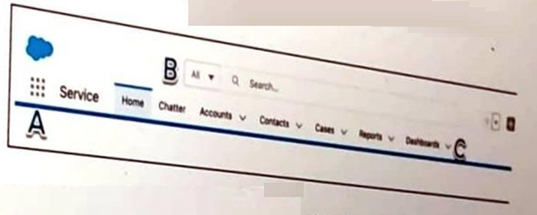
Refer to the screenshot that shows the top portion of the Salesforce Service app with areas labeled A, B, and C.


Get Cloudy Consulting (GCC) offers sales and services consoles to meet the various needs of its end users?
Where should GCC' end users go to change to the Sales Console.
Show answerHide answer

Correct answer: A App Launcher icon (Label A)

Explanation

Explanation:

Why this is correct
The App Launcher (labeled A in the screenshot) is the grid icon in Salesforce Lightning Experience that lets users switch between different apps, such as the Service Console and Sales Console.
For GCC’s scenario:
End users currently in the Service Console can click the App Launcher.
They can then search for or select Sales Console to switch apps.
This is the standard method for navigating to a different console app in Salesforce.
📖 Salesforce Documentation:
“Use the App Launcher to switch between apps and find the items and data you need.”
Salesforce Help: App Launcher

Why the other options are incorrect
B. Search bar (Label B) ❌
The search bar is for finding records, objects, and other resources within Salesforce, not for switching between apps.
C. A dropdown in the navigation bar (Label C) ❌
The navigation bar dropdown customizes tabs within the current app but does not change to a different app, like the Sales Console.
Question 6 Choose 1
Salesforce associate received a promotion and needs Edit access to fields on opportunity records across the organization. Which user setting need updating to allow Edit access?
Show answerHide answer

Correct answer: B Permission Set

Explanation

Explanation:

In Salesforce, field-level permissions and record-level access are controlled through a combination of profiles and permission sets.
If a Salesforce associate needs Edit access to specific fields (or entire records) across the organization, an administrator can:
Update the user’s profile, or
Assign a permission set that grants the needed “Edit” permissions for the Opportunity object or its fields.
Permission sets are preferred when you want to grant additional permissions without changing the user’s base profile.

Key point:
This is about user settings for access rights, not record ownership or grouping.

Why not the other options?
A. Queue ❌
Queues are for managing ownership of records (e.g., unassigned leads or cases), not for granting editing permissions.
C. Public Group ❌
Public Groups are used for sharing rules and collaboration (e.g., in Chatter or folder access), but they don’t inherently give field-level “Edit” permissions.

Reference:
Salesforce Help: Permission Sets Overview– See how to extend user access without modifying profiles.
Question 7 Choose 1
Get Cloudy Consulting currently stores information about is customers and partners in the Account object. There are a few details specific to partners that are not applicable to customers. What is the recommended way to display only the information application to each group?
Show answerHide answer

Correct answer: B Create record types on Account called Partner and Customer

Explanation

Explanation:

Option B (Correct) – Record types allow you to segment data within the same object while displaying different fields, page layouts, and picklist values based on the record type. Since both customers and partners are logically stored in the Account object, using record types is the most efficient and scalable solution.

Benefits:
Avoids data duplication (unlike creating a custom object).
Maintains reporting consistency (all accounts remain in one object).
Allows for different page layouts and business processes for each type.

Option A (Incorrect) – Creating a custom object for partners would unnecessarily complicate data management. Since partners are still accounts (just with different attributes), splitting them into a separate object would:
Break standard Salesforce relationships (Contacts, Opportunities).
Require extra reporting and integration work.

Option C (Incorrect) – Similar to Option A, this suggests creating two separate custom objects, which is redundant and inefficient. The Account object already supports this use case via record types.

Reference:
Salesforce Help - Record Types
Question 8 Choose 1
Get Cloudy Consulting (GCC) has recently been onboarded as aSalesforce customer. GCC wants to enroll its in-house IT administration team in a Salesforce instructor-led training workshop. Which resource provides virtual and in-person learning that should help the team accelerate their Salesforce knowledge?
Show answerHide answer

Correct answer: C Trailhead Academy

Explanation

Explanation:

Get Cloudy Consulting (GCC) is looking to enroll its in-house IT administration team in a Salesforce instructor-led training workshop that offers both virtual and in-person learning to accelerate their Salesforce knowledge. Among the provided options, Trailhead Academy is the resource that best fits this requirement, as it provides expert-led, instructor-driven training sessions in both virtual and in-person formats, tailored to build and validate Salesforce skills.

Option A: Trailhead Community
The Trailhead Community is a collaborative platform where Salesforce users, including admins, developers, and other professionals, can connect, ask questions, share knowledge, and collaborate with peers. While it’s valuable for peer-to-peer learning and networking, it does not offer structured, instructor-led training workshops, either virtually or in-person.
Why this is incorrect: The Trailhead Community focuses on community-driven support and discussions, not formal instructor-led training, which doesn’t meet GCC’s need for a structured workshop.

Option B: Salesforce Help
Salesforce Help is the official documentation portal that provides detailed guides, articles, and resources on Salesforce features, configurations, and troubleshooting. It’s an excellent self-service resource for learning, but it does not offer instructor-led training workshops, whether virtual or in-person.
Why this is incorrect: Salesforce Help is a self-paced resource and does not provide the interactive, expert-led training experience GCC is seeking.

Option C: Trailhead Academy
Trailhead Academy is Salesforce’s official training program that offers instructor-led classes, both virtual and in-person, delivered by certified Salesforce experts. These workshops cover a wide range of topics, including Salesforce administration, and are designed to accelerate learning for teams and individuals. Courses like ADX201 (Essentials for New Lightning Experience Administrators) are specifically tailored for IT administration teams to build foundational and advanced Salesforce skills.
Why this is correct: Trailhead Academy directly addresses GCC’s need for instructor-led training workshops available in both virtual and in-person formats, making it the ideal resource to help the IT administration team accelerate their Salesforce knowledge.

Reference:
Salesforce Trailhead Academy: Trailhead Academy Overview – Describes Trailhead Academy as offering virtual and in-person instructor-led classes to build Salesforce expertise.
Salesforce Help Documentation: Trailhead Academy for Admins – Highlights how Trailhead Academy provides structured training for Salesforce administrators.
Trailhead Module: Salesforce Fundamentals – Introduces learning paths, including Trailhead Academy for expert-led training.
Question 9 Choose 1
A Salesforce associate at Get Cloudy Consulting is working with a user to view multiple records and their related records on the same screen. Currently, the user uses multiple browser tabs. Which app should the associate recommend for the user to view multiple records and their related records on one screen?
Show answerHide answer

Correct answer: B Salesforce Lightning Console

Explanation

Explanation:

Option B (Correct) – The Salesforce Lightning Console App is specifically designed for users who need to work with multiple records and their related records on a single screen. It provides a tabbed interface, allowing users to:
Open multiple records in sub-tabs within the same window.
View related lists and details side-by-side.
Improve productivity by reducing the need for multiple browser tabs.
This is ideal for support agents, sales reps, or consultants who need to cross-reference data efficiently.

Option A (Incorrect) – A Salesforce Lightning Page (like a Home Page or Record Page) displays a single record’s details but does not support multiple records in a tabbed layout like the Console App.

Option C (Incorrect) – A Dashboard provides visual summaries of data (charts, metrics) but does not allow direct interaction with multiple records and their related details in one view.

Reference:
Salesforce Help - Lightning Console App
Question 10 Choose 1
Get Cloudy Consulting is rolling out Salesforce to its organization. New users may have different access requirements base on department. What should be recommended to allow new users the correct access based on their department’s requirements?
Show answerHide answer

Correct answer: C Permission sets

Explanation

Explanation:

Get Cloudy Consulting is implementing Salesforce and needs to provide new users with appropriate access based on their department’s requirements. The most effective and flexible way to achieve this is by using permission sets, which allow administrators to grant specific permissions and access levels to users without modifying their profiles. This approach is ideal for accommodating varying access needs across departments while maintaining scalability and ease of management.

Option A: Role Hierarchy
The Role Hierarchy in Salesforce controls record-level access and data visibility based on a user’s position in the organizational structure. It determines which records users can access (e.g., their own records or those of subordinates) through sharing rules and ownership. While useful for managing data visibility, the role hierarchy does not directly address field-level permissions, object access, or other granular access requirements that may vary by department.
Why this is incorrect: The role hierarchy is primarily for record-level access and data sharing, not for assigning specific permissions like object or field access, which are likely needed to meet department-specific requirements.

Option B: Individual profiles
Profiles in Salesforce define a baseline set of permissions for users, including access to objects, fields, tabs, and apps, as well as system permissions like “View All Data” or “Modify All Data.” Creating individual profiles for each department could theoretically work, but it’s not practical or scalable. Managing multiple profiles for each department’s unique requirements would lead to administrative overhead, as profiles are rigid and each user can only be assigned one profile.
Why this is incorrect: Using individual profiles is inefficient and cumbersome for managing department-specific access, especially as the number of departments or requirements grows.

Option C: Permission sets
Permission sets allow administrators to bundle specific permissions (e.g., access to objects, fields, record types, or apps) and assign them to users on top of their existing profiles. This enables Get Cloudy Consulting to assign a standard profile to users (e.g., “Standard User”) and then use permission sets to grant additional, department-specific access as needed. For example, the Sales department might need access to Opportunities, while the Marketing department needs access to Campaigns, and permission sets can handle these differences efficiently.
Why this is correct: Permission sets are flexible, reusable, and scalable, making them the best solution for tailoring access to meet department-specific requirements without creating multiple profiles.

Reference:
Salesforce Help Documentation: Permission Sets – Explains how permission sets provide granular, user-specific permissions on top of profiles.
Trailhead Module: Data Security – Covers profiles, permission sets, and role hierarchies, emphasizing permission sets for flexible access control.
Salesforce Help Documentation: Role Hierarchy – Describes the role hierarchy’s focus on record-level access and data visibility.
Trailhead Module: User Management – Discusses managing user access with profiles and permission sets, recommending permission sets for department-specific needs.
Full mock exam

Sit the Salesforce-Platform-Foundations exam before exam day

Full-length mocks with the same number of questions and the same time limit as the real Salesforce-Platform-Foundations exam. Every attempt draws a new set of questions from the full bank, so you can keep going until you pass comfortably.

Get full Salesforce-Platform-Foundations mock exam
  • 40questions per mock
  • 70 mintime limit
  • 122questions in the bank
  • Newmock on every attempt

Exam Domains Covered in This Practice Test


This free Salesforce Certified Platform Foundations practice test is mapped to the official Salesforce exam blueprint (Plat-101). Every question in this practice bank is tagged to one of the four weighted domains below, so you can identify which areas need more study time before exam day.

Platform Foundations Exam Blueprint Coverage
Exam Domain Official Weight What It Tests
Salesforce Ecosystem 32% Salesforce Customer 360 product offerings and use cases, how companies use Salesforce, job roles and career paths in the ecosystem, and resources available to learn and apply Salesforce skills (Trailhead, Trailblazer Community, AgentExchange). The largest domain on the exam.
Navigation 28% Locating and accessing information in Lightning Experience (Global Search, list views, apps, user settings), and identifying where customization takes place in Setup (Object Manager, Lightning App Builder, user management).
Data Model 25% Core standard objects (Account, Contact, Lead, Opportunity, Case) and their relationships, field types, page layouts, record types, data visibility and access control, and data integrity tools (validation rules, picklists).
Reports & Dashboards 15% Report formats (tabular, summary, matrix, joined), report types, filters and groupings, report folders, dashboard components and refresh behavior, and how to visualize business data for stakeholders.

What You Will Learn by Practicing Here


  • Understand the Salesforce Ecosystem : the largest domain at 32%, covering Customer 360 products, career paths, and the learning resources that help you grow in the platform.
  • Navigate Lightning Experience confidently : Global Search, list views, user settings, and the distinction between what users do in the UI versus what admins configure in Setup.
  • Map the core data model : how Account, Contact, Lead, Opportunity, and Case relate to each other, and why this matters for reporting and data quality.
  • Apply data visibility and integrity tools : understanding which features control who sees what (sharing, profiles) versus which features ensure data stays clean (validation rules, picklists).
  • Build and interpret reports : distinguishing tabular vs. summary vs. matrix vs. joined formats, and knowing when each format answers a business question.
  • Understand dashboard components : recognizing that each component is based on a single source report and requires a manual refresh unless scheduled.

How to Use This Practice Test


  1. Start with Salesforce Ecosystem (32%). Take the untimed questions tagged to "Customer 360," "Career Paths," and "Learning Resources" first. This is the highest-weighted domain and the foundation for everything else.
  2. Audit your navigation logic. For "Navigation" questions (28%), ask yourself: could I explain where a user finds a record vs. where an admin customizes a field? The exam tests the boundary between user actions and Setup configuration.
  3. Trace the data model relationships. For "Data Model" questions (25%), verify you can describe how a Lead converts into an Account, Contact, and Opportunity, and why Case is related to Account but not Lead.
  4. Distinguish visibility from integrity. The Data Model domain tests both "who can see this record?" (sharing, org-wide defaults) and "is this data valid?" (validation rules, picklist dependencies). Know which tool solves which problem.
  5. Practice report format selection. For "Reports & Dashboards" questions (15%), verify you can explain why a summary report fits a grouped analysis but a matrix report fits a cross-tab comparison.
  6. Run the timed simulator.Switch to the timed simulator to build stamina for 40 questions in 70 minutes.

Domain weights reflect the official Salesforce Platform Foundations exam guide. The exam contains 40 scored multiple-choice questions plus up to 5 unscored questions, with a 70-minute time limit and a passing score of 62%. The certification was formerly named Salesforce Certified Associate.


Why Choose Salesforceexams.com for Your Salesforce Certified Platform Foundations Exam (Plat-101)?

Old Name: Salesforce Certified Associate


Feature Salesforceexams.com Generic Study Platforms
Realistic Practice Test Format Matches actual Plat-101 exam structure and difficulty Often too simple or outdated
Detailed Explanations Every answer includes clear, easy-to-understand reasoning Limited or no explanations
Topic-Wise Coverage Covers all domains: Navigation, Data, Reports, CRM May skip essential Associate-level topics
Performance Tracking Identifies strengths and weaknesses automatically Little to no performance feedback
Updated Questions Regularly updated to reflect latest exam changes Static and sometimes outdated content
First-Time Pass Support Designed to maximize your chances on the first try No guarantee of readiness


Our Wall of Fame 🏆


New to Salesforce, Ahmed turned to Salesforceexams.com to prepare for the Salesforce Platform Foundations exam. The practice tests simplified complex topics like standard vs. custom objects and user interface navigation. After just a few days of focused practice, he felt confident and aced the exam on his first attempt.

Olivia built a strong foundation in CRM basics, Salesforce navigation, and data management. The test helped her identify weaker topics like reporting and dashboards, allowing her to focus her revision. With structured preparation, she passed the Salesforce Platform Foundations exam confidently on her first try.

Just starting my Salesforce journey? Start here. Salesforceexams.com helped me nail the fundamentals from org setup to security basics. The practice tests were straightforward and built my confidence for the real thing. Passed on my first try.
Brandon Lee, New Admin | Phoenix, AZ