Splunk certification · Exam SPLK-1005

SPLK-1005 Mock Exam Page 3

Splunk Cloud Certified Admin

Free SPLK-1005 mock exam questions 21–24, each with the answer and an explanation.

20 questions · 33 minutes · free, no sign-up

Free SPLK-1005 questions

21–24 of 24 free
Question 21 Choose 1
At what point in the indexing pipeline set is SEDCMD applied to data?
Show answerHide answer

Correct answer: D In the typing pipeline

Explanation

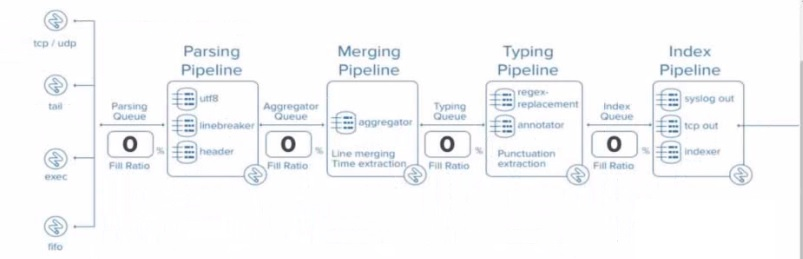
Explanation: In Splunk, SEDCMD (Stream Editing Commands) is applied during the Typing Pipeline of the data indexing process. The Typing Pipeline is responsible for various tasks, such as applying regular expressions for field extractions, replacements, and data transformation operations that occur after the initial parsing and aggregation steps.
Here’s how the indexing process works in more detail:
Parsing Pipeline: In this stage, Splunk breaks incoming data into events, identifies timestamps, and assigns metadata.
Merging Pipeline: This stage is responsible for merging events and handling timebased operations.
Typing Pipeline: The Typing Pipeline is where SEDCMD operations occur. It applies regular expressions and replacements, which is essential for modifying raw data before indexing. This pipeline is also responsible for field extraction and other similar operations.
Index Pipeline: Finally, the processed data is indexed and stored, where it becomes available for searching.
Splunk Cloud Reference: To verify this information, you can refer to the official Splunk documentation on the data pipeline and indexing process, specifically focusing on the stages of the indexing pipeline and the roles they play. Splunk Docs often discuss the exact sequence of operations within the pipeline, highlighting when and where commands like SEDCMD are applied during data processing.
Question 22 Choose 1
When should Splunk Cloud Support be contacted?
Show answerHide answer

Correct answer: C When unable to resolve issues or perform problem isolation.

Explanation

Explanation: Splunk Cloud Support should be contacted when issues arise that cannot be resolved internally or when problem isolation has been unsuccessful.
C. When unable to resolve issues or perform problem isolation is the correct answer. Splunk Cloud Support is typically involved when internal troubleshooting has been exhausted, and the issue requires expert assistance or deeper investigation. While scripted input troubleshooting might be handled by internal teams, contacting support for unresolved issues is the appropriate step.
Question 23 Choose 1
When a forwarder phones home to a Deployment Server it compares the check-sum value of the forwarder's app to the Deployment Server's app. What happens to the app If the check-sum values do not match?
Show answerHide answer

Correct answer: A The app on the forwarder is always deleted and re-downloaded from the Deployment Server.

Explanation

Explanation: When a forwarder phones home to a Deployment Server, it compares the checksum of its apps with those on the Deployment Server. If the checksums do not match, the app on the forwarder is always deleted and re-downloaded from the Deployment Server. This ensures that the forwarder has the most current and correct version of the app as dictated by the Deployment Server.
Question 24 Choose 1
When monitoring directories that contain mixed file types, which setting should be omitted from inputs, conf and instead be overridden in propo.conf?
Show answerHide answer

Correct answer: A sourcetype

Explanation

Explanation: When monitoring directories containing mixed file types, the sourcetype should typically be overridden in props.conf rather than defined in inputs.conf. This is because sourcetype is meant to classify the type of data being ingested, and when dealing with mixed file types, setting a single sourcetype in inputs.conf would not be effective for accurate data classification. Instead, you can use props.conf to define rules that apply different sourcetypes based on the file path, file name patterns, or other criteria. This allows for more granular and accurate assignment of sourcetypes, ensuring the data is properly parsed and indexed according to its type.
Splunk Cloud Reference: For further clarification, refer to Splunk's official documentation on configuring inputs and props, especially the sections discussing monitoring directories and configuring sourcetypes.

That's the last free question

You've seen the free 30% (24 of 80 questions). Full access unlocks every question and full-length SPLK-1005 mock exams (65 questions, 105 minutes), a different mock on every attempt.

Unlock full mock exam
Full mock exam

Sit the SPLK-1005 exam before exam day

Full-length mocks with the same number of questions and the same time limit as the real SPLK-1005 exam. Every attempt draws a new set of questions from the full bank, so you can keep going until you pass comfortably.

Get full SPLK-1005 mock exam
  • 65questions per mock
  • 105 mintime limit
  • 80questions in the bank
  • Newmock on every attempt