An international delivery company hosts a delivery management system on AWS. Drivers
use the system to upload confirmation of delivery. Confirmation includes the recipient's
signature or a photo of the package with the recipient. The driver's handheld device
uploads signatures and photos through FTP to a single Amazon EC2 instance. Each
handheld device saves a file in a directory based on the signed-in user, and the file name
matches the delivery number. The EC2 instance then adds metadata to the file after
querying a central database to pull delivery information. The file is then placed in Amazon
S3 for archiving.
As the company expands, drivers report that the system is rejecting connections. The FTP
server is having problems because of dropped connections and memory issues. In
response to these problems, a system engineer schedules a cron task to reboot the EC2
instance every 30 minutes. The billing team reports that files are not always in the archive
and that the central system is not always updated.
A solutions architect needs to design a solution that maximizes scalability to ensure that the archive always receives the files and that systems are always updated. The handheld
devices cannot be modified, so the company cannot deploy a new application.
Which solution will meet these requirements?
Show answerHide answer
Correct answer: CUse AWS Transfer Family to create an FTP server that places the files in Amazon S3.
Use an S3 event notification through Amazon Simple Notification Service (Amazon SNS) to
invoke an AWS Lambda function. Configure the Lambda function to add the metadata and
update the delivery system.
Explanation
Explanation: Using AWS Transfer Family to create an FTP server that places the files in
Amazon S3 and using S3 event notifications through Amazon Simple Notification Service
(Amazon SNS) to invoke an AWS Lambda function will ensure that the archive always
receives the files and that the central system is always updated. This solution maximizes
scalability and eliminates the need for manual intervention, such as rebooting the EC2
instance.
Question 42Choose 1
A company recently completed the migration from an on-premises data center to the AWS
Cloud by using a replatforming strategy. One of the migrated servers is running a legacy
Simple Mail Transfer Protocol (SMTP) service that a critical application relies upon. The
application sends outbound email messages to the company’s customers. The legacy
SMTP server does not support TLS encryption and uses TCP port 25. The application can
use SMTP only.
The company decides to use Amazon Simple Email Service (Amazon SES) and to
decommission the legacy SMTP server. The company has created and validated the SES
domain. The company has lifted the SES limits.
What should the company do to modify the application to send email messages from
Amazon SES?
Show answerHide answer
Correct answer: BConfigure the application to connect to Amazon SES by using STARTTLS. Obtain
Amazon SES SMTP credentials. Use the credentials to authenticate with Amazon SES.
Explanation
Explanation: To set up a STARTTLS connection, the SMTP client connects to the Amazon
SES SMTP endpoint on port 25, 587, or 2587, issues an EHLO command, and waits for
the server to announce that it supports the STARTTLS SMTP extension. The client then
issues the STARTTLS command, initiating TLS negotiation. When negotiation is complete,
the client issues an EHLO command over the new encrypted connection, and the SMTP
session proceeds normally To set up a TLS Wrapper connection, the SMTP client connects
to the Amazon SES SMTP endpoint on port 465 or 2465. The server presents its
certificate, the client issues an EHLO command, and the SMTP session proceeds normally.
Question 43Choose 1
A company is processing videos in the AWS Cloud by using Amazon EC2 instances in an
Auto Scaling group. It takes 30 minutes to process a video. Several EC2 instances scale in
and out depending on the number of videos in an Amazon Simple Queue Service (Amazon
SQS) queue.
The company has configured the SQS queue with a redrive policy that specifies a target
dead-letter queue and a maxReceiveCount of 1. The company has set the visibility timeout
for the SQS queue to 1 hour. The company has set up an Amazon CloudWatch alarm to
notify the development team when there are messages in the dead-letter queue.
Several times during the day, the development team receives notification that messages are in the dead-letter queue and that videos have not been processed properly. An
investigation finds no errors in the application logs.
How can the company solve this problem?
Show answerHide answer
Correct answer: BUpdate the visibility timeout for the SOS queue to 3 hours.
Explanation
Explanation: The best solution for this problem is to update the visibility timeout for the
SQS queue to 3 hours. This is because when the visibility timeout is set to 1 hour, it means
that if the EC2 instance doesn't process the message within an hour, it will be moved to the
dead-letter queue. By increasing the visibility timeout to 3 hours, this should give the EC2
instance enough time to process the message before it gets moved to the dead-letter
queue. Additionally, configuring scale-in protection for the EC2 instances during processing
will help to ensure that the instances are not terminated while the messages are being
processed.
Question 44Choose 1
A company has an asynchronous HTTP application that is hosted as an AWS Lambda
function. A public Amazon API Gateway endpoint invokes the Lambda function. The
Lambda function and the API Gateway endpoint reside in the us-east-1 Region. A solutions
architect needs to redesign the application to support failover to another AWS Region.
Which solution will meet these requirements?
Show answerHide answer
Correct answer: BCreate an Amazon Simple Queue Service (Amazon SQS) queue. Configure API
Gateway to direct traffic to the SQS queue instead of to the Lambda function. Configure the
Lambda function to pull messages from the queue for processing.
Explanation
Explanation:
This solution allows for deploying the Lambda function and API Gateway endpoint to
another region, providing a failover option in case of any issues in the primary region.
Using Route 53's failover routing policy allows for automatic routing of traffic to the healthy
endpoint, ensuring that the application is available even in case of issues in one region.
This solution provides a cost-effective and simple way to implement failover while
minimizing operational overhead.
A company needs to establish a connection from its on-premises data center to AWS. The
company needs to connect all of its VPCs that are located in different AWS Regions with
transitive routing capabilities between VPC networks. The company also must reduce
network outbound traffic costs, increase bandwidth throughput, and provide a consistent
network experience for end users.
Which solution will meet these requirements?
Show answerHide answer
Correct answer: BCreate an AWS Direct Connect connection between the on-premises data center and
AWS. Provision a transit VIF, and connect it to a Direct Connect gateway. Connect the
Direct Connect gateway to all the other VPCs by using a transit gateway in each Region.
Question 46Choose 2
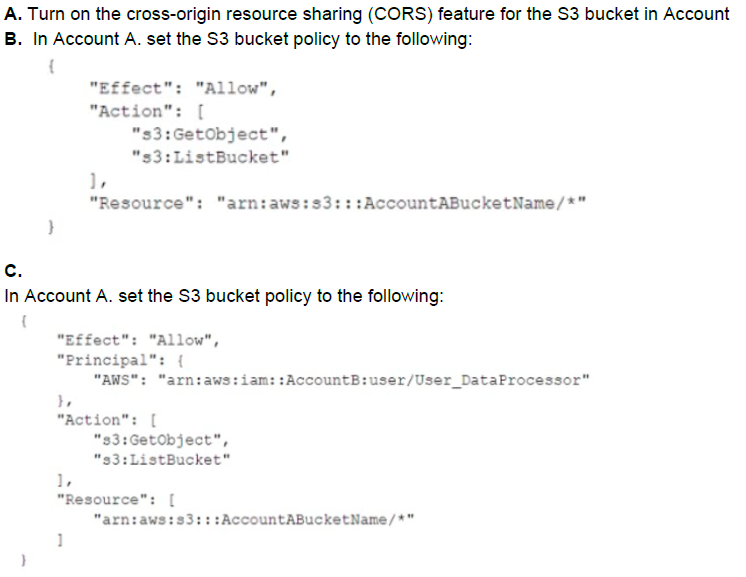
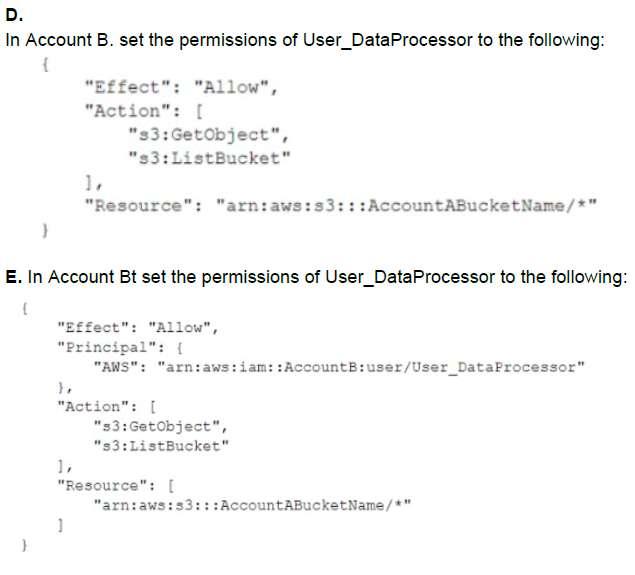
A retail company needs to provide a series of data files to another company, which is its
business partner These files are saved in an Amazon S3 bucket under Account A. which
belongs to the retail company. The business partner company wants one of its 1AM users.
User_DataProcessor. to access the files from its own AWS account (Account B).
Which combination of steps must the companies take so that User_DataProcessor can
access the S3 bucket successfully? (Select TWO.)
Show answerHide answer
Correct answer: C, DOption COption D
Question 47Choose 1
A company runs a processing engine in the AWS Cloud The engine processes
environmental data from logistics centers to calculate a sustainability index The company
has millions of devices in logistics centers that are spread across Europe The devices send
information to the processing engine through a RESTful API
The API experiences unpredictable bursts of traffic The company must implement a
solution to process all data that the devices send to the processing engine Data loss is
unacceptable
Which solution will meet these requirements?
Show answerHide answer
Correct answer: ACreate an Application Load Balancer (ALB) for the RESTful API Create an Amazon
Simple Queue Service (Amazon SQS) queue Create a listener and a target group for the
ALB Add the SQS queue as the target Use a container that runs in Amazon Elastic
Container Service (Amazon ECS) with the Fargate launch type to process messages in the
queue
Explanation
Explanation: it will use the ALB to handle the unpredictable bursts of traffic and route it to
the SQS queue. The SQS queue will act as a buffer to store incoming data temporarily and
the container running in Amazon ECS with the Fargate launch type will process messages
in the queue. This approach will ensure that all data is processed and prevent data loss.
Question 48Choose 1
A company is building a call center by using Amazon Connect. The company’s operations
team is defining a disaster recovery (DR) strategy across AWS Regions. The contact
center has dozens of contact flows, hundreds of users, and dozens of claimed phone
numbers.
Which solution will provide DR with the LOWEST RTO?
Show answerHide answer
Correct answer: DProvision a new Amazon Connect instance with all existing users and contact flows in a
second Region. Create an Amazon Route 53 health check for the URL of the Amazon
Connect instance. Create an Amazon CloudWatch alarm for failed health checks. Create
an AWS Lambda function to deploy an AWS CloudFormation template that provisions claimed phone numbers. Configure the alarm to invoke the Lambda function.
Explanation
Explanation: Option D provisions a new Amazon Connect instance with all existing users
and contact flows in a second Region. It also sets up an Amazon Route 53 health check for
the URL of the Amazon Connect instance, an Amazon CloudWatch alarm for failed health
checks, and an AWS Lambda function to deploy an AWS CloudFormation template that
provisions claimed phone numbers. This option allows for the fastest recovery time
because all the necessary components are already provisioned and ready to go in the
second Region. In the event of a disaster, the failed health check will trigger the AWS
Lambda function to deploy the CloudFormation template to provision the claimed phone
numbers, which is the only missing component.
Question 49Choose 1
A company operates a proxy server on a fleet of Amazon EC2 instances. Partners in
different countries use the proxy server to test the company's functionality. The EC2
instances are running in a VPC. and the instances have access to the internet.
The company's security policy requires that partners can access resources only from
domains that the company owns.
Which solution will meet these requirements?
Show answerHide answer
Correct answer: ACreate an Amazon Route 53 Resolver DNS Firewall domain list that contains the
allowed domains. Configure a DNS Firewall rule group with a rule that has a high numeric
value that blocks all requests. Configure a rule that has a low numeric value that allows
requests for domains in the allowed list. Associate the rule group with the VPC.
Explanation
Explanation: The company should create an Amazon Route 53 Resolver DNS Firewall domain list that
contains the allowed domains. The company should configure a DNS Firewall rule group
with a rule that has a high numeric value that blocks all requests. The company should
configure a rule that has a low numeric value that allows requests for domains in the
allowed list. The company should associate the rule group with the VPC. This solution will
meet the requirements because Amazon Route 53 Resolver DNS Firewall is a feature that
enables you to filter and regulate outbound DNS traffic for your VPC. You can create
reusable collections of filtering rules in DNS Firewall rule groups and associate them with
your VPCs. You can specify lists of domain names to allow or block, and you can
customize the responses for the DNS queries that you block1. By creating a domain list
with the allowed domains and a rule group with rules to allow or block requests based on
the domain list, the company can enforce its security policy and control access to sites.
The other options are not correct because:
Configuring a Route 53 outbound endpoint and associating it with the VPC would
not help with filtering outbound DNS traffic. A Route 53 outbound endpoint is a
resource that enables you to forward DNS queries from your VPC to your network
over AWS Direct Connect or VPN connections2. It does not provide any filtering
capabilities.
Creating a Route 53 traffic flow policy to match the allowed domains would not
help with filtering outbound DNS traffic. A Route 53 traffic flow policy is a resource
that enables you to route traffic based on multiple criteria, such as endpoint health,
geographic location, and latency3. It does not provide any filtering capabilities.
Creating a Gateway Load Balancer (GWLB) would not help with filtering outbound
DNS traffic. A GWLB is a service that enables you to deploy, scale, and manage
third-party virtual appliances such as firewalls, intrusion detection and prevention
systems, and deep packet inspection systems in the cloud4. It does not provide
any filtering capabilities.
Question 50Choose 2
A solutions architect is designing an AWS account structure for a company that consists of
multiple teams. All the teams will work in the same AWS Region. The company needs a
VPC that is connected to the on-premises network. The company expects less than 50
Mbps of total traffic to and from the on-premises network.
Which combination of steps will meet these requirements MOST cost-effectively? (Select
TWO.)
Show answerHide answer
Correct answer: B, DCreate an AWS Cloud Formation template that provisions a VPC and the required
subnets. Deploy the template to a shared services account Share the subnets by using
AWS Resource Access Manager.Use AWS Site-to-Site VPN for connectivity to the on-premises network.
Full mock exam
Sit the SAP-C02 exam before exam day
Full-length mocks with the same number of questions and the same time limit as the real SAP-C02 exam. Every attempt draws a new set of questions from the full bank, so you can keep going until you pass comfortably.