You are deploying a microservices application to Google Kubernetes Engine (GKE) that will
broadcast livestreams. You expect unpredictable traffic patterns and large variations in the
number of concurrent users. Your application must meet the following requirements:
Scales automatically during popular events and maintains high availability
Is resilient in the event of hardware failures
How should you configure the deployment parameters? (Choose two.)
Show answerHide answer
Correct answer: A, CDistribute your workload evenly using a multi-zonal node pool.Use cluster autoscaler to resize the number of nodes in the node pool, and use a
Horizontal Pod Autoscaler to scale the workload.
Question 32Choose 1
Your application is controlled by a managed instance group. You want to share a large
read-only data set
between all the instances in the managed instance group. You want to ensure that each
instance can start
quickly and can access the data set via its filesystem with very low latency. You also want
to minimize the total
cost of the solution.
What should you do?
Show answerHide answer
Correct answer: CMove the data to a Compute Engine persistent disk, and attach the disk in read-only
mode to multiple
Compute Engine virtual machine instances.
Question 33Choose 1
Your organization has recently begun an initiative to replatform their legacy applications
onto Google Kubernetes Engine. You need to decompose a monolithic application into
microservices. Multiple instances have read and write access to a configuration file, which
is stored on a shared file system. You want to minimize the effort required to manage this
transition, and you want to avoid rewriting the application code. What should you do?
Show answerHide answer
Correct answer: DCreate a new ConfigMap and volumeMount to store the contents of the configuration
file.
Explanation
ConfigMaps bind non-sensitive configuration artifacts such as configuration files,
command-line arguments, and environment variables to your Pod containers and system
components at runtime.
A ConfigMap separates your configurations from your Pod and components, which helps
keep your workloads portable. This makes their configurations easier to change and
manage, and prevents hardcoding configuration data to Pod specifications.
Question 34Choose 1
Show answerHide answer
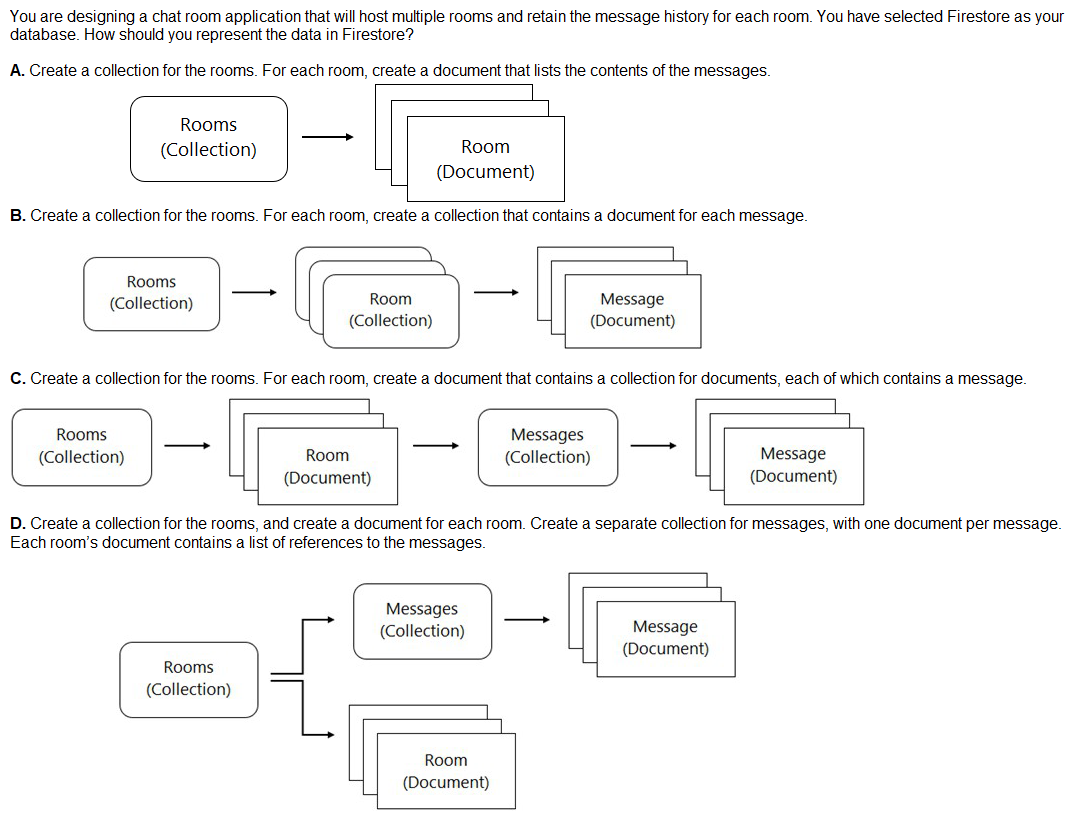
Correct answer: COption C
Question 35Choose 1
You are running a web application on Google Kubernetes Engine that you inherited. You
want to determine whether the application is using libraries with known vulnerabilities or is
vulnerable to XSS attacks. Which service should you use?
Show answerHide answer
Correct answer: CWeb Security Scanner
Explanation
Web Security Scanner identifies security vulnerabilities in your App Engine, Google
Kubernetes Engine (GKE), and Compute Engine web applications. It crawls your
application, following all links within the scope of your starting URLs, and attempts to
exercise as many user inputs and event handlers as possible.
Question 36Choose 1
The new version of your containerized application has been tested and is ready to deploy
to production on Google Kubernetes Engine. You were not able to fully load-test the new
version in pre-production environments, and you need to make sure that it does not have
performance problems once deployed. Your deployment must be automated. What should
you do?
Show answerHide answer
Correct answer: CDeploy the application via a continuous delivery pipeline using blue/green deployments. Use Cloud Monitoring to look for performance issues, and launch fully when the metrics
support it.
Question 37Choose 1
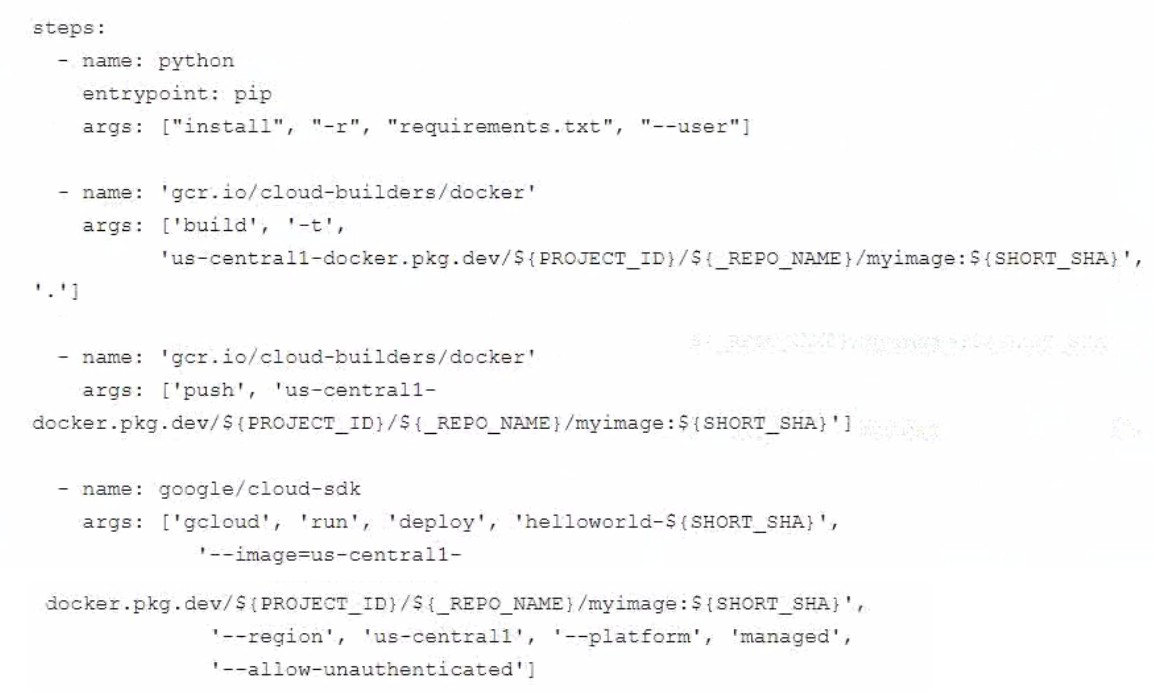
You are deploying a Python application to Cloud Run using Cloud Build. The Cloud Build
pipeline is shown below:
You want to optimize deployment times and avoid unnecessary steps What should you do?
Show answerHide answer
Correct answer: BAdd the —cache-from argument to the Docker build step in your build config file.
Question 38Choose 1
You are a developer at a large corporation You manage three Google Kubernetes Engine
clusters. Your team’s developers need to switch from one cluster to another regularly
without losing access to their preferred development tools. You want to configure access to
these clusters using the fewest number of steps while following Google-recommended best
practices. What should you do?
Show answerHide answer
Correct answer: DIn a configuration file, define the clusters users, and contexts Email the file to the
developers and ask them to use kubect1 config to add cluster, user and context details.
Question 39Choose 1
You have written a Cloud Function that accesses other Google Cloud resources. You want
to secure the environment using the principle of least privilege. What should you do?
Show answerHide answer
Correct answer: DCreate a new service account that has a custom IAM role to access the resources. The
deployer is given permission to act as the new service account.
Question 40Choose 1
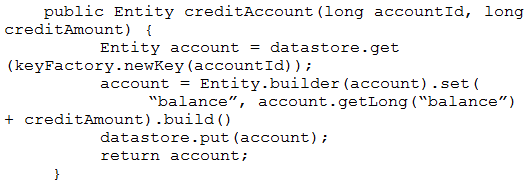
Your teammate has asked you to review the code below, which is adding a credit to an
account balance in Cloud Datastore. Which improvement should you suggest your
teammate make?
Show answerHide answer
Correct answer: AGet the entity with an ancestor query.
Full mock exam
Sit the Professional-Cloud-Developer exam before exam day
Full-length mocks with the same number of questions and the same time limit as the real Professional-Cloud-Developer exam. Every attempt draws a new set of questions from the full bank, so you can keep going until you pass comfortably.