Google certification · Exam PROFESSIONAL-CLOUD-ARCHITECT

PROFESSIONAL-CLOUD-ARCHITECT Mock Exam

PROFESSIONAL CLOUD ARCHITECT

Free PROFESSIONAL-CLOUD-ARCHITECT questions on Topic 2, TerramEarth Case Study, each with the answer and an explanation.

20 questions · 33 minutes · free, no sign-up

Topic 2, TerramEarth Case Study questions

1–3 of 3 free
Question 1 Choose 1
For this question, refer to the TerramEarth case study.
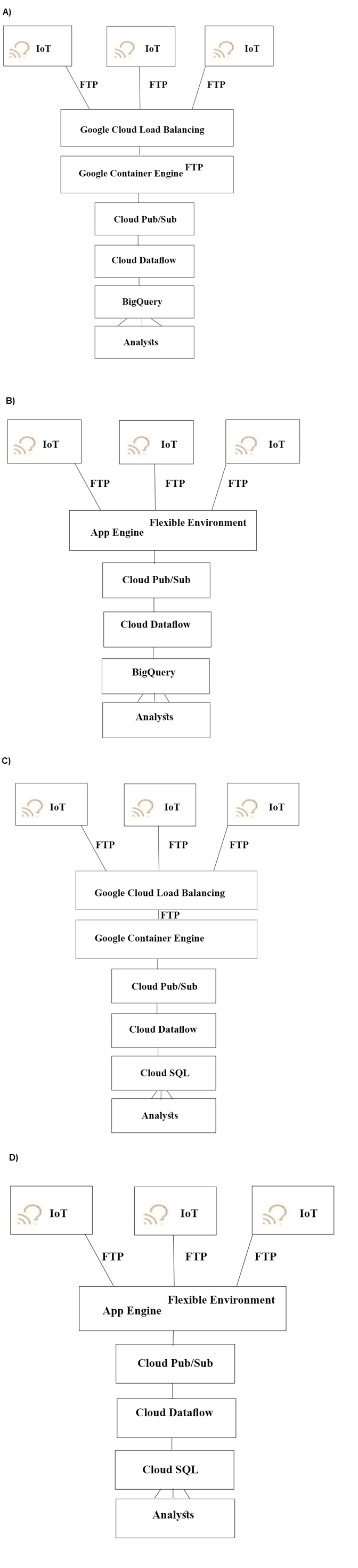
TerramEarth's CTO wants to use the raw data from connected vehicles to help identify approximatelyh when a vehicle in the development team to focus teir failure. You want to allow analysts to centrally query the vehicle data. Which architecture should you recommend?
Show answerHide answer

Correct answer: A Option A

Explanation

Explanation:
The requirement is to process terabytes of daily IoT vehicle data for predictive analytics and enable centralized SQL querying by analysts. Option A presents the correct, scalable Google Cloud reference architecture for this use case, while the other options contain critical flaws in component selection.

Why Option A is Correct:
The architecture follows the standard pattern for IoT data processing:
GKE with Load Balancing:
A containerized ingestion service on Google Kubernetes Engine (GKE) is ideal for the custom, long-running process of pulling data from FTP servers. The load balancer ensures scalability and high availability.
Pub/Sub for Messaging:
This provides a durable, asynchronous buffer, decoupling the ingestion service from the processing pipeline and handling massive data ingestion rates.
Dataflow for Processing:
This serverless tool is purpose-built for transforming and enriching streaming data (like the vehicle data) in real-time.
BigQuery for Analytics:
This is the correct choice for the data warehouse. It allows analysts to run fast, SQL-based queries on petabyte-scale datasets, directly fulfilling the requirement for "centralized querying."

Why Other Options Are Incorrect:
Option B:
Incorrectly uses App Engine Flexible Environment for data ingestion. App Engine is a Platform-as-a-Service (PaaS) optimized for web applications and has request timeouts and scaling models less suited for robust, long-running backend data-pull processes compared to GKE.

Options C & D:
The critical flaw is using Cloud SQL for the analytical data store. Cloud SQL is a managed relational database for transactional workloads (OLTP). It is not designed for the analytical workload (OLAP) described. With terabytes of data daily, Cloud SQL would be prohibitively expensive, slow, and would hit severe scaling limits. BigQuery is the serverless, petabyte-scale data warehouse designed specifically for this task.

References
Google Cloud Architecture Center - IoT Data Processing:
This reference architecture demonstrates the standard pattern of using Pub/Sub, Dataflow, and BigQuery for IoT analytics.
BigQuery Documentation:
Clearly states it is a "serverless, highly scalable, and cost-effective cloud data warehouse designed for business agility."
Question 2 Choose 1
For this question refer to the TerramEarth case study Operational parameters such as oil pressure are adjustable on each of TerramEarth's vehicles to increase their efficiency, depending on their environmental conditions. Your primary goal is to increase the operating efficiency of all 20 million cellular and unconnected vehicles in the field How can you accomplish this goal?
Show answerHide answer

Correct answer: B Capture all operating data, train machine learning models that identify ideal operations, and run locally to make operational adjustments automatically.

Explanation

Explanation:
TerramEarth operates 20 million vehicles, many of which are unconnected or have intermittent connectivity. The goal is to increase operating efficiency by adjusting parameters like oil pressure based on environmental conditions. The most effective strategy is to use locally deployed machine learning models that can make real-time decisions without relying on constant cloud connectivity.

✅ Why B Is Correct
Local execution: Running ML models locally ensures that vehicles can make operational adjustments even when offline.
Scalable intelligence:
Once trained in the cloud, models can be deployed to millions of devices to optimize performance autonomously.
Edge compatibility:
This approach aligns with edge computing principles, where inference ha
ppens on-device, reducing latency and dependency on network availability. Efficiency gains:
Models can continuously adapt to environmental inputs (e.g., altitude, temperature) and optimize parameters like oil pressure for fuel and performance efficiency.
Reference
Google Cloud Edge ML Deployment
ML at the Edge – Google Cloud

❌ Why Other Options Are Incorrect
A. Engineers inspect data and create rule-based algorithms
Rule-based systems lack adaptability and scalability. With 20 million vehicles and diverse environments, manual rules are inefficient and brittle.

C. Dataflow streaming job with GCM
Dataflow is for cloud-based stream processing. GCM (deprecated in favor of Firebase Cloud Messaging) requires connectivity. This setup fails for unconnected vehicles and doesn’t support local decision-making.
Reference
Cloud Dataflow Overview
Firebase Cloud Messaging

D. Host ML models in Google Cloud ML Platform
Hosting models in the cloud requires vehicles to be online to query predictions. This excludes unconnected vehicles and introduces latency and reliability issues.
Reference
📘 Vertex AI (formerly Cloud ML Platform)

Summary
To optimize efficiency across connected and unconnected vehicles, TerramEarth should:
Train ML models centrally using captured operational data.
Deploy models locally to vehicles for offline, real-time adjustments.
Question 3 Choose 1
For this question, refer to the TerramEarth case study You analyzed TerramEarth's business requirement to reduce downtime, and found that they can achieve a majority of time saving by reducing customers' wait time for parts You decided to focus on reduction of the 3
weeks aggregate reporting time Which modifications to the company's processes should you recommend?
Show answerHide answer

Correct answer: B Migrate from FTP to streaming transport, migrate from CSV to binary format, and develop machine learning analysis of metrics.

Explanation

Explanation:
The core problem is reducing the 3-week aggregate reporting time. This delay is caused by the batch-oriented nature of the current process: data is collected in CSV files and transferred weekly via FTP from dealers. To reduce downtime by cutting wait times for parts, the company needs to identify failing parts much faster. The solution must focus on accelerating the data pipeline from data generation to actionable insight.

Let's evaluate the options:
Why B is Correct:
This set of recommendations directly attacks the 3-week delay. Migrate from FTP to streaming transport: This is the most critical change. Replacing weekly batch FTP transfers with a real-time streaming pipeline (e.g., using Pub/Sub) ensures data is sent to the cloud as soon as it's generated. This eliminates the multi-week latency built into the current process.
Migrate from CSV to binary format:
CSV is a verbose, text-based format. Binary formats (like Protocol Buffers or Avro) are more compact, leading to faster serialization/deserialization and reduced network transfer times. This optimization works in tandem with streaming to make the data pipeline as efficient as possible.
Develop machine learning analysis of metrics:
With data now flowing in near real-time, machine learning models can be applied immediately to identify patterns predictive of part failure. This allows TerramEarth to proactively ship parts to dealers before a vehicle breaks down, directly achieving the goal of reducing customer wait time.

Why A is Incorrect:
While migrating to a binary format and developing ML are good, simply switching from FTP to SFTP (Secure File Transfer Protocol) does not solve the latency problem. SFTP is still a batch-oriented file transfer protocol. It adds security but does not change the fundamental weekly batch cycle. The 3-week aggregate time would remain.

Why C is Incorrect:
Increasing cellular connectivity is a long-term infrastructure project and not a direct process modification for the data pipeline. While more connectivity would provide more data, it doesn't address the core issue of how the data is handled once it is connected. The existing process for connected vehicles still relies on batch FTP transfers from dealers, which is the root cause of the delay. This option is indirect and insufficient on its own.

Why D is Incorrect:
This option combines an ineffective process change (SFTP, which is still batch) with a business outcome (increasing inventory) that is not a data process modification. Increasing inventory by a fixed factor is a costly and inefficient brute-force approach that does not use data intelligently. It does not address the fundamental problem of the slow data reporting pipeline.

Reference
TerramEarth Case Study:
The case study explicitly describes the current "3-week aggregate" delay and attributes it to the process of "dealers upload[ing] the files weekly to a central FTP server." The logical solution is to replace this batch process with a real-time streaming architecture.
Google Cloud - Dataflow & Pub/Sub:
The recommended architecture for real-time analytics involves streaming data ingestion with Pub/Sub and processing with Dataflow, which is what the correct option enables.

That's the last free question in Topic 2, TerramEarth Case Study

You've seen the free 30% (3 of 11 questions). Full access unlocks every question and full-length PROFESSIONAL-CLOUD-ARCHITECT mock exams (65 questions, 105 minutes), a different mock on every attempt.

Unlock full mock exam
Full mock exam

Sit the PROFESSIONAL-CLOUD-ARCHITECT exam before exam day

Full-length mocks with the same number of questions and the same time limit as the real PROFESSIONAL-CLOUD-ARCHITECT exam. Every attempt draws a new set of questions from the full bank, so you can keep going until you pass comfortably.

Get full PROFESSIONAL-CLOUD-ARCHITECT mock exam
  • 65questions per mock
  • 105 mintime limit
  • 250questions in the bank
  • Newmock on every attempt