The Open Group certification · Exam OGEA-103

OGEA-103 Mock Exam Page 3

TOGAF Enterprise Architecture Combined Part 1 and Part 2

Free OGEA-103 questions on Topic 1: Part 1, each with the answer and an explanation.

20 questions · 33 minutes · free, no sign-up

Topic 1: Part 1 questions

21–27 of 27 free
Question 21 Choose 1
Consider the following descriptions of deliverables consumed and produced across the TOGAF ADM cycle.
  1. General rules and guidelines, intended to be enduring and seldom amended, that inform and support the way in which an organization sets about fulfilling its mission.
  2. The joint agreements between development partners and sponsors on the deliverables, quality, and fitness-for-purpose of an architecture.
  3. A document that is sent from the sponsoring organization to the architecture organization to trigger the start of an architecture development cycle.
  4. A set of quantitative statements that outline what an implementation project must do in order to comply with the architecture.
Which deliverables match these descriptions?

Show answerHide answer

Correct answer: A 1 Architecture Principles -2 Architecture Contracts - 3 Request for Architecture Work - 4 Architecture Requirements Specification
Question 22 Choose 1
Which of the following are the four purposes that typically frame the planning horizon, depth and breadth of an Architecture Project, and the contents of the EA Repository-?
Show answerHide answer

Correct answer: D Strategy Portfolio Project Solution Delivery

Explanation

Explanation: Strategy Portfolio Project Solution Delivery are the four purposes that typically frame the planning horizon, depth and breadth of an Architecture Project, and the contents of the EA Repository. They correspond to different levels of abstraction and granularity in the architecture development process.
Question 23 Choose 1
What is presented as ”striking a balance between positive and negative outcomes resulting from the realization of either opportunities or threats?
Show answerHide answer

Correct answer: D Risk Management

Explanation

Explanation: Risk Management is the process of identifying, assessing, and responding to risks that may affect the achievement of the enterprise’s objectives. Risk Management involves balancing positive and negative outcomes resulting from the realization of either opportunities or threats.
Question 24 Choose 1
What are the following activities part of?
  • Risk classification
  • Risk identification
  • Initial risk assessment
Show answerHide answer

Correct answer: D Risk Management

Explanation

Explanation:
Risk management is a generic technique that can be applied across all phases of the Architecture Development Method (ADM), as well as in the Preliminary Phase and the Requirements Management Phase2. Risk management involves the following steps1:

Risk identification: This step involves identifying the potential risks that may affect the architecture project, such as technical, business, organizational, environmental, or legal risks. The risks can be identified through various sources, such as stakeholder interviews, workshops, surveys, checklists, historical data, or expert judgment.

Risk classification: This step involves categorizing the risks based on their nature, source, impact, and priority. The risks can be classified according to different criteria, such as time, cost, scope, quality, security, or compliance. The classification helps in prioritizing the risks and allocating resources and efforts to address them effectively.

Initial risk assessment: This step involves assessing the likelihood and impact of each risk, and determining the initial level of risk. The likelihood is the probability of the risk occurring, and the impact is the severity of the consequences if the risk occurs. The initial level of risk is the product of the likelihood and impact, and it indicates the urgency and importance of the risk. The initial risk assessment helps in identifying the most critical risks that need immediate attention and mitigation.
Question 25 Choose 1
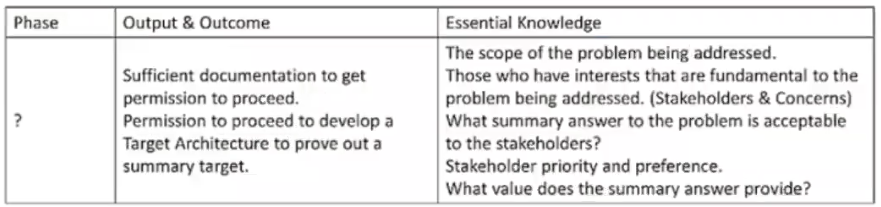
Refer to the table below:

Which ADM Phase does this describe?
Show answerHide answer

Correct answer: B Phase B

Explanation

Explanation: Phase B of the ADM cycle is the Business Architecture phase. It describes the development of a Business Architecture to support an agreed Architecture Vision. The objectives of this phase are to describe the baseline and target Business Architecture, identify candidate Architecture Roadmap components based on gaps between the baseline and target, and determine whether an incremental approach is required.
Question 26 Choose 1
What is an objective of the ADM Implementation Governance Phase?
Show answerHide answer

Correct answer: B To ensure conformance for the target architecture

Explanation

Explanation: The objective of the ADM Implementation Governance Phase is to provide an architectural oversight of the implementation and to ensure conformance for the target architecture. This phase involves establishing procedures and processes to monitor and control the implementation projects and to verify that they comply with the defined architecture.
Question 27 Choose 1
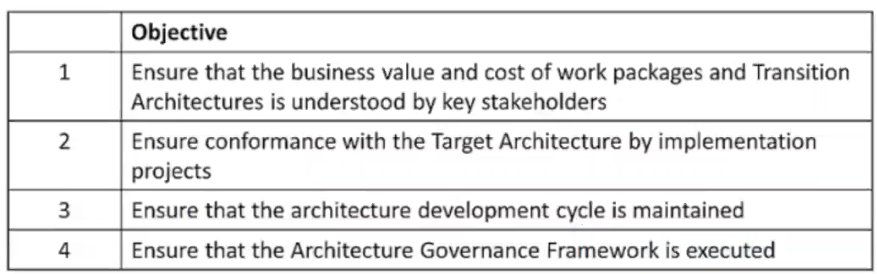
Consider the following ADM phases objectives.

Which phase does each objective match?
Show answerHide answer

Correct answer: B 1H-2F-3F-4G

Explanation

According to the TOGAF Standard, Version 9.2, the ADM phases and their objectives are as follows1:
Based on the above definitions, we can match each objective with the corresponding phase as follows:

That's the last free question in Topic 1: Part 1

You've seen the free 30% (27 of 91 questions). Full access unlocks every question and full-length OGEA-103 mock exams (65 questions, 105 minutes), a different mock on every attempt.

Unlock full mock exam
Full mock exam

Sit the OGEA-103 exam before exam day

Full-length mocks with the same number of questions and the same time limit as the real OGEA-103 exam. Every attempt draws a new set of questions from the full bank, so you can keep going until you pass comfortably.

Get full OGEA-103 mock exam
  • 65questions per mock
  • 105 mintime limit
  • 103questions in the bank
  • Newmock on every attempt