Correct answer: B
You recommend that an analysis of the stakeholders is undertaken resulting in documenting the stakeholders and their concerns in a Stakeholder Map. The concerns and relevant views should then be defined for each group and recorded in the Architecture Vision document. The requirements will include risk mitigation through regular assessments. This will also allow a supervised agile implementation of the continuous Machine Learning.
Explanation
Explanation: A Stakeholder Map is a technique that can be used to identify and classify
the stakeholders of the architecture work, and to document their key interests,
requirements, and concerns. A stakeholder is any person, group, or organization that has a
stake in the outcome of the architecture work, such as the sponsor, the client, the users,
the suppliers, the regulators, or the competitors. A Stakeholder Map can help to understand
the needs and expectations of the stakeholders, and to communicate and engage with
them effectively1.
The steps for creating a Stakeholder Map are:
Identify the stakeholders of the architecture work, using various sources and
methods, such as interviews, surveys, workshops, or existing documents.
Classify the stakeholders according to their roles, responsibilities, and
relationships, using various criteria and dimensions, such as power, influence,
interest, attitude, or impact.
Define the concerns and relevant views for each stakeholder group, using various
techniques, such as business scenarios, use cases, or value propositions. A
concern is a key interest or issue that is relevant to the stakeholder, such as a
goal, a problem, a need, or a risk. A view is a representation of the system of
interest from the perspective of one or more stakeholders and their concerns.
Record the stakeholders and their concerns in a Stakeholder Map, which shows
the mapping between the stakeholder groups, the concerns, and the views. The
Stakeholder Map also shows the dependencies, assumptions, and issues related
to each stakeholder and concern.
Therefore, the best answer is B, because it recommends the approach that would enable
the development of an architecture that addresses the concerns of the CIO and the
partners, using the Stakeholder Map technique. The answer covers the following aspects:
An analysis of the stakeholders is undertaken, which involves identifying,
classifying, and defining the stakeholders and their concerns.
The stakeholders and their concerns are documented in a Stakeholder Map, which
provides a clear and comprehensive picture of the stakeholder landscape and their
interests.
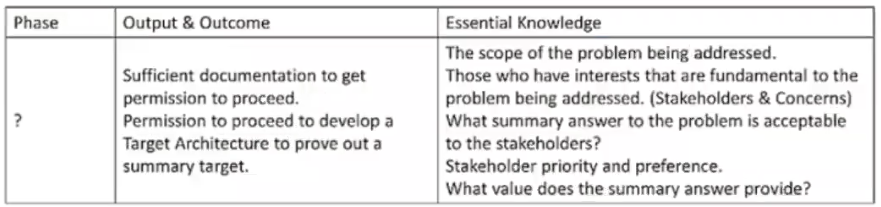
The concerns and relevant views are recorded in the Architecture Vision
document, which is the output of Phase A: Architecture Vision of the Architecture
Development Method (ADM), which is the core process of the TOGAF standard
that guides the development and management of the enterprise architecture. The
Architecture Vision defines the scope and approach of the architecture work, and
establishes the business goals and drivers that motivate the architecture work. The
Architecture Vision also involves obtaining the approval and commitment of the
sponsors and other key stakeholders, and initiating the Architecture Governance
process2.
The requirements include risk mitigation through regular assessments, which
involves identifying, analyzing, and evaluating the risks that may affect the
architecture, and determining the appropriate measures or actions to prevent,
reduce, or mitigate the risks. Risk mitigation can also involve monitoring and
reviewing the risk situation, and communicating and reporting the risk status and
actions3.
This approach also allows a supervised agile implementation of the continuous
Machine Learning, which involves applying agile principles and practices to the
architecture development and implementation, such as iterative and incremental
delivery, frequent feedback, collaboration, and adaptation. A supervised agile
implementation can help to ensure the quality, value, and alignment of the
architecture, and to respond to the changing needs and expectations of the
stakeholders.