A financial company receives a high volume of real-time market data streams from an
external provider. The streams consist of thousands of JSON records every second.
The company needs to implement a scalable solution on AWS to identify anomalous data
points.
Which solution will meet these requirements with the LEAST operational overhead?
Show answerHide answer
Correct answer: AIngest real-time data into Amazon Kinesis data streams. Use the built-in
RANDOM_CUT_FOREST function in Amazon Managed Service for Apache Flink to
process the data streams and to detect data anomalies.
Explanation
Explanation:
This solution is the most efficient and involves the least operational overhead:
Amazon Kinesis data streams efficiently handle real-time ingestion of high-volume
streaming data.
Amazon Managed Service for Apache Flink provides a fully managed environment for
stream processing with built-in support for RANDOM_CUT_FOREST, an algorithm
designed for anomaly detection in real-time streaming data.
This approach eliminates the need for deploying and managing additional infrastructure like
SageMaker endpoints, Lambda functions, or external tools, making it the most scalable and
operationally simple solution.
Question 12Choose 1
A company has implemented a data ingestion pipeline for sales transactions from its
ecommerce website. The company uses Amazon Data Firehose to ingest data into
Amazon OpenSearch Service. The buffer interval of the Firehose stream is set for 60
seconds. An OpenSearch linear model generates real-time sales forecasts based on the
data and presents the data in an OpenSearch dashboard.
The company needs to optimize the data ingestion pipeline to support sub-second latency
for the real-time dashboard.
Which change to the architecture will meet these requirements?
Show answerHide answer
Correct answer: AUse zero buffering in the Firehose stream. Tune the batch size that is used in the
PutRecordBatch operation.
Explanation
Explanation:
Amazon Kinesis Data Firehose allows for near real-time data streaming. Setting
thebuffering hintsto zero or a very small value minimizes the buffering delay and ensures that records are delivered to the destination (Amazon OpenSearch Service) as quickly as
possible. Additionally, tuning thebatch sizein thePutRecordBatchoperation can further
optimize the data ingestion for sub-second latency. This approach minimizes latency while
maintaining the operational simplicity of using Firehose.
Question 13Choose 1
An ML engineer has trained a neural network by using stochastic gradient descent (SGD).
The neural network performs poorly on the test set. The values for training loss and
validation loss remain high and show an oscillating pattern. The values decrease for a few
epochs and then increase for a few epochs before repeating the same cycle.
What should the ML engineer do to improve the training process?
Show answerHide answer
Correct answer: DDecrease the learning rate.
Explanation
Explanation:
In training neural networks using Stochastic Gradient Descent (SGD), the learning rate is a
critical hyperparameter that influences the convergence behavior of the model. Observing
oscillations in training and validation loss suggests that the learning rate may be too high,
causing the optimization process to overshoot minima in the loss landscape.
Understanding the Impact of Learning Rate:
High Learning Rate:A high learning rate can cause the model parameters to
update too aggressively, leading to oscillations or divergence in the loss function.
This manifests as the loss decreasing for a few epochs and then increasing,
repeating this cycle without stable convergence.
Low Learning Rate:A low learning rate results in smaller parameter updates,
allowing the model to converge more steadily to a minimum, albeit potentially at a
slower pace.
Recommended Action:
Decreasing the learning rate allows for more precise adjustments to the model parameters,
facilitating smoother convergence and reducing oscillations in the loss function. This
adjustment helps the model settle into minima more effectively, improving overall
performance.
Supporting Evidence:
Research indicates that large learning rates can lead to phenomena such as "catapults,"
where spikes in training loss occur due to aggressive updates. Reducing the learning rate
Question 14Choose 1
An ML engineer needs to use an Amazon EMR cluster to process large volumes of data in
batches. Any data loss is unacceptable.
Which instance purchasing option will meet these requirements MOST cost-effectively?
Show answerHide answer
Correct answer: DRun the primary node and core nodes on On-Demand Instances. Run the task nodes on
Spot Instances.
Explanation
Explanation:
For Amazon EMR, the primary node and core nodes handle the critical functions of the
cluster, including data storage (HDFS) and processing. Running them on On-Demand
Instances ensures high availability and prevents data loss, as Spot Instances can be
interrupted. The task nodes, which handle additionalprocessing but do not store data, can
use Spot Instances to reduce costs without compromising the cluster's resilience or data
integrity. This configuration balances cost-effectiveness and reliability.
Question 15Choose 1
A company wants to predict the success of advertising campaigns by considering the color
scheme of each advertisement. An ML engineer is preparing data for a neural network
model. The dataset includes color information as categorical data.
Which technique for feature engineering should the ML engineer use for the model?
Show answerHide answer
Correct answer: DOne-hot encode the color categories to transform the color scheme feature into a binary
matrix.
Explanation
Explanation:
One-hot encodingis the appropriate technique for transforming categorical data, such as
color information, into a format suitable for input to a neural network. This technique
creates a binary vector representation where each unique category (color) is represented
as a separate binary column, ensuring that the model does not infer ordinal relationships
between categories. This approach preserves the categorical nature of the data and avoids
introducing unintended biases.
Question 16Choose 1
An ML engineer is using a training job to fine-tune a deep learning model in Amazon
SageMaker Studio. The ML engineer previously used the same pre-trained model with a
similar
dataset. The ML engineer expects vanishing gradient, underutilized GPU, and overfitting
problems.
The ML engineer needs to implement a solution to detect these issues and to react in
predefined ways when the issues occur. The solution also must provide comprehensive
real-time metrics during the training.
Which solution will meet these requirements with the LEAST operational overhead?
Show answerHide answer
Correct answer: DUse SageMaker Debugger built-in rules to monitor the training job. Configure the rules
to initiate the predefined actions.
Explanation
Explanation:
SageMaker Debugger provides built-in rules to automatically detect issues like vanishing
gradients, underutilized GPU, and overfitting during training jobs. It generates real-time
metrics and allows users to define predefined actions that are triggered when specific
issues occur. This solution minimizes operational overhead by leveraging the managed
monitoring capabilities of SageMaker Debugger without requiring custom setups or
extensive manual intervention.
Question 17Choose 1
A company stores historical data in .csv files in Amazon S3. Only some of the rows and
columns in the .csv files are populated. The columns are not labeled. An ML
engineer needs to prepare and store the data so that the company can use the data to train
ML models.
Select and order the correct steps from the following list to perform this task. Each step
should be selected one time or not at all. (Select and order three.)
• Create an Amazon SageMaker batch transform job for data cleaning and feature
engineering.
• Store the resulting data back in Amazon S3.
• Use Amazon Athena to infer the schemas and available columns.
• Use AWS Glue crawlers to infer the schemas and available columns.
• Use AWS Glue DataBrew for data cleaning and feature engineering.
A company has a binary classification model in production. An ML engineer needs to
develop a new version of the model.
The new model version must maximize correct predictions of positive labels and negative
labels. The ML engineer must use a metric to recalibrate the model to meet these
requirements.
Which metric should the ML engineer use for the model recalibration?
Show answerHide answer
Correct answer: AAccuracy
Explanation
Explanation:
Accuracy measures the proportion of correctly predicted labels (both positive and negative)
out of the total predictions. It is the appropriate metric when the goal is to maximize the
correct predictions of both positive and negative labels. However, it assumes that the
classes are balanced; if the classes are imbalanced, other metrics like precision, recall, or
specificity may be more relevant depending on the specific needs.
Question 18
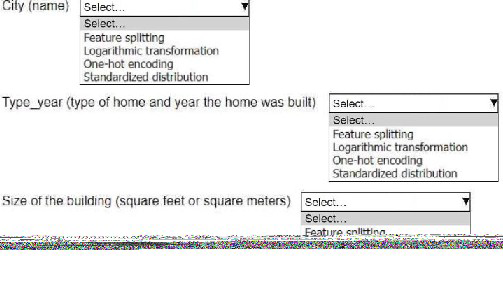
An ML engineer is working on an ML model to predict the prices of similarly sized homes.
The model will base predictions on several features The ML engineer will use the following
feature engineering techniques to estimate the prices of the homes:
Select the correct feature engineering techniques for the following list of features. Each
feature engineering technique should be selected one time or not at all (Select three.)
Show answerHide answer
Explanation
Explanation:
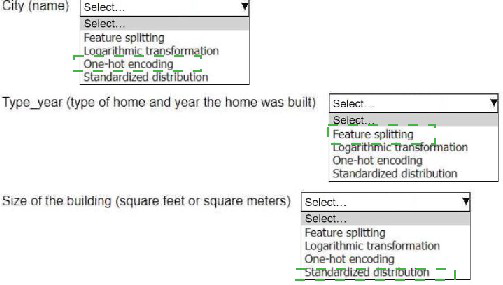
City (name):One-hot encoding
Type_year (type of home and year the home was built):Feature splitting
Size of the building (square feet or square meters):Standardized distribution
City (name): One-hot encoding
Type_year (type of home and year the home was built): Feature splitting
Size of the building (square feet or square meters): Standardized distribution
By applying these feature engineering techniques, the ML engineer can ensure that the
input data is correctly formatted and optimized for the model to make accurate predictions.
Question 19Choose 1
A company is running ML models on premises by using custom Python scripts and
proprietary datasets. The company is using PyTorch. The model building requires unique
domain knowledge. The company needs to move the models to AWS.
Which solution will meet these requirements with the LEAST effort?
Show answerHide answer
Correct answer: BUse SageMaker script mode and premade images for ML frameworks.
Explanation
Explanation:
SageMaker script mode allows you to bring existing custom Python scripts and run them on
AWS with minimal changes. SageMaker provides prebuilt containers for ML frameworks
like PyTorch, simplifying the migration process. This approach enables the company to
leverage their existing Python scripts and domain knowledge while benefiting from the
scalability and managed environment of SageMaker. It requires the least effort compared
to building custom containers or retraining models from scratch.
Question 20Choose 1
An ML engineer needs to implement a solution to host a trained ML model. The rate of
requests to the model will be inconsistent throughout the day.
The ML engineer needs a scalable solution that minimizes costs when the model is not in
use. The solution also must maintain the model's capacity to respond to requests during
times of peak usage.
Which solution will meet these requirements?
Show answerHide answer
Correct answer: DDeploy the model to an Amazon SageMaker endpoint. Create SageMaker endpoint auto
scaling policies that are based on Amazon CloudWatch metrics to adjust the number of
instances dynamically.
That's the last free question
You've seen the free 30% (20 of 69 questions). Full access unlocks every question and full-length MLA-C01 mock exams (65 questions, 105 minutes), a different mock on every attempt.
Full-length mocks with the same number of questions and the same time limit as the real MLA-C01 exam. Every attempt draws a new set of questions from the full bank, so you can keep going until you pass comfortably.