IIA certification · Exam IIA-CRMA-ADV

IIA-CRMA-ADV Mock Exam Page 7

Certification in Risk Management Assurance

Free IIA-CRMA-ADV mock exam questions 61–70, each with the answer and an explanation.

20 questions · 25 minutes · free, no sign-up

Free IIA-CRMA-ADV questions

61–70 of 84 free
Question 61 Choose 1
Non-statistical sampling does not require which of the following?
Show answerHide answer

Correct answer: A The sample to be representative of the population.

Explanation

Explanation:

A critical characteristic of non-statistical (or judgmental) sampling is that it does not provide a mathematical basis for measuring sampling risk or projecting findings to the entire population with a known confidence level . Because the sample selection is based on the auditor's professional judgment, there is no assurance that it is mathematically representative of the population, and therefore, results should not be extrapolated . The fundamental requirement for projecting results to a population is that the sample must be representative, which is a characteristic of statistical sampling—not non-statistical sampling.

Why Other Options Are Incorrect

B. The sample to be selected haphazardly:
This is incorrect. Haphazard selection is just one method within non-statistical sampling, not a required feature . The method of selection is a matter of auditor judgment, not a mandatory requirement for non-statistical sampling.

C. A smaller sample size than if selected using statistical sampling:
This is incorrect. Sample size is determined by the auditor's professional judgment based on risk and materiality, not a guaranteed smaller size . Non-statistical sampling does not require a smaller sample than statistical sampling.

D. Projecting the results to the population:
This is not a requirement for non-statistical sampling. In fact, because a judgmental sample is unlikely to be representative, projecting its results to the population is not appropriate .

References

IIA Standard 2320 – Analysis and Evaluation: Requires that conclusions be based on appropriate analyses. Statistical sampling provides a quantifiable basis for projecting results, whereas non-statistical sampling does not .

IIA Practice Advisory 2320-2: Distinguishes between statistical and non-statistical sampling, noting that statistical methods allow for quantifiable sampling risk and population projection .
Question 62 Choose 1
An internal auditor is evaluating techniques management uses to mitigate risks within a particular product division. Which of the following is an example of risk reduction?
Show answerHide answer

Correct answer: D Management modifies the product division to minimize errors.

Explanation

Explanation:

Risk reduction (also called risk mitigation) is a risk response strategy that involves taking proactive actions to reduce the likelihood and/or impact of a risk to an acceptable level, without eliminating it entirely. In this context, modifying the product division's operations, processes, or controls specifically to minimize errors is a textbook example of risk reduction. The organization accepts that some risk remains but actively works to lessen its potential negative consequences.

Why Other Options Are Incorrect

A. Management sells the product division to a competitor:
This is an example of risk avoidance. By selling the division, management completely eliminates the risk exposure associated with that product line. Avoidance means exiting the activity that gives rise to the risk.

B. Management outsources the product division to a third party:
This is an example of risk sharing (or risk transfer). Outsourcing transfers some or all of the operational and financial risk to a third party (the outsourcer), while the organization still retains some oversight. This does not reduce the inherent risk—it shifts responsibility.

C. Management allows the product division to remain unchanged:
This is an example of risk acceptance (or risk tolerance). Management consciously decides to take no action, accepting the current level of risk because it falls within the organization's risk appetite or because the cost of mitigation outweighs the potential loss.

References

COSO Enterprise Risk Management – Integrating with Strategy and Performance (2017): Identifies five risk response categories: avoid, reduce, share, accept, and pursue (for upside risks). Reducing risk involves actions to lower severity or likelihood.

IIA Standard 2120 – Risk Management:Internal audit must evaluate the effectiveness and contribute to the improvement of risk management processes, including the appropriateness of management's risk responses.
Question 63 Choose 1
Which of the following is an example of a detective control?
Show answerHide answer

Correct answer: C Confirmation with suppliers and vendors.

Explanation

Explanation:

Detective controls are designed to identify errors or irregularities after they have occurred . They are reactive in nature—they do not stop an adverse event but rather uncover it so that corrective action can be taken . Confirmations with suppliers and vendors (also known as circularization) is a classic detective control in an audit context. This procedure involves independently verifying outstanding payable or receivable balances directly with external third parties to detect discrepancies, errors, or potential fraud that may have already occurred in the accounting records .

Why Other Options Are Incorrect

A. Automatic shut-off valve:
This is a preventive control. Its primary purpose is to stop a dangerous situation (e.g., gas leak, overflow) from escalating or occurring in the first place by automatically cutting off the flow . It is designed to be proactive and deter an adverse event.

B. Auto-correct software functionality:
This is a preventive or corrective control. Like typing "teh" and having it automatically change to "the," it is designed to prevent errors from entering the final document or data . It acts before the error is finalized, not after.

D. Safety instructions:
Safety instructions, such as safety data sheets or warnings in manuals, are preventive controls . Their purpose is to proactively inform and educate employees or users on safe handling procedures to prevent accidents or non-compliance .

References

IIA Standard 2120 – Risk Management: Internal audit must evaluate the effectiveness of risk management processes, which includes the design of control activities (preventive vs. detective).

COSO Internal Control – Integrated Framework: Defines preventive controls as those that deter problems, and detective controls as those that identify problems after they arise .
Question 64 Choose 1
When auditing the award of a major contract, which of the following should an internal auditor suspect as a red flag for a bidding fraud scheme?
1. Subsequent change orders increase requirements for low-bid items.
2. Material contract requirements are different on the actual contract than on the request for bids.
3. A high percentage of employees are charged to indirect accounts.
4. Losing bidders are hired as subcontractors.
Show answerHide answer

Correct answer: D 2 and 4.

Explanation

Explanation:

When auditing a major contract award, specific red flags can indicate a bidding fraud scheme. A red flag is a circumstance that suggests a higher risk of misconduct and warrants further investigation, though it is not definitive proof of fraud.

Options 2 and 4 are well-documented red flags for procurement fraud:

Item 2 (Material contract requirements are different on the actual contract than on the request for bids):
This is a significant red flag suggesting bid rigging or an attempt to favor a specific bidder. In a fair process, the final contract should reflect the requirements initially stated in the request for bids. Unilateral or substantial changes to material requirements after the award can indicate that the specifications were tailored to favor a competitor, or that collusion is occurring to circumvent the competitive process .

Item 4 (Losing bidders are hired as subcontractors):
This is a classic indicator of collusive bidding or bid rigging. In this scheme, competing firms agree that one will submit the winning bid while the others submit artificially high "cover" bids to give the appearance of competition. In return, the losing bidders are compensated, often by being hired as subcontractors on the project or being awarded future contracts .

Why Other Options Are Incorrect

Item 1 (Subsequent change orders increase requirements for low-bid items):
This is a red flag but in a different context. It is specifically associated with unbalanced bidding. In this scheme, a bidder quotes a very low price for an item, knowing that the project officials will issue a change order to increase the quantity of that item later. While suspicious, it represents a different fraud method than the broader "bidding fraud scheme" indicators in Items 2 and 4 .

Item 3 (A high percentage of employees charged to indirect accounts):
While this can indicate inefficiency, cost mischarging, or poor internal controls, it is not a standard red flag for the manipulation of the contract bidding/award process. It is more relevant to the detection of fraudulent billing during contract execution, rather than as a direct sign of a scheme to subvert the initial tender process .

References

U.S. Government Accountability Office (GAO) & GSA OIG: Identify losing bidders hired as subcontractors and change orders that modify low-bid items as common red flags for procurement fraud .

European Anti-Fraud Knowledge Centre: Lists "losing bidders hired as subcontractors" as a fraud indicator in cases of bid rigging .
Question 65 Choose 1
An internal auditor is using a spreadsheet application to review a cash flow forecast prepared by management. Which of the following correctly identifies the type of evidence this information represents?
Show answerHide answer

Correct answer: D ircumstantial evidence of the future solvency of the organization.

Explanation

Explanation:

When an internal auditor reviews a cash flow forecast prepared by management, the evidence obtained is circumstantial in nature. Circumstantial evidence is indirect and relies on inference to connect it to a conclusion—it does not directly prove a fact but rather supports an inference about that fact.

A cash flow forecast is a projection of future cash inflows and outflows based on assumptions. Because it predicts future events, it cannot directly confirm solvency at a given point in time; instead, it provides indirect (circumstantial) evidence from which the auditor can infer the organization's ability to meet future obligations. It is not a direct observation or a confirmation of historical fact, which makes it circumstantial rather than direct evidence.

Why Other Options Are Incorrect

A. Competent, corroborative evidence of future working capital requirements:
This is incorrect because a forecast is not "corroborative" (it does not confirm something already known) and it is not directly competent evidence of future working capital—it is an estimate, not a certainty.

B. Sufficient, analytical evidence of the cash flow position at a given point of time in the future:
While a forecast can be analyzed, it is not evidence of an actual cash flow position at a future date—it is only a prediction. Analytical evidence typically involves comparisons of relationships and historical data, not future projections.

C. Competent, documentary evidence of future cash flow changes within the organization:
A forecast is a document, but "competent" evidence in auditing refers to information that is reliable and relevant—such as original source documents. A forecast is not competent evidence of actual future changes; it is a management assertion about what might happen, not a record of what has happened.

References

IIA Standard 2310 – Identifying Information: Internal auditors must identify sufficient, reliable, relevant, and useful information to achieve the engagement's objectives. Evidence can be classified by nature (direct vs. circumstantial) and source (primary vs. secondary).

IIA Practice Advisory 2310-1 – Identifying Information: Differentiates evidence types. Circumstantial evidence is indirect and tends to prove a fact by inference, as opposed to direct evidence that proves a fact without inference (e.g., original invoices). Forecasts and projections are considered circumstantial because they depend on assumptions and are not direct observations of actual transactions.
Question 66 Choose 1
Which of the following is an example of a directive control?
Show answerHide answer

Correct answer: C Incentive compensation plans.

Explanation

Explanation:

A directive control is designed to encourage, guide, or cause the occurrence of a desirable event or outcome . Unlike preventive controls which block unwanted events, or detective controls which identify them after they occur, directive controls provide positive motivation and clear direction for desired behavior . Incentive compensation plans are a classic example of a directive control . By rewarding employees for achieving specific performance targets, the organization is directing behavior toward its strategic objectives—such as sales growth, profitability, or safety goals. The control encourages the right actions to happen .

Why Other Options Are Incorrect

A. Segregation of duties:
This is a preventive control. It prevents errors or fraud by ensuring that no single individual has complete control over a critical process from start to finish . It is designed to stop an unwanted event, not to guide behavior.

B. Exception reports:
This is a detective control. Exception reports identify errors, irregularities, or deviations from standards after they have occurred, allowing management to take corrective action . They do not proactively guide behavior.

D. Automated reconciliations:
While reconciliations are a detective control—they are used to uncover discrepancies after transactions have been processed . They identify errors or irregularities that have already occurred rather than guiding or encouraging specific outcomes.

References

IIA Definition of Directive Controls: Controls designed to cause or encourage the occurrence of a desirable event . Policies, procedures, and training are other common examples .

COSO Internal Control – Integrated Framework: Control activities include directive (or "performance") controls that establish outcomes and guide behavior toward achieving objectives
Question 67 Choose 1
If appropriate safeguards exist, which of the following is considered a legitimate internal audit role within risk management at an organization?
Show answerHide answer

Correct answer: B Providing consolidated reporting on risks.

Explanation

Explanation:

The IIA's guidance on the role of internal auditing in risk management makes a clear distinction between roles that are appropriate, especially when safeguards exist, and those that are fundamentally management responsibilities and would impair internal audit's objectivity.

Providing consolidated reporting on risks is explicitly listed as a legitimate internal audit role. This is an advisory or coordinating activity that supports the risk management process without taking on management's accountability for the risks themselves . It is a consulting service that enhances the value provided by internal audit while maintaining its independence.

Why Other Options Are Incorrect

A. Imposing risk management processes:
This is a management function, not a legitimate internal audit role. IIA guidance explicitly lists "impose risk management process" as a role internal audit should not undertake because it would cross into management's domain and impair objectivity .

C. Taking accountability for risk management:
This is clearly a management responsibility. The Three Lines Model emphasizes that management is accountable for managing risk; internal audit is independent and provides assurance over management's processes . Assuming accountability would destroy internal audit's independence and impartiality.

D. Making decisions on risk responses:
This is fundamentally a management decision-making role. IIA guidance lists "make decisions and implement risk response" as a role internal audit should not perform, as it would mean internal audit is no longer providing objective, independent assurance but is instead managing the organization .

References

IIA Position Paper: The Role of Internal Auditing in Enterprise-Wide Risk Management (Table outlining legitimate, core, and prohibited roles)

IIA Three Lines Model (which clarifies management's accountability for risk and internal audit's independent assurance role)
Question 68 Choose 1
Which of the following situations is most likely to impair internal audit objectivity?
Show answerHide answer

Correct answer: D An internal auditor performs an audit in a department that is led by the auditor's close friend.

Explanation

Explanation:

IIA guidance explicitly identifies auditing an area where a relative or close friend is employed as a direct impairment to individual objectivity . This is a classic familiarity threat—a personal relationship that can compromise an auditor's impartiality, regardless of their intentions.

This situation creates a conflict of interest, as defined by IIA Standard 1120, where a competing personal interest can make it difficult to fulfill duties impartially . Even the appearance of impropriety can undermine confidence in the internal auditor and the profession .

Why Other Options Are Less Likely to Impair Objectivity

A. Reporting to the CFO:
While administrative reporting to a CFO is not ideal (the IIA recommends reporting to the CEO), it does not automatically impair objectivity. It is a structural concern often mitigated by a dual-reporting line to the audit committee (functional reporting) .

B. Auditing AP after being an AP intern three years prior:
This is the least likely to impair objectivity. Standard 1130.A1 applies a one-year "cooling off" period after an auditor had responsibility for an area . Three years clearly exceeds this, so objectivity is not presumed impaired.

C. Approval from CFO prior to requesting information:
This constitutes a scope limitation and threatens organizational independence . While it is a serious impairment, it is a structural issue affecting the entire audit activity, whereas Option D is a direct, personal threat to an individual auditor's impartial mindset, making it the most immediate impairment to objectivity.

References

IIA Standard 1120 – Individual Objectivity: Internal auditors must have an impartial, unbiased attitude and avoid any conflict of interest .

IIA Standard 1130.A1: Internal auditors must refrain from assessing operations for which they were responsible within the previous year .
Question 69 Choose 1
Which of the following statements is true with regard to conducting an effective quality assurance and improvement program?
Show answerHide answer

Correct answer: D The conclusions of periodic internal assessments are intended to assist in achieving conformity to the Standards.

Explanation

Explanation:

The primary purpose of periodic internal assessments is to evaluate the internal audit activity's conformance with the Standards and the Code of Ethics . These assessments help validate that ongoing monitoring is working effectively and provide a comprehensive review to identify areas for improvement, directly supporting the goal of achieving and maintaining conformity . By systematically evaluating the internal audit activity against mandatory guidance, these assessments ensure alignment with professional requirements and help the CAE develop action plans to address any identified deficiencies .

Why Other Options Are Incorrect

A. The IIA's Quality Assessment Manual must be used as the basis for periodic assessments.
While the manual is a valuable authoritative global guidance and essential reference, it is not mandatory for periodic assessments . The Standards do not require a specific methodology; CAEs may develop their own QAIP structure in conformance with the Standards .

B. Members of the internal audit activity are not permitted to perform quality assessments, as they would not be independent.
This is incorrect. Internal staff may perform internal assessments (ongoing monitoring and periodic self-assessments) under Standard 1311 . Independence is required only for external assessments .

C. Periodic internal assessments provide the most current and independent recommendations for improvement. This is inaccurate. While periodic assessments provide current recommendations, they are not cons
dered independent. They are conducted by internal staff or others within the organization, whereas independence is a key characteristic of external assessments .

References

IIA Standard 1300 – Quality Assurance and Improvement Program: The CAE must develop and maintain a QAIP that covers all aspects of the internal audit activity .

IIA Standard 1310 – Requirements of the QAIP: The program must include both internal and external assessments .
Question 70 Choose 1
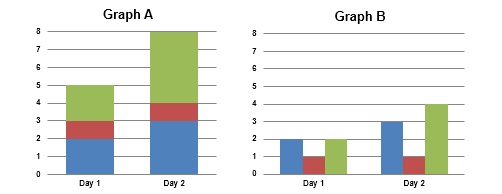
Click the Exhibit.

Internal auditors are asked to keep track of how many hours per day they spend planning the audit, conducting the engagement, and writing the audit report. The data for two days has been collected as follows:

Day 1
Day 2
Planning the audit
2 hours
3 hours
Conducting the engagement
1 hour
1 hour
Writing the audit report 2 hours
4 hours
Which of the following graphs depicts the data accurately?
Show answerHide answer

Correct answer: C Both A and B.

Explanation

Explanation:

To determine which graph accurately represents the data, let's map out the given numbers against both chart types:

Data Breakdown:
Blue (Planning the audit): Day 1 = 2 hours | Day 2 = 3 hours
Red (Conducting the engagement): Day 1 = 1 hour | Day 2 = 1 hour
Green (Writing the audit report): Day 1 = 2 hours | Day 2 = 4 hours
Analysis of Graph A (Stacked Bar Chart)
A stacked bar chart shows the cumulative total of the categories for each day.

Day 1 Stack:
Blue starts at 0 and goes up to 2 (Value = 2)
Red goes from 2 up to 3 (Value = 3 - 2 = 1)
Green goes from 3 up to 5 (Value = 5 - 3 = 2)
Total height = 5 hours (2 + 1 + 2). This matches the data perfectly.

Day 2 Stack:
Blue starts at 0 and goes up to 3 (Value = 3)
Red goes from 3 up to 4 (Value = 4 - 3 = 1)
Green goes from 4 up to 8 (Value = 8 - 4 = 4)
Total height = 8 hours (3 + 1 + 4). This matches the data perfectly.
Analysis of Graph B (Side-by-Side Clustered Bar Chart)
A clustered bar chart shows each category as individual standalone bars grouped by day.
Day 1 Bars: Blue is at 2, Red is at 1, and Green is at 2. (Accurate)
Day 2 Bars: Blue is at 3, Red is at 1, and Green is at 4. (Accurate)

Reference
Since both data visualizations—the stacked layout (Graph A) and the clustered layout (Graph B)—correctly chart every single data point relative to the Y-axis scale, both graphs are accurate depictions of the collected audit hours.
Full mock exam

Sit the IIA-CRMA-ADV exam before exam day

Full-length mocks with the same number of questions and the same time limit as the real IIA-CRMA-ADV exam. Every attempt draws a new set of questions from the full bank, so you can keep going until you pass comfortably.

Get full IIA-CRMA-ADV mock exam
  • 120questions per mock
  • 150 mintime limit
  • 283questions in the bank
  • Newmock on every attempt