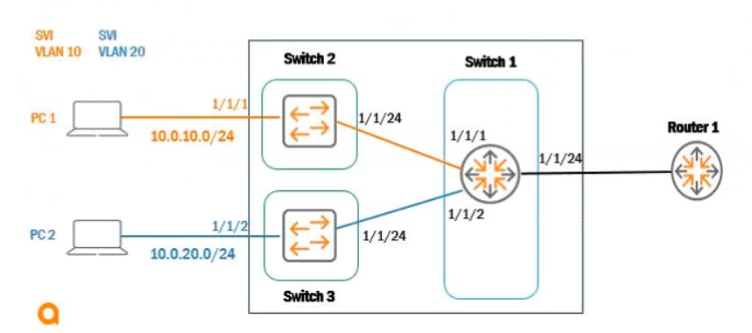
When using the OSPF dynamic routing protocol on an Aruba CX switch, what must match on the neighboring devices to exchange routes?
Show answerHide answer
Correct answer: A Hello timers
Explanation
Summary:For two OSPF neighbors to successfully form an adjacency and exchange routing information, several parameters in their OSPF Hello packets must match. These parameters are a fundamental part of the OSPF protocol's handshake mechanism. A mismatch in any of these required fields will prevent the neighbor relationship from moving beyond the "Init" or "2-Way" state, effectively blocking route exchange.
Correct Option:
A. Hello timers:
For OSPF neighbors to form an adjacency, their Hello and Dead timers must be identical. These timers are included in the OSPF Hello packets. If the timers do not match, the routers will not recognize each other as valid neighbors and will not proceed to exchange Link-State Advertisements (LSAs), which contain the routing information.
Incorrect Option:
B. DR configuration:
The Designated Router (DR) is an role elected by the OSPF routers on a multi-access network segment (like Ethernet). While the DR/BDR election process is important for network efficiency, the configuration of which router becomes the DR does not need to "match" for a basic adjacency to form. Routers will still form adjacencies with the DR and BDR regardless of their initial configuration.
C. ECMP method:
ECMP (Equal-Cost Multi-Path) is a feature that allows a router to load-balance traffic across multiple paths to the same destination that have the same cost. The method or configuration of ECMP is a local decision on each router and does not need to be negotiated or matched between OSPF neighbors for them to form an adjacency and exchange routes.
D. BDR configuration:
Similar to the DR, the Backup Designated Router (BDR) is an elected role. The configuration related to BDR priority does not need to match between neighbors. The election uses the configured priorities to determine the winner, but a mismatch in priority values does not prevent adjacency formation; it only influences the outcome of the election.
Reference:
Aruba Official Website/Documentation: The ArubaOS-CX OSPF Configuration Guide details the requirements for OSPF adjacency formation. It explicitly lists that OSPF neighbors must have matching Hello intervals, Dead intervals, Area ID, Authentication parameters, and stub area flags. A mismatch in Hello/Dead timers is a common cause for OSPF neighbor relationships failing to form.