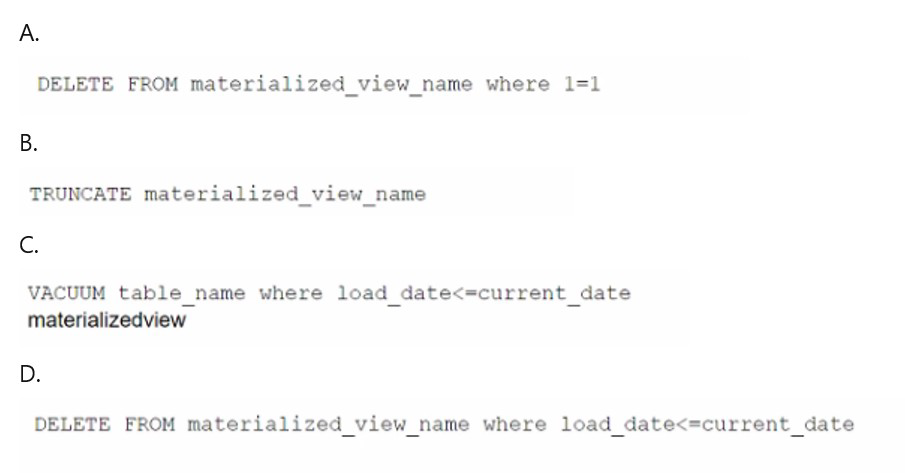
Correct answer: C
Create an Amazon Athena workgroup. Explore the data that is in Amazon S3 by using
Apache Spark through Athena. Provide the Athena workgroup schema and tables to the
analytics department.
Explanation
Explanation: The best solution to meet the requirements of creating a data catalog that
includes the IoT data, and allowing the analytics department to index the data, most costeffectively,
is to create an Amazon Athena workgroup, explore the data that is in Amazon
S3 by using Apache Spark through Athena, and provide the Athena workgroup schema
and tables to the analytics department.
Amazon Athena is a serverless, interactive query service that makes it easy to analyze
data directly in Amazon S3 using standard SQL or Python1. Amazon Athena also supports
Apache Spark, an open-source distributed processing framework that can run large-scale
data analytics applications across clusters of servers2. You can use Athena to run Spark
code on data in Amazon S3 without having to set up, manage, or scale any
infrastructure. You can also use Athena to create and manage external tables that pointto
your data in Amazon S3, and store them in an external data catalog, such as AWS Glue
Data Catalog, Amazon Athena Data Catalog, or your own Apache Hive metastore3. You
can create Athena workgroups to separate query execution and resource allocation based
on different criteria, such as users, teams, or applications4. Youcan share the schemas
and tables in your Athena workgroup with other users or applications, such as Amazon
QuickSight, for data visualization and analysis5.
Using Athena and Spark to create a data catalog and explore the IoT data in Amazon S3 is
the most cost-effective solution, as you pay only for the queries you run or the compute you use, and you pay nothing when the service is idle1. You also save on the operational
overhead and complexity of managing data warehouse infrastructure, as Athena and Spark
are serverless and scalable. You can also benefit from the flexibility and performance of
Athena and Spark, as they support various data formats, including JSON, and can handle
schema changes and complex queries efficiently.
Option A is not the best solution, as creating an AWS Glue Data Catalog, configuring an
AWS Glue Schema Registry, creating a new AWS Glue workload to orchestrate the
ingestion of the data that the analytics department will use into Amazon Redshift
Serverless, would incur more costs and complexity than using Athena and Spark. AWS
Glue Data Catalog is a persistent metadata store that contains table definitions, job
definitions, and other control information to help you manage your AWS Glue
components6. AWS Glue Schema Registry is a service that allows you to centrally store
and manage the schemas of your streaming data in AWS Glue Data Catalog7. AWS Glue
is a serverless data integration service that makes it easy to prepare, clean, enrich, and
move data between data stores8. Amazon Redshift Serverless is a feature of Amazon
Redshift, a fully managed data warehouse service, that allows you to run and scale
analytics without having to manage data warehouse infrastructure9. While these services
are powerful and useful for many data engineering scenarios, they are not necessary or
cost-effective for creating a data catalog and indexing the IoT data in Amazon S3. AWS
Glue Data Catalog and Schema Registry charge you based on the number of objects
stored and the number of requests made67. AWS Glue charges you based on the compute
time and the data processed by your ETL jobs8. Amazon Redshift Serverless charges you
based on the amount of data scanned by your queries and the compute time used by your
workloads9. These costs can add up quickly, especially if you have large volumes of IoT
data and frequent schema changes. Moreover, using AWS Glue and Amazon Redshift
Serverless would introduce additional latency and complexity, as you would have to ingest
the data from Amazon S3 to Amazon Redshift Serverless, and then query it from there,
instead of querying it directly from Amazon S3 using Athena and Spark.
Option B is not the best solution, as creating an Amazon Redshift provisioned cluster,
creating an Amazon Redshift Spectrum database for the analytics department to explore
the data that is in Amazon S3, and creating Redshift stored procedures to load the data
into Amazon Redshift, would incur more costs and complexity than using Athena and
Spark. Amazon Redshift provisioned clusters are clusters that you create and manage by
specifying the number and type of nodes, and the amount of storage and compute
capacity10. Amazon Redshift Spectrum is a feature of Amazon Redshift that allows you
toquery and join data across your data warehouse and your data lake using standard
SQL11. Redshift stored procedures are SQL statements that you can define and store in
Amazon Redshift, and then call them by using the CALL command12. While these features
are powerful and useful for many data warehousing scenarios, they are not necessary or
cost-effective for creating a data catalog and indexing the IoT data in Amazon S3. Amazon Redshift provisioned clusters charge you based on the node type, the number of nodes,
and the duration of the cluster10. Amazon Redshift Spectrum charges you based on the
amount of data scanned by your queries11. These costs can add up quickly, especially if
you have large volumes of IoT data and frequent schema changes. Moreover, using
Amazon Redshift provisioned clusters and Spectrum would introduce additional latency
and complexity, as you would have to provision and manage the cluster, create an external
schema and database for the data in Amazon S3, and load the data into the cluster using
stored procedures, instead of querying it directly from Amazon S3 using Athena and Spark.
Option D is not the best solution, as creating an AWS Glue Data Catalog, configuring an
AWS Glue Schema Registry, creating AWS Lambda user defined functions (UDFs) by
using the Amazon Redshift Data API, and creating an AWS Step Functions job to
orchestrate the ingestion of the data that the analytics department will use into Amazon
Redshift Serverless, would incur more costs and complexity than using Athena and
Spark. AWS Lambda is a serverless compute service that lets you run code without
provisioning or managing servers13. AWS Lambda UDFs are Lambda functions that you
can invoke from within an Amazon Redshift query. Amazon Redshift Data API is a service
that allows you to run SQL statements on Amazon Redshift clusters using HTTP requests,
without needing a persistent connection. AWS Step Functions is a service that lets you
coordinate multiple AWS services into serverless workflows. While these services are
powerful and useful for many data engineering scenarios, they are not necessary or costeffective
for creating a data catalog and indexing the IoT data in Amazon S3. AWS Glue
Data Catalog and Schema Registry charge you based on thenumber of objects stored and
the number of requests made67. AWS Lambda charges you based on the number of
requests and the duration of your functions13. Amazon Redshift Serverless charges you
based on the amount of data scanned by your queries and the compute time used by your
workloads9. AWS Step Functions charges you based on the number of state transitions in
your workflows. These costs can add up quickly, especially if you have large volumes of
IoT data and frequent schema changes. Moreover, using AWS Glue, AWS Lambda,
Amazon Redshift Data API, and AWS Step Functions would introduce additional latency
and complexity, as you would have to create and invoke Lambda functions to ingest the
data from Amazon S3 to Amazon Redshift Serverless using the Data API, and coordinate
the ingestion process using Step Functions, instead of querying it directly from Amazon S3
using Athena and Spark.
References:
What is Amazon Athena?
Apache Spark on Amazon Athena
Creating tables, updating the schema, and adding new partitions in the Data
Catalog from AWS Glue ETL jobs
Managing Athena workgroups
Using Amazon QuickSight to visualize data in Amazon Athena
AWS Glue Data Catalog
AWS Glue Schema Registry
What is AWS Glue?
Amazon Redshift Serverless
Amazon Redshift provisioned clusters
Querying external data using Amazon Redshift Spectrum
Using stored procedures in Amazon Redshift
What is AWS Lambda?
[Creating and using AWS Lambda UDFs]
[Using the Amazon Redshift Data API]
[What is AWS Step Functions?]
AWS Certified Data Engineer - Associate DEA-C01 Complete Study Guide