Which of the following image data augmentation techniques allows a data scientist to increase the size of a data set?
Show answerHide answer
Correct answer: B Cropping
Explanation
Explanation:The goal of data augmentation is to artificially expand the size and diversity of a training dataset without collecting new data. This is done by applying random-yet-realistic transformations to existing images.
How Cropping Increases Data Set Size:
When you apply random cropping to an image, you select a random portion of the original image (e.g., a 200x200 pixel section from a 250x250 image). This creates a new, unique image that is added to the training set. By performing this process multiple times on each original image, you can generate hundreds or thousands of new training examples from a single source image. This effectively "increases the size of the data set."
Why the Other Options Are Not Correct
A. Clipping
Purpose: In the context of image processing, clipping typically refers to restricting pixel values to a certain range (e.g., clipping values above 255 to 255 after a contrast adjustment) or clipping graphical elements that extend beyond a canvas boundary.
Why it's wrong: Clipping is an operation that constrains data; it does not create new data. It might be a step in a normalization process, but it does not generate new image files or variants that can be added to a dataset. Therefore, it does not increase the dataset size.
C. Masking
Purpose: Masking involves applying a binary mask to an image to isolate or hide specific regions. For example, you might mask out the background of a photo to focus on the main object.
Why it's wrong: While masking can be a useful pre-processing step to help a model focus on relevant features, it is not a primary data augmentation technique. Applying the same mask to an image does not create meaningfully new training examples in the way that geometric transformations do. It alters the image but doesn't typically generate multiple unique variants from a single source for the purpose of dataset expansion.
D. Scaling
Purpose: Scaling (or resizing) changes the dimensions of an image (e.g., from 500x500 pixels to 250x250 pixels).
Why it's misleading and not the best answer:
Scaling is a pre-processing requirement, not a standard data augmentation technique. Convolutional Neural Networks (CNNs) require all input images to be the same size. Therefore, you must scale all images to a fixed dimensions (e.g., 224x224) before feeding them into the model. While you could technically create different scaled versions, the standard practice is to scale everything to one consistent size. It is not used to create new training examples but to standardize existing ones. Cropping, flipping, and rotating are used for augmentation; scaling is used for pre-processing.
References
Deep Learning Frameworks:
The documentation for popular deep learning libraries like TensorFlow and PyTorch explicitly list RandomCrop as a core image augmentation transformation. For instance, torchvision.transforms.RandomCrop is designed to "Crop the given image at a random location" to increase data diversity.
Image Data Augmentation Standards:
Foundational textbooks and resources on computer vision (e.g., Deep Learning for Computer Vision by Rajalingappaa Shanmugamani) consistently list cropping, along with rotating, flipping, and color jittering, as fundamental techniques for dataset expansion. Scaling is universally listed as a pre-processing step, not an augmentation step.
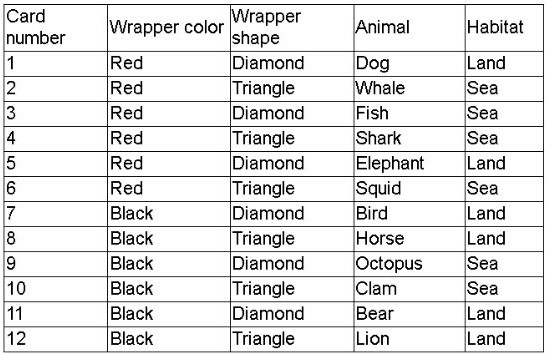 The data scientist is tasked with designing an initial model iteration to predict whether the
animal on the card lives in the sea or on land, given the card's features: Wrapper color,
Wrapper shape, and Animal.