A developer is storing sensitive data generated by an application in Amazon S3. The
developer wants to encrypt the data at rest. A company policy requires an audit trail of
when the AWS Key Management Service (AWS KMS) key was used and by whom.
Which encryption option will meet these requirements?
Show answerHide answer
Correct answer: BServer-side encryption with AWS KMS managed keys (SSE-KMS}
Explanation
Explanation: This solution meets the requirements because it encrypts data at rest using
AWS KMS keys and provides an audit trail of when and by whom they were used. Serverside
encryption with AWS KMS managed keys (SSE-KMS) is a feature of Amazon S3 that
encrypts data using keys that are managed by AWS KMS. When SSE-KMS is enabled for
an S3 bucket or object, S3 requests AWS KMS to generate data keys and encrypts data
using these keys. AWS KMS logs every use of its keys in AWS CloudTrail, which records
all API calls to AWS KMS as events. These events include information such as who made
the request, when it was made, and which key was used. The company policy can use
CloudTrail logs to audit critical events related to their data encryption and access. Serverside
encryption with Amazon S3 managed keys (SSE-S3) also encrypts data at rest using
keys that are managed by S3, but does not provide an audit trail of key usage. Server-side
encryption with customer-provided keys (SSE-C) and server-side encryption with selfmanaged
keys also encrypt data at rest using keys that are provided or managed by
customers, but do not provide an audit trail of key usage and require additional overhead
for key management.
Question 32Choose 1
A developer is creating a new batch application that will run on an Amazon EC2 instance.
The application requires read access to an Amazon S3 bucket. The developer needs to
follow security best practices to grant S3 read access to the application.
Which solution meets these requirements?
Show answerHide answer
Correct answer: AAdd the permissions to an 1AM policy. Attach the policy to a role. Attach the role to the
EC2 instance profile.
Explanation
Explanation: Step 1: Understanding the Requirements
Best Practices for Security:
Access Scope:The application needsread-only accessto an S3 bucket.
Step 2: Solution Analysis
Option A:
Option B:
Option C:
Option D:
Step 3: Implementation Steps
Create an IAM Policy:
json
Copy code
{
"Version": "2012-10-17",
"Statement": [
{
"Effect": "Allow",
"Action": "s3:GetObject",
"Resource": "arn:aws:s3:::your-bucket-name/*"
}
]
}
Attach the Policy to an IAM Role:
Associate the Role with the EC2 Instance:
Question 33Choose 1
A company runs a web application on Amazon EC2 instances behind an Application Load
Balancer. The application uses Amazon DynamoDB as its database. The company wants to ensure high performance for reads and writes.
Which solution will meet these requirements MOST cost-effectively?
Show answerHide answer
Correct answer: AConfigure auto-scaling for the DynamoDB table with a target utilization of 70%. Set the
minimum and maximum capacity units based on the expected workload.
Explanation
Explanation:
Why Option A is Correct:Auto-scaling with a target utilization ensures the
DynamoDB table dynamically adjusts capacity based on workload, maintaining
high performance while optimizing cost. Setting a reasonable target utilization
minimizes overprovisioning and throttling risks.
Question 34Choose 1
A developer is working on an ecommerce website The developer wants to review server
logs without logging in to each of the application servers individually. The website runs on
multiple Amazon EC2 instances, is written in Python, and needs to be highly available
How can the developer update the application to meet these requirements with MINIMUM
changes?
Show answerHide answer
Correct answer: DInstall the unified Amazon CloudWatch agent on the EC2 instances Configure the agent
to push the application logs to CloudWatch
Explanation
Explanation:
Centralized Logging Benefits:Centralized logging is essential for operational
visibility in scalable systems, especially those using multiple EC2 instances like
our e-commerce website. CloudWatch provides this capability, along with other
monitoring features.
Question 35Choose 1
A company is using Amazon OpenSearch Service to implement an audit monitoring
system. A developer needs to create an AWS Cloudformation custom resource that is
associated with an AWS Lambda function to configure the OpenSearch Service domain.
The Lambda function must access the OpenSearch Service domain by using Open Search Service internal master user credentials.
What is the MOST secure way to pass these credentials to the Lambdas function?
Show answerHide answer
Correct answer: DUse CloudFoimalion to create an AWS Secrets Manager Secret. Use a CloudFormation
dynamic reference to retrieve the secret's value for the OpenSearch Service domain's
MasterUserOptions. Create an 1AM role that has the secrets manager. GetSecretvalue
permission. Assign the role to the Lambda Function Store the secrets name as the Lambda
function's environment variable. Resole the secret's value at runtime.
Explanation
Explanation: The solution that will meet the requirements is to use CloudFormation to
create an AWS Secrets Manager secret. Use a CloudFormation dynamic reference to
retrieve the secret’s value for the OpenSearch Service domain’s MasterUserOptions.
Create an IAM role that has the secretsmanager:GetSecretValue permission. Assign the
role to the Lambda function. Store the secret’s name as the Lambda function’s environment
variable. Resolve the secret’s value at runtime. This way, the developer can pass the
credentials to the Lambda function in a secure way, as AWS Secrets Manager encrypts
and manages the secrets. The developer can also use a dynamic reference to avoid
exposing the secret’s value in plain text in the CloudFormation template. The other options
either involve passing the credentials as plain text parameters, which is not secure, or
encrypting them with AWS KMS, which is less convenient than using AWS Secrets
Manager.
Question 36Choose 1
A developer is creating an AWS Lambda function in VPC mode An Amazon S3 event will invoke the Lambda function when an object is uploaded into an S3 bucket The Lambda
function will process the object and produce some analytic results that will be recorded into
a file Each processed object will also generate a log entry that will be recorded into a file.
Other Lambda functions. AWS services, and on-premises resources must have access to
the result files and log file. Each log entry must also be appended to the same shared log
file. The developer needs a solution that can share files and append results into an existing
file.
Which solution should the developer use to meet these requirements?
Show answerHide answer
Correct answer: ACreate an Amazon Elastic File System (Amazon EFS) file system. Mount the EFS file
system in Lambda. Store the result files and log file in the mount point. Append the log
entries to the log file.
Explanation
Explanation:
Amazon EFS: A network file system (NFS) providing shared, scalable storage
across multiple Lambda functions and other AWS resources.
Lambda Mounting: EFS file systems can be mounted within Lambda functions to
access a shared storage space.
Log Appending: EFS supports appending data to existing files, making it ideal for
the log file scenario.
Question 37Choose 1
An application that is hosted on an Amazon EC2 instance needs access to files that are
stored in an Amazon S3 bucket. The application lists the objects that are stored in the S3
bucket and displays a table to the user. During testing, a developer discovers that the application does not show any objects in the list.
What is the MOST secure way to resolve this issue?
Show answerHide answer
Correct answer: BUpdate the IAM instance profile that is attached to the EC2 instance to include the
S3:ListBucket permission for the S3 bucket.
Explanation
Explanation: IAM instance profiles are containers for IAM roles that can be associated
with EC2 instances. An IAM role is a set of permissions that grant access to AWS
resources. An IAM role can be used to allow an EC2 instance to access an S3 bucket by
including the appropriate permissions in the role’s policy. The S3:ListBucket permission
allows listing the objects in an S3 bucket. By updating the IAM instance profile with this
permission, the application on the EC2 instance can retrieve the objects from the S3 bucket
and display them to the user.
Question 38Choose 1
A developer needs to write an AWS CloudFormation template on a local machine and
deploy a CloudFormation stack to AWS.
What must the developer do to complete these tasks?
Show answerHide answer
Correct answer: CInstall the AWS CLI. Configure the AWS CLI by using an 1AM user access key and
secret key.
Question 39Choose 1
A large company has its application components distributed across multiple AWS accounts.
The company needs to collect and visualize trace data across these accounts.
What should be used to meet these requirements?
Show answerHide answer
Correct answer: AAWS X-Ray
Question 40Choose 1
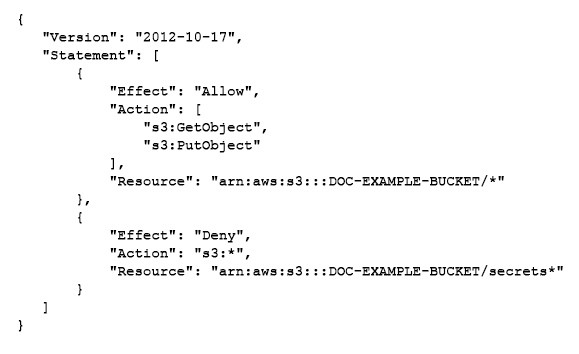
A developer has written the following IAM policy to provide access to an Amazon S3
bucket:
Which access does the policy allow regarding the s3:GetObject and s3:PutObject actions?
Show answerHide answer
Correct answer: DAccess on all objects in the “DOC-EXAMPLE-BUCKET” bucket except on objects that
start with “secrets”
Explanation
Explanation: The IAM policy shown in the image is a resource-based policy that grants or
denies access to an S3 bucket based on certain conditions. The first statement allows
access to any S3 action on any object in the “DOC-EXAMPLE-BUCKET” bucket when the
request is made over HTTPS (the value of aws:SecureTransport is true). The second
statement denies access to the s3:GetObject and s3:PutObject actions on any object in the
“DOC-EXAMPLE-BUCKET/secrets” prefix when the request is made over HTTP (the value
of aws:SecureTransport is false). Therefore, the policy allows access on all objects in the
“DOC-EXAMPLE-BUCKET” bucket except on objects that start with “secrets”.
Full mock exam
Sit the DVA-C02 exam before exam day
Full-length mocks with the same number of questions and the same time limit as the real DVA-C02 exam. Every attempt draws a new set of questions from the full bank, so you can keep going until you pass comfortably.