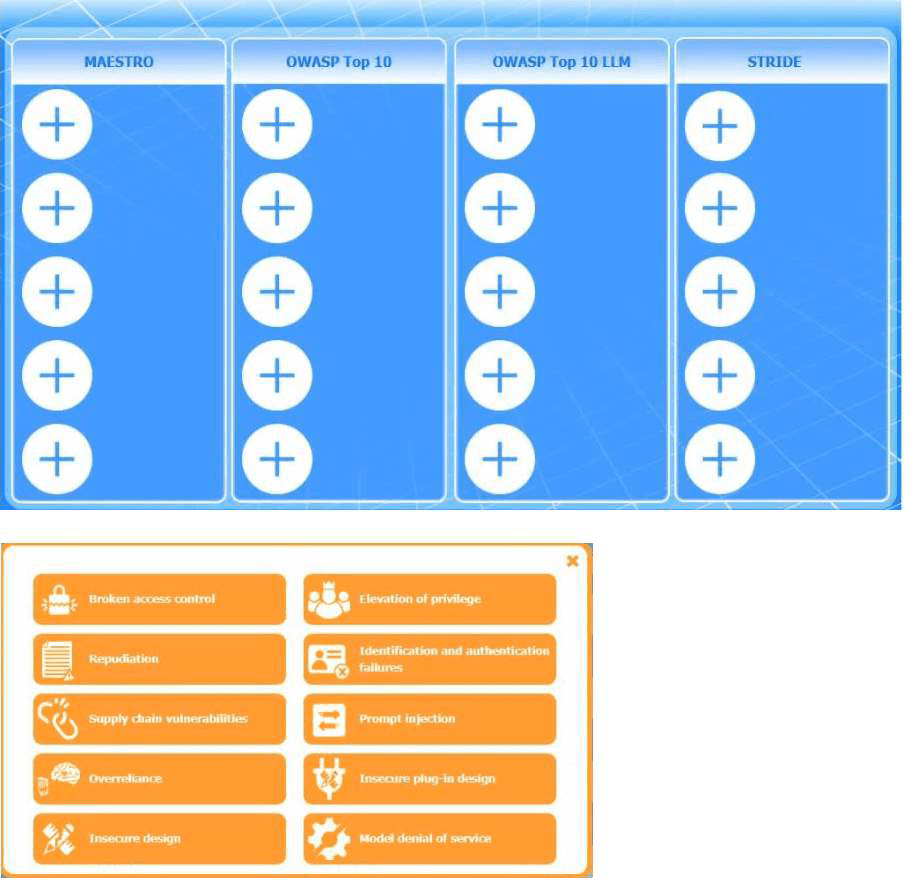
Instructions: Click the (+) to assign each threat category into its appropriate framework.
An architect is modeling an agentic system to meet security standards.
Show answerHide answer
Explanation
Explanations:MAESTRO (Agentic Architecture Framework):
Covers agent-specific risks across system layers. Supply chain vulnerabilities affect third-party agent components, models, and dependencies, while Overreliance targets dynamic risks in autonomous decision-making.
OWASP Top 10 (Traditional Web App Security):
Focuses on core application security. Broken access control ($A01:2021$) and Identification and authentication failures ($A07:2021$) address traditional authorization and identity flaws.
OWASP Top 10 for LLM Applications:
Focuses on Generative AI risks. Prompt injection ($LLM01$), Insecure plug-in design ($LLM07$), and Model denial of service ($LLM04$) represent specific direct threats to LLM execution and resource availability.
STRIDE (Threat Modeling Methodology):
A general threat taxonomy created by Microsoft. Repudiation ($R$) and Elevation of privilege ($E$) map directly to its acronym, while Insecure design reflects foundational architectural threat modeling.
Why Misclassifications Are Incorrect
Overreliance & Supply Chain in STRIDE/OWASP Top 10:
Legacy STRIDE only covers threat outcomes ($S, T, R, I, D, E$) and does not account for modern multi-agent autonomy or supply chain layers.
Prompt Injection in OWASP Top 10:
Standard web applications do not process natural language model contexts; prompt injection is strictly an OWASP Top 10 LLM risk.
Broken Access Control in MAESTRO:
While access control applies to agents, the category itself is a foundational web security risk under traditional OWASP Top 10.
References
Cloud Security Alliance (CSA): Agentic AI Threat Modeling Framework: MAESTRO (2025).
OWASP Foundation: OWASP Top 10:2021 and OWASP Top 10 for Large Language Model Applications.