The newest direction for laboratory testing procedures is
Show answerHide answer
Correct answer: CMolecular diagnostic techniques in various laboratory departments
Question 132Choose 1
Valine substitutes for glutamic acid in the Beta 6 position to produce HbS.
To produce hemoglobin S, glutamic acid that is normally present in the sixth position on the
beta globin chain is substituted with which of the following?
Show answerHide answer
Correct answer: DValine
Question 133Choose 1
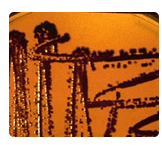
The colonies seen growing on the bird seed agar appear smooth and have a distinct
reddish-brown pigmentation. The active ingredient in bird seed (Guizotia abyssinica) agar
is caffeic acid, which is extracted and placed in an agar containing 1% glucose. Of the
cryptococci, and other species of yeasts, Cryptococcus neoformans selectively produces
the enzyme phenoloxidase, which oxidizes the caffeic acid in the medium to melanin,
producing the red-brown pigmentation.
The other yeast species included in this exercise do not possess phenoloxidase activity
and therefore remain non-pigmented when grown on bird seed agar.
The colonies shown in this photograph were grown on Guizotia abyssinica (bird seed) agar
at 30°C for 72 hours. The most likely identification is:
Show answerHide answer
Correct answer: BCryptococcus neoformans
Question 134Choose 1
The steps in the PCR process are:
1. Denaturation (Turning double stranded DNA into single strands.)
2. Annealing/Hybrization (Attachment of primers to the single DNA strands.)
3. Extension (Creating the complementary strand to produce new double stranded DNA.)
What is the first step of the PCR reaction?
Show answerHide answer
Correct answer: DDenaturation
Question 135Choose 4
Match each of the following definitions associated with heart disease and heart failure to
the term that it defines.
1. Congestive heart failure
2. Infarction
3. Ischemia
4. Angina
Show answerHide answer
Correct answer: A, B, C, DAn inadequate blood supply that decreases availability of oxygen.
Chest pain caused by inadequate supply of oxygen to heart myocardium.
An area of tissue death that occurs due to lack of oxygen.
A left ventricular dysfunction resulting from aging, hypertension, atherosclerosis or
muscle damage from an AMI or repeated AMIs.
Question 136Choose 1
The dematiaceous molds can be broadly separated into two major groups: the agents of
chromomycosis that grow more slowly, maturing only after 7 days or more of incubation,
and the more rapidly growing species that most commonly are clinically insignificant
commensals or contaminants when recovered from clinical specimens, but in rare
situations may cause opportunistic infections called phaeohyphomycosis.
Dematiaceous molds can be broadly separated into two major groups; the agents of
chromomycosis and clinically insignificant commensals or contaminants. The agents of
chromomycosis grow: more slowly than; more rapidly than; or generally at the same rate as
the clinically insignificant commensals or contaminants?
Show answerHide answer
Correct answer: Amore slowly than
Question 137Choose 1
The recommended order of draw for a complete blood count (CBC), prothrombin time, and
cholesterol is:
Show answerHide answer
Correct answer: Alight blue, red, and lavender
Question 138Choose 1
Blood plasma will contain coagulation proteins, but not in a clotted tube where serum is
present.
Blood serum contains each of the following substances except:
Show answerHide answer
Correct answer: CCoagulation proteins
Question 139Choose 2
1. A
2. A
3. B
4. A
5. B
6. B
A cardiovascular risk marker is an analyte in a body fluid that can be measured by the
clinical laboratory and has been associated with the development of cardiovascular
disease. Examples of risk markers include: LDL-C, triglycerides, and hs-CRP.
A cardiovascular risk factor is a condition (not a laboratory analyte) that is associated with
an increased risk of developing cardiovascular disease. Examples of risk factors include:
smoking, obesity, diabetes and hypertension.
Determine if each of the following is a cardiovascular risk marker or a cardiovascular risk
factor.
1. Smoking
2. Obesity
3. Low density lipoprotein (LDL)
4. Hypertension
5. Triglycerides
6. High sensitivity-C-reactive protein (hsCRP)
Show answerHide answer
Correct answer: A, BCardiovascular risk factor
Cardiovascular risk marker
Question 140Choose 1
Small, dense LDL is most likely to interact with arterial walls, leading to deposition of
cholesterol, and initiating or worsening atherosclerosis. Small, dense LDL is associated
with more than a three-fold increase in the risk of coronary heart disease.
Large, buoyant LDL is less atherogenic than small, dense LDL.
The LDL phenotype A is normal. It is the so called 'B' pattern that is associated with
increased risk.
Which of the following is most likely to interact with arterial walls, leading to deposition of
cholesterol, and initiating or worsening atherosclerosis?
Show answerHide answer
Correct answer: BSmall dense LDL
Full mock exam
Sit the ASCP-MLT exam before exam day
Full-length mocks with the same number of questions and the same time limit as the real ASCP-MLT exam. Every attempt draws a new set of questions from the full bank, so you can keep going until you pass comfortably.