Microsoft certification · Exam AI-901

AI-901 Mock Exam Page 2

Microsoft Azure AI Fundamentals (Updated Version)

Free AI-901 mock exam questions 11–14, each with the answer and an explanation.

14 questions · 16 minutes · free, no sign-up

Free AI-901 questions

11–14 of 14 free
Question 11
For each of the following statements, select Yes if the statement is true. Otherwise, select No.

NOTE:Each correct selection is worth one point.
Show answerHide answer

Explanation


Explanation:
This question tests your understanding of the fairness principle in Microsoft's responsible AI framework. Fairness is about ensuring AI systems treat all individuals equitably and do not disproportionately harm or disadvantage specific groups. It requires intentional design, evaluation, and mitigation—not simply optimizing for overall accuracy or treating every user identically regardless of context.

Correct Options (Yes):

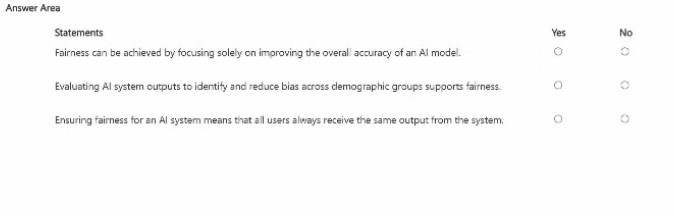
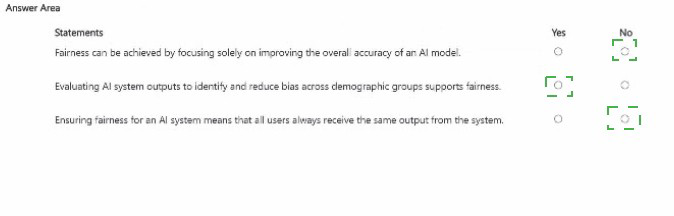
Evaluating AI system outputs to identify and reduce bias across demographic groups supports fairness.
This is true. Fairness requires proactive measurement and mitigation. You must evaluate model performance across different demographic groups (e.g., gender, ethnicity, age) to detect disparities. If bias is found, you take steps to reduce it. This is a core practice in building fair AI systems.

Incorrect Options (No):

Fairness can be achieved by focusing solely on improving the overall accuracy of an AI model.
This is false. Overall accuracy can mask disparities. A model may have high average accuracy but still perform poorly for specific subgroups (e.g., lower accuracy for a particular ethnicity or gender). Fairness requires disaggregated evaluation to ensure equitable performance across all groups, not just aggregate metrics.

Ensuring fairness for an AI system means that all users always receive the same output from the system.
This is false. Fairness does not mean identical outputs for everyone—that would ignore legitimate differences in context, needs, and circumstances. Fairness means the system should not discriminate or produce systematically biased outcomes. It is about equitable treatment, not uniform outputs (e.g., personalized recommendations can still be fair).

Reference:
Microsoft Learn: "Fairness" – Microsoft Responsible AI principles. Fairness is defined as ensuring AI systems treat everyone fairly and avoid perpetuating discrimination. Key practices include evaluating models for bias across demographic groups and mitigating disparities, rather than relying solely on overall accuracy or mandating identical outputs for all users. Also covered in the AI-901 module on Responsible AI.
Question 12
For each of the following statements, select Yes if the statement is true. Otherwise, select No.

NOTE: Each correct selection is worth one point.

Show answerHide answer

Explanation


Explanation:
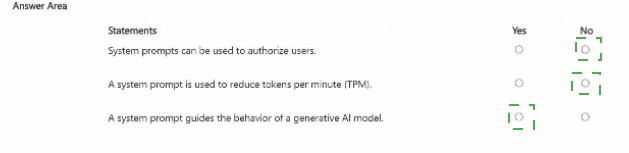
This question tests your understanding of the purpose and limitations of system prompts (also called system instructions) in generative AI models like Azure OpenAI. System prompts are text-based instructions that guide the model's behavior, tone, and constraints. However, they are not infrastructure or security controls—they cannot authorize users or affect performance settings like rate limits.

Correct Options (Yes):

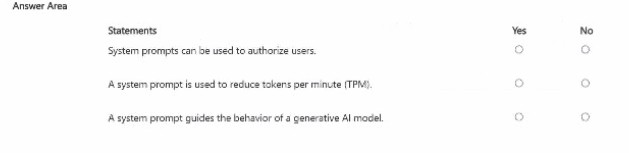
A system prompt guides the behavior of a generative AI model.
This is the primary purpose of a system prompt. It defines the AI's persona, tone, constraints, and response style (e.g., "You are a helpful assistant that answers only in Spanish"). It shapes how the model interprets and responds to user inputs throughout the conversation.

Incorrect Options (No):

System prompts can be used to authorize users.
This is false. Authorization (determining who has access to what) is handled by identity and access management (IAM) systems like Microsoft Entra ID (formerly Azure AD), role-based access control (RBAC), and API keys. System prompts are text instructions to the model and have no security or access-control capabilities.

A system prompt is used to reduce tokens per minute (TPM).
This is false. TPM is a rate-limiting and capacity metric configured at the Azure resource or deployment level. It controls throughput and is managed through the Azure portal or API quota settings. System prompts have no effect on TPM allocation or throttling behavior.

Reference:
Microsoft Learn: "System prompts" – Azure OpenAI Service documentation. System prompts are explicitly described as a way to define model behavior and context. Security and access control are covered under "Authentication and authorization" and "Azure OpenAI quota and limits" for TPM and rate limiting.
Question 13
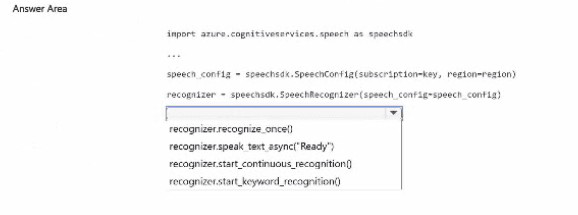
You are developing a voice application that listens for spoken commands and converts them into text by using Azure Speech in Foundry Tools.

How should you complete the Python code? To answer, select the appropriate option in the answer area.

NOTE: Each correct selection is worth one point.

Show answerHide answer

Explanation


Explanation:
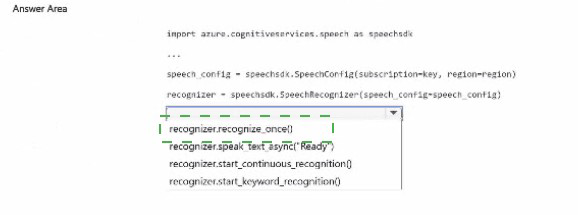
The question asks which method should be used to convert spoken commands into text using Azure Speech SDK. The SpeechRecognizer class provides different methods for recognition depending on the scenario. Since the application needs to listen for spoken commands and convert them to text, the appropriate method is recognize_once() for single-shot recognition or start_continuous_recognition() for ongoing listening. However, among the options provided, the correct choice for a single command is recognize_once().

Explanation of Correct Answer:

recognizer.recognize_once() –
This method performs single-shot speech recognition. It captures audio from the default microphone (or configured audio input), waits for a utterance to complete, and returns the recognized text. This is ideal for command-based applications where the user speaks one command at a time and expects an immediate response.

Incorrect Options:

recognizer.speak_text_async("Ready") –
This does not exist in the Speech SDK. The SpeechSynthesizer class has speak_text_async() for text-to-speech, not the SpeechRecognizer. This method would attempt to synthesize speech, not recognize it.

recognizer.start_continuous_recognition() –
This method starts continuous, event-driven recognition for long-running scenarios (e.g., transcribing a meeting). While it does convert speech to text, it requires event handlers and is more complex than necessary for simple command-based applications.

recognizer.start_keyword_recognition() –
This method is used for keyword (wake word) detection. It listens for a specific keyword before starting recognition. It does not directly convert general spoken commands to text; it only detects a predefined keyword.

Reference:
Microsoft Learn: "Speech-to-text quickstart" – Azure Speech SDK documentation. The recognize_once() method is the recommended approach for single-shot recognition of short utterances. Event-driven scenarios use start_continuous_recognition() with recognized event handlers. The speak_text_async() method is part of the SpeechSynthesizer class for text-to-speech, not recognition.
Question 14
For each of the following statements, select Yes if the statement is true. Otherwise, select No.

NOTE:Each correct selection is worth one point.

Show answerHide answer

Explanation


Explanation:
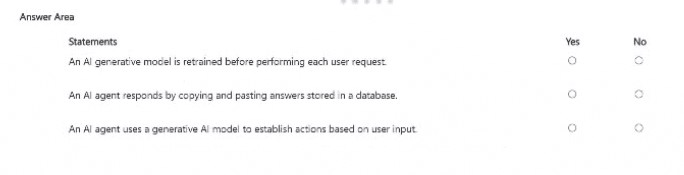
This question tests your understanding of how generative AI models and AI agents work. Generative AI models are pre-trained and perform inference (generation) per request without retraining. AI agents use generative models to reason, interpret user input, and determine actions dynamically—they do not simply retrieve static answers from a database unless specifically designed as retrieval-augmented systems.

Correct Options (Yes):

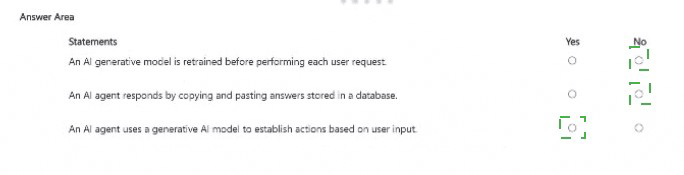
An AI agent uses a generative AI model to establish actions based on user input.
This is the core definition of an AI agent. It takes user input, processes it through a generative AI model (often with system instructions and tools), and determines the appropriate action or response dynamically. The model reasons about the input and context to generate a tailored response or execute a function.

Incorrect Options (No):

An AI generative model is retrained before performing each user request.
This is false. Generative AI models are pre-trained on large datasets and then deployed for inference. Retraining is a costly, time-consuming process that happens periodically—not per request. Each user request triggers a forward pass through the already-trained model to generate a response.

An AI agent responds by copying and pasting answers stored in a database.
This is false. While some AI systems use retrieval-augmented generation (RAG) to pull relevant documents from a database, the AI agent does not simply "copy and paste" static answers. It generates novel, context-aware responses based on the user's input, system instructions, and any retrieved data. This distinguishes generative AI from traditional rule-based or search-based systems.

Reference:
Microsoft Learn: "What is generative AI?" and "AI agents" – Azure AI Foundry documentation. Generative models are used for inference, not retraining, per request. AI agents leverage generative models to interpret user intent and take actions, often integrating with tools and data sources for dynamic, intelligent behavior.

That's the last free question

You've seen the free 30% (14 of 49 questions). Full access unlocks every question and full-length AI-901 mock exams (40 questions, 45 minutes), a different mock on every attempt.

Unlock full mock exam
Full mock exam

Sit the AI-901 exam before exam day

Full-length mocks with the same number of questions and the same time limit as the real AI-901 exam. Every attempt draws a new set of questions from the full bank, so you can keep going until you pass comfortably.

Get full AI-901 mock exam
  • 40questions per mock
  • 45 mintime limit
  • 49questions in the bank
  • Newmock on every attempt