Cisco certification · Exam 350-101

350-101 Mock Exam

Implementing and Operating Cisco Wireless Core Technologies (350-101 WLCOR)v1.0

Find out if you're ready for 350-101. Take the free timed mock exam and get your score in minutes, or study the free 350-101 questions below with answers and explanations.

20 questions · 27 minutes · free, no sign-up

Free 350-101 questions

1–10 of 27 free
Question 1 Choose 1
Exhibit:

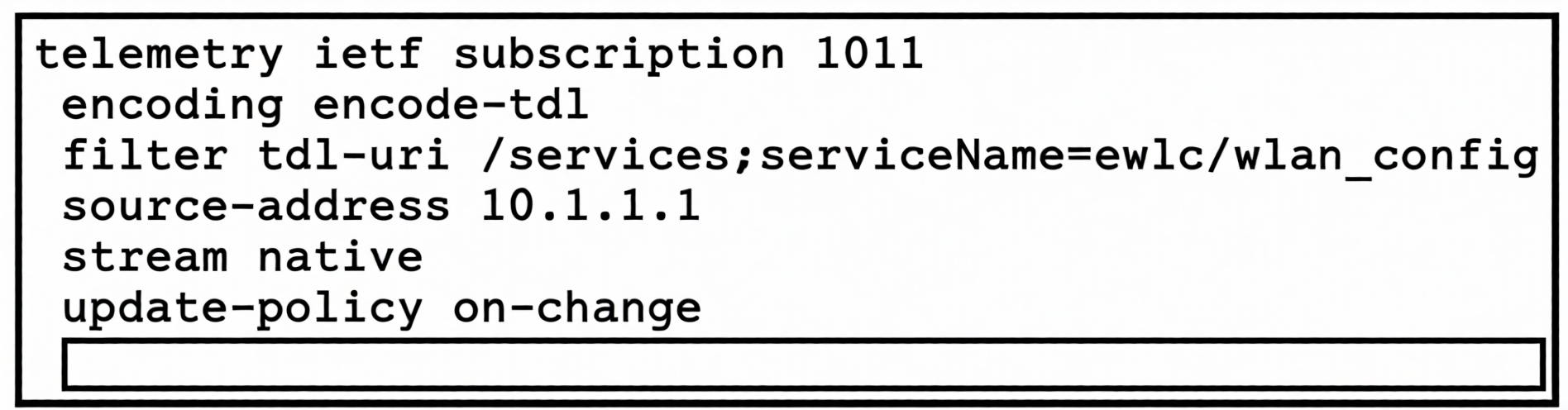
Refer to the exhibit. An organization wants to use Cisco Spaces for location analytics, and an engineer is setting up the Cisco Catalyst 9800 WLC to send location data. The Spaces connector has already been configured and is operational on the WLC. The engineer must now configure the controller to forward telemetry data to the correct Spaces cloud endpoint using TLS to complete the integration. Which CLI command must be added to the box in the code?
Show answerHide answer

Correct answer: C receiver ip address 198.51.100.10 57555 protocol tls-native profile spaces-profile

Explanation

Explanation:

Option C is correct because the command receiver ip address 198.51.100.10 57555 protocol tls-native profile spaces-profile follows the Cisco Catalyst 9800 WLC telemetry receiver configuration syntax. It specifies the destination IP address, TCP port 57555, TLS-native protocol for secure communication, and the existing spaces-profile TLS profile. This allows the WLC to securely forward telemetry data to the configured Cisco Spaces destination.

Why Other Options Are Incorrect:


A: Incorrect syntax and missing the required destination port.
B: Incorrect command order. The receiver IP address and port must appear before the protocol and profile parameters.
D: Incorrect syntax. The command must begin with receiver ip address, not profile.

Cisco References:

Cisco Catalyst 9800 Configuration Best Practices
Cisco Troubleshoot Telemetry from Catalyst 9800 WLC
Question 2 Choose 1
An organization must manage ongoing firmware updates for redundant controllers in the network. They will use Cisco Catalyst Center for deployment and visibility. The current environment uses centralized and distributed management approaches. Automation and reporting are critical to minimize operational workload. Which method must be used to manage structured update processes and monitor progress throughout the update cycle?
Show answerHide answer

Correct answer: C software image management workflows

Explanation

Explanation:

Cisco Catalyst Center uses Software Image Management (SWIM) workflows to automate firmware upgrades, manage software image distribution and activation, schedule updates, and monitor upgrade progress. These workflows provide centralized visibility, upgrade readiness checks, and status reporting, helping administrators efficiently maintain redundant wireless controllers while reducing manual effort.

Why Other Options Are Incorrect:


A: Inventory snapshots provide hardware and software information but cannot automate or manage firmware upgrades.
B: Software templates standardize device configurations rather than manage the complete software update process.
D: Lifecycle workflows is a general term, whereas SWIM provides the specific image management and upgrade monitoring capabilities required.

References:

Cisco Catalyst Center Manage Software Images
Cisco Troubleshoot Catalyst Center SWIM
Question 3 Choose 1
Users report slowness on the network, and it is suspected that certain applications are consuming all the bandwidth. A network engineer must enable the NBAR protocol to improve wireless client traffic visibility and provide advanced, granular, application classification, and analytics. How should the network engineer configure NBAR on a 9800 WLC?
Show answerHide answer

Correct answer: D Configure AVC on the policy profile.

Explanation

Explanation:

Cisco Catalyst 9800 Wireless LAN Controllers use Application Visibility and Control (AVC) with Network-Based Application Recognition (NBAR) to identify, classify, and monitor wireless client traffic. AVC uses deep packet inspection (DPI) to provide application level visibility, helping administrators identify bandwidth-intensive applications and analyze network usage. AVC is configured on the wireless policy profile, which is mapped to the WLAN through a policy tag. cisco.com+1

Why Other Options Are Incorrect:


A: NBARv2 is not enabled directly on the WLAN. Application recognition is configured through the wireless policy profile.
B: Deep packet inspection is a technology used by NBAR, not a separate WLAN configuration option.
C: Packet inspection is not the specific AVC configuration feature used for application classification on the policy profile.

References:

Cisco Understand Application Visibility and Control on Catalyst 9800
Cisco NBAR Protocol Discovery Configuration
Question 4 Choose 1
A business is deploying Cisco Catalyst 9100 APs managed by Catalyst 9800 WLCs. The IT team needs policies that adapt based on user identity and device posture and also provide visibility into device activity and location. Which configuration meets these requirements?
Show answerHide answer

Correct answer: A Integrate Cisco Catalyst Center with Cisco ISE for policy control, add mobile device management for posture checks, and use Cisco Spaces for location visibility.

Explanation

Explanation:

Cisco Catalyst Center, Cisco Identity Services Engine (ISE), Mobile Device Management (MDM), and Cisco Spaces work together to provide adaptive wireless network security and visibility. Cisco ISE enables identity-based access policies, MDM supplies device compliance and posture information, and Cisco Spaces provides location tracking and analytics. Cisco Catalyst Center supports centralized network management, monitoring, and policy integration.

Why Other Options Are Incorrect


B: WLC ACLs provide basic traffic filtering but cannot independently deliver comprehensive identity-based access control, posture assessment, and location analytics.
C: Static VLAN assignments cannot dynamically adapt to user identity or device compliance, and Catalyst Center Assurance alone does not provide the required policy enforcement.
D: Cisco ISE supports identity-based policies, but omitting MDM and location services leaves device compliance integration and location visibility incomplete.

References
Cisco Catalyst Center  Configure External Services
Cisco Identity Services Engine Data Sheet
Question 5 Choose 1
Which role does a fabric edge node perform in a Cisco wireless fabric architecture?
Show answerHide answer

Correct answer: C Terminating user data

Explanation

Explanation:

In Cisco Software-Defined Access (SD-Access) wireless fabric architecture, a fabric edge node terminates VXLAN tunnels from fabric-enabled access points and forwards wireless client traffic into the wired fabric network. It provides connectivity between wireless endpoints and the fabric while supporting traffic segmentation, policy enforcement, and VXLAN encapsulation or decapsulation.

Why Other Options Are Incorrect


A: TLS authentication for management connections is not a primary function of a fabric edge node.
B: Multicast snooping is a Layer 2 traffic optimization feature, not the defining role of a fabric edge node.
D: Converting Layer 2 addresses to Layer 3 addresses is not the fabric edge node's primary function. It handles endpoint connectivity and VXLAN traffic forwarding.

References

Cisco Software-Defined Access Wireless Configuration
Cisco SD-Access Design Guide
Question 6 Choose 1
Which Cisco Ultra-Reliable Wireless Backhaul process enables devices to establish a reliable connection with the next AP along their path before losing connectivity to the current one in a wireless network during roaming?
Show answerHide answer

Correct answer: D Make-before-break handover logic

Explanation

Explanation:

Cisco Ultra-Reliable Wireless Backhaul (URWB) uses make-before-break handover logic to maintain uninterrupted connectivity while devices move between access points. This process establishes a reliable connection with the next AP before disconnecting from the current AP, minimizing packet loss, latency, and communication interruptions. It is particularly useful for industrial vehicles, automated guided vehicles (AGVs), and other mission-critical applications requiring seamless roaming.

Why Other Options Are Incorrect


A: Open Roaming simplifies secure wireless network access across participating networks but does not provide URWB's make-before-break handover process.
B: Fast client handoff is a general roaming concept, but make-before-break handover is the specific URWB mechanism described.
C: IEEE 802.11v supports wireless network management and roaming assistance but does not establish a new AP connection before disconnecting from the current AP.

References

Cisco Ultra-Reliable Wireless Backhaul Solution Overview
Cisco What Is Ultra-Reliable Wireless Backhaul?
Question 7 Choose 1


A wireless controller is deployed at a branch location to facilitate secure client connectivity. A network engineer configures one WLAN using WPA2 Personal authentication and activates the preshared key method to align with company security policies. Which action must be taken to enable the client to connect to the WLAN?
Show answerHide answer

Correct answer: A Enter the preshared key at the WLAN security configuration prompt

Explanation

Explanation:

Cisco Catalyst wireless controllers support WPA2-Personal authentication using a Pre-Shared Key (PSK). The network engineer must configure the preshared key in the WLAN security settings, and wireless clients must use the same key to authenticate and establish a secure connection.
WPA2-Personal uses AES-CCMP encryption and does not require an external RADIUS authentication server or individual client certificates.

Why Other Options Are Incorrect


B: MAC filtering restricts access based on device MAC addresses but does not replace WPA2-Personal PSK authentication.
C: Active Directory integration is not required for WPA2-Personal. Enterprise authentication typically uses 802.1X with a RADIUS server.
D: Client certificates are associated with certificate-based authentication methods such as EAP-TLS, not WPA2-Personal PSK authentication.

References

Cisco Catalyst 9800 WLAN Security Configuration
Cisco Catalyst 9800 PSK Authentication Configuration
Question 8 Choose 1
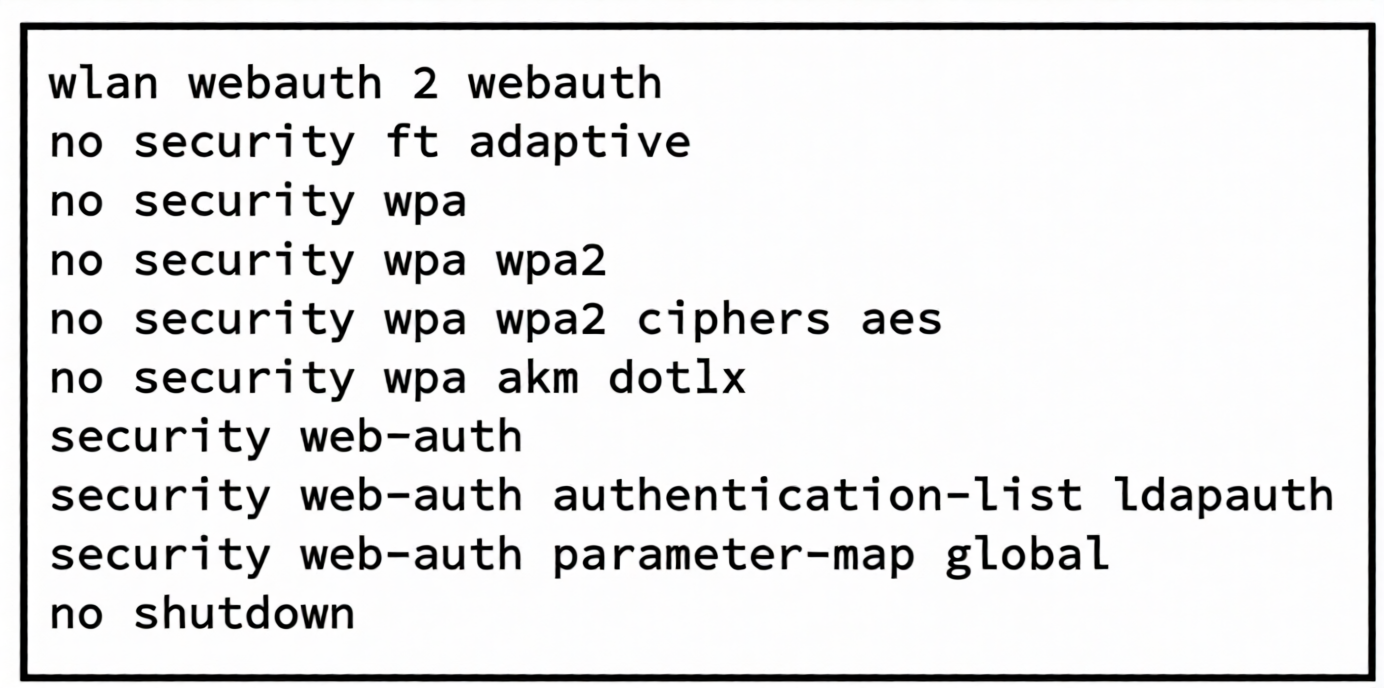
Refer to the exhibit. A wireless controller is deployed at a branch location to facilitate guest client connectivity. A network engineer configures one WLAN using Web authentication and activates web-based method to align with company security policies. Which configuration enables client authentication for this WLAN?
Show answerHide answer

Correct answer: A security web-auth

Explanation

Explanation:

Cisco Catalyst 9800 Wireless LAN Controllers use the security web-auth command to enable web-based authentication on a WLAN. This allows guest wireless clients to authenticate through a web portal before accessing network resources.
Web authentication is commonly used for guest access, where users connect to a WLAN and complete authentication through a browser-based login page. Cisco documentation also describes associating an AAA authentication list with the web authentication configuration.

Why Other Options Are Incorrect


B: wlan webauth 2 webauth creates or enters a WLAN configuration context but does not enable web authentication.
C: no security wpa wpa2 disables WPA2 security but does not enable web-based authentication.
D: no security wpa akm dot1x disables 802.1X authentication but does not activate web authentication.

References

Cisco Configure Local Web Authentication on Catalyst 9800
Cisco Web-Based Authentication Configuration Guide
Question 9 Choose 1
A network administrator at a marketing company manages a Cisco Catalyst 9800 Series Wireless Controller running Cisco IOS XE 17.x. The WLAN named XYZ-Guest is set up for visitors, and the administrator wants to implement a web authentication (WebAuth) portal using an external server to manage guest access. To ensure seamless and secure guest authentication, the controller must be configured to use an external WebAuth server for the WLAN. The administrator must configure the XYZ-Guest WLAN to use an external WebAuth server with a parameter map named webauth-ext. Which set of Cisco IOS XE commands must be used?
Show answerHide answer

Correct answer: A wireless wlan XYZ-Guestsecurity web-auth external webauth-ext

Question 10 Choose 1
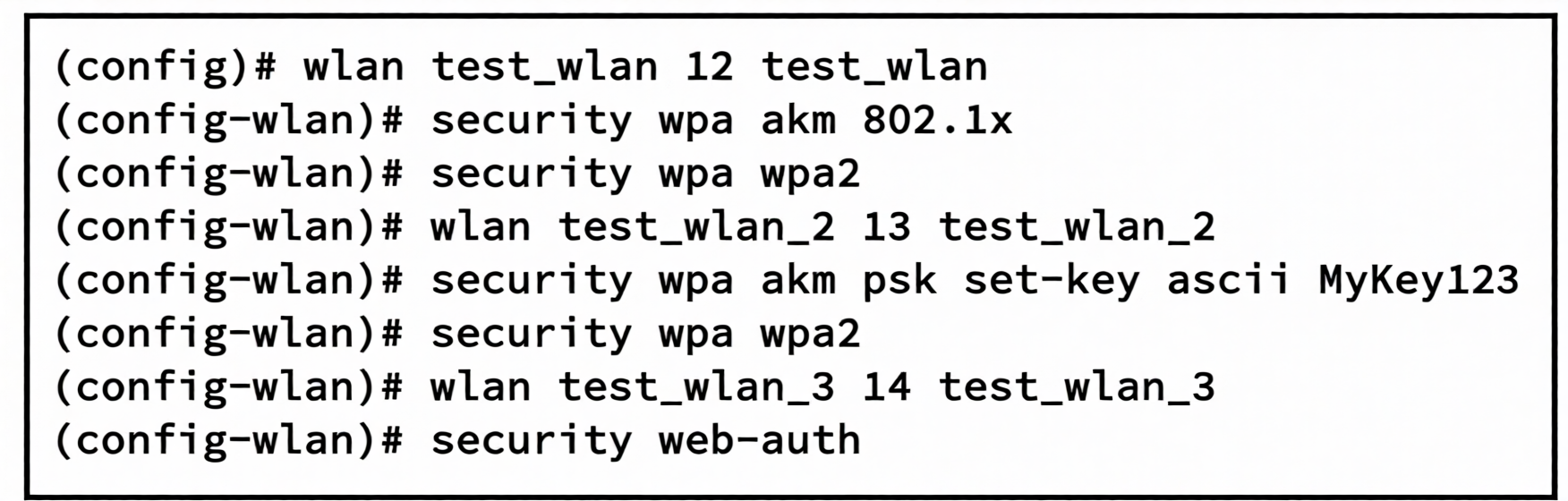
Refer to the exhibit. The Catalyst 9800 WLC logs show when a client with MAC address 9C:4E:36:8A:2B:F1 fails to connect to a WLAN configured for Wi-Fi Protected Access 3-Enterprise with 802.1X. Which action must the engineer take to resolve the issue?

Show answerHide answer

Correct answer: C Verify the client's Active Directory credentials and ensure that the RADIUS server is reachable.

Full mock exam

Sit the 350-101 exam before exam day

Full-length mocks with the same number of questions and the same time limit as the real 350-101 exam. Every attempt draws a new set of questions from the full bank, so you can keep going until you pass comfortably.

Get full 350-101 mock exam
  • 90questions per mock
  • 120 mintime limit
  • 102questions in the bank
  • Newmock on every attempt

From RF Fundamentals to AI-Driven Wi-Fi: Your Cisco 350-101 WLCOR Exam Preparation Roadmap

The Cisco 350-101 WLCOR v1.0 (Implementing and Operating Cisco Wireless Core Technologies) exam evaluates your ability to configure, manage, secure, and troubleshoot enterprise wireless networks. This 120-minute exam is part of the CCNP Wireless and CCIE Wireless certification paths.

Understanding the official blueprint helps you prioritize high-weightage topics and prepare efficiently.

Cisco WLCOR v1.0 Exam Blueprint and Weightage

Cisco divides the exam into seven domains:

Exam DomainWeightage
RF Fundamentals15%
802.11 Technology Fundamentals10%
Wireless Network Implementation10%
Wireless Network Operation20%
Client Connectivity Configuration20%
Wireless Monitoring and Management15%
Automation and AI10%

Important: Wireless Network Operation and Client Connectivity Configuration together account for 40% of the exam, making them your highest study priorities.

Master Wireless Network Operations First

Wireless Network Operation (20%) requires practical configuration knowledge. Focus on:

  • Cisco wireless infrastructure initialization

  • Access point discovery and CAPWAP joining

  • AP operating modes and WLAN configuration

  • Client policies using Cisco Catalyst Center, ISE, and wireless controllers

Practice configuration scenarios rather than memorizing definitions.

Understand Wireless Authentication and Roaming

Client Connectivity Configuration (20%) tests secure wireless access.

Study authentication methods, WLAN security, Cisco ISE integration, roaming behavior, and guest network configuration.

Understand how authentication failures and roaming problems affect connectivity.

Strengthen Your RF and Troubleshooting Knowledge

RF Fundamentals (15%) covers signal propagation, RSSI, SNR, interference, RF calculations, and antenna characteristics.

Wireless Monitoring and Management (15%) includes network maintenance, client monitoring, connectivity troubleshooting, and platform integrations.

Practice identifying weak signals, interference, and authentication-related failures.

Don't Overlook the Remaining 30%

Three additional domains require focused preparation:

  • 802.11 Technology Fundamentals (10%): Wi-Fi standards, channel widths, modulation, MIMO, MLO, and regulatory requirements.

  • Wireless Network Implementation (10%): Fabric, mesh, local and cloud architectures, physical connections, and management access.

  • Automation and AI (10%): Python basics, NETCONF/YANG, wireless APIs, Cisco Catalyst Center AI Analytics, AI Operations, and AI-RRM.

A Practical Study Strategy for WLCOR Candidates

Start with the two 20% domains, then cover RF fundamentals and monitoring. Complete the remaining domains before attempting full mock exams.

Combine theoretical learning with hands-on wireless configuration and troubleshooting exercises.

Turn Practice Questions Into Exam Readiness

Cistified.com provides free Cisco 350-101 WLCOR practice questions to help you review important concepts and identify knowledge gaps.

Use paid mock tests to practice under timed conditions, assess your preparation, and improve question-solving speed.

Final preparation tip: Review incorrect answers by blueprint domain and revisit your weakest topics before scheduling the actual exam.