Cisco certification · Exam 300-745

300-745 Mock Exam

Designing Cisco Security Infrastructure (300-745 SDSI) v1.0

Find out if you're ready for 300-745. Take the free timed mock exam and get your score in minutes, or study the free 300-745 questions below with answers and explanations.

17 questions · 28 minutes · free, no sign-up

Free 300-745 questions

1–10 of 17 free
Question 1 Choose 1
A legal services company wants to prevent remote employees from accessing personal email and social media accounts while using corporate laptops. Which security solution enforces the policy?
Show answerHide answer

Correct answer: C Cisco Umbrella

Explanation

Explanation:

Cisco Umbrella is a cloud-delivered security solution that provides DNS-layer protection and web content filtering. It allows organizations to block access to personal email services, social media, and other restricted websites.

With the Umbrella Roaming Security module deployed on corporate laptops, security policies can be enforced even when employees work remotely, outside the corporate network.

Why Other Options Are Incorrect:

A. Cisco TrustSec: Provides identity-based network segmentation and access control, not primarily internet content filtering.
B. RADIUS server: Provides centralized authentication, authorization, and accounting (AAA), but does not directly block personal email or social media websites.
D. Network monitoring tool: Monitors network activity but does not inherently enforce website-blocking policies.

References:

Cisco Umbrella Web Content Filtering
Cisco Umbrella Roaming Client Configuration
Question 2 Choose 1
A software development company relies on GitHub for managing the source code and is committed to maintaining application security. The company must ensure that known software vulnerabilities are not introduced to the application. The company needs a capability within GitHub that can analyze semantic versioning and flag any software components that pose security risks. Which GitHub feature must be used?
Show answerHide answer

Correct answer: A Depend-a-bot

Explanation

Explanation:

GitHub Dependabot automatically identifies vulnerable dependencies in a project's software components. It checks dependency versions against known security advisories and alerts developers when vulnerabilities are discovered.
Dependabot can also create pull requests to update vulnerable dependencies to safer versions, taking semantic versioning and compatibility constraints into account.

Why Other Options Are Incorrect:

B. Sealed boxes: Provide public-key encryption for securely transmitting sensitive information. They do not scan software dependencies.
C. GitHub Actions: Automates CI/CD workflows, testing, and deployment. It can run security tools but does not inherently provide Dependabot's dependency vulnerability detection.
D. Artifact attestations: Provide verifiable information about software artifact provenance and build integrity, not dependency vulnerability scanning.

References:

GitHub Docs Dependabot Alerts
GitHub Docs Dependabot Version Updates
Question 3 Choose 1
An oil and gas company recently faced a security breach when an employee’s notepad, which contained critical login credentials, was stolen. The incident led to unauthorized access to a user account, which posed a significant risk to sensitive company data and operations. The company wants to adopt a security measure that enhances user account protection. Which action must be taken to prevent breaches like this from happening in the future?
Show answerHide answer

Correct answer: A Implement MFA

Explanation

Explanation:

Multi-Factor Authentication (MFA) provides an additional security layer by requiring users to verify their identities using two or more authentication factors, such as a password and a security key or authenticator app.
Even if an attacker steals a notepad containing valid login credentials, MFA can prevent unauthorized access because the attacker would also need to satisfy the additional authentication requirement.

Why Other Options Are Incorrect:

B. Implement single sign-on: SSO allows users to access multiple applications with one login. It simplifies authentication but does not independently protect against stolen credentials.
C. Update the RADIUS server: Updating RADIUS infrastructure may improve security, but it does not directly address unauthorized access caused by stolen passwords.
D. Configure a password expiration policy: Password expiration requires periodic password changes but cannot reliably prevent an attacker from using stolen credentials before they expire.

References:

Cisco What Is Multi-Factor Authentication?
Cisco Two-Factor Authentication and Account Protection
Question 4 Choose 1
A retail company is facing a series of cyberattacks targeting web servers, which results in disruptions to online services. Upon investigation, the security team identified that these attacks involved invalid HTTP request headers, which were used to exploit vulnerabilities in the web application. To safeguard the company websites against similar threats in the future, the security team must deploy a security solution specifically designed to detect and block such malicious web traffic. Which security product must be used to protect the websites from similar attacks?
Show answerHide answer

Correct answer: C web application firewall

Explanation

Explanation:

A Web Application Firewall (WAF) protects web applications by inspecting and filtering HTTP/HTTPS traffic at Layer 7 (Application Layer).
A WAF can detect and block malicious requests containing invalid HTTP headers, malformed requests, SQL injection attempts, and cross-site scripting (XSS) attacks.
In this scenario, a WAF is the best solution because it examines web requests and blocks malicious traffic before it reaches the company's web servers.

Why Other Options Are Incorrect:

A. Antivirus software: Detects malware and malicious files but does not specialize in inspecting HTTP requests targeting web applications.
B. Traditional firewall: Primarily filters network traffic using IP addresses, ports, and protocols. It generally lacks dedicated web application attack protection.
D. Host-based firewall: Controls incoming and outgoing network connections on individual servers but does not typically inspect HTTP headers for application-layer attacks.

References:

Cisco What Is a Web Application Firewall?
Cisco HTTP Application Inspection and Header Security
Question 5 Choose 1
A manufacturing company experienced a security breach that resulted in sales data being compromised. An engineer participating in the investigation must identify who logged into the sales system during the affected period. Which approach must be used to gather the information?
Show answerHide answer

Correct answer: C AAA

Explanation

Explanation:

AAA (Authentication, Authorization, and Accounting) is a security framework that manages user access and records user activities.

In this scenario, the engineer needs to identify who logged into the sales system during the security breach. The Accounting component of AAA provides audit records that can include usernames, login timestamps, and session information.
AAA has three components: - Authentication: Verifies the user's identity. - Authorization: Determines which resources the user can access. - Accounting: Records user access and session activities for auditing and investigation.

Why Other Options Are Incorrect:

A. SNMP: Monitors and manages network devices but is not primarily designed to track user login sessions.
B. NACM: Network Access Control Model controls access to network configuration and management operations, not general sales-system login auditing.
D. PKI: Public Key Infrastructure manages digital certificates and cryptographic identities but does not directly maintain user login activity logs.

References:

Cisco Configuring AAA Accounting
Cisco Authentication, Authorization, and Accounting Explained
Question 6 Choose 1
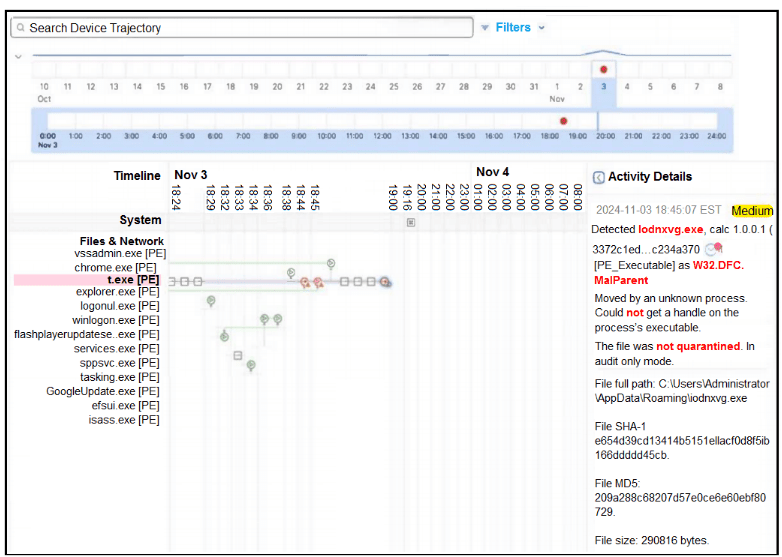
Refer to the exhibit.

A retail company recently deployed a file inspection feature using secure endpoint. The file inspection must detect and prevent the execution of malicious files on machines. During testing, logs showed that certain malicious files are still being executed despite the presence of the security measure. To understand why the threats are not being blocked, it is essential to investigate the configuration of secure endpoint policies. Which configuration is allowing the files to execute?
Show answerHide answer

Correct answer: D Policy rule is in audit mode.

Explanation

Explanation:

In Cisco Secure Endpoint, Audit Mode detects and logs malicious file activity but does not block or quarantine detected malicious files.
When a file inspection policy is configured in Audit Mode, malicious files may still execute even though security events appear in the logs.
To prevent malicious file execution, the administrator should change the file protection setting from Audit to Quarantine (Protect Mode).

Why Other Options Are Incorrect:

A. Files are not malicious: The scenario identifies the files as malicious, so this does not explain why they are allowed to execute.
B. Policy must block the network connections: Network blocking prevents malicious connections but does not directly stop local malicious file execution.
C. Policy rule is disabled: A disabled rule would not enforce protection, but the scenario's combination of detection logs and permitted execution specifically indicates Audit Mode.

References:

Cisco Secure Endpoint User Guide File Conviction Modes
Cisco Converting Secure Endpoint from Audit to Protect Mode
Question 7 Choose 1
A video game company identified a potential threat of a SYN flood attack, which could disrupt the online gaming services and impact user experience. The attack can overwhelm network resources by exploiting the TCP handshake process, leading to server unavailability and degraded performance. To safeguard the company's infrastructure and ensure uninterrupted service, it is essential to enhance the security measures in place. The company must implement a solution that manages and mitigates the risk of such networkbased attacks. Which security product must be implemented to mitigate similar risks?
Show answerHide answer

Correct answer: D Cisco Secure Firewall

Explanation

Explanation:

Cisco Secure Firewall provides network-level protection against attacks such as TCP SYN floods, which attempt to exhaust server resources by sending large numbers of TCP SYN requests without completing the three-way handshake.
Cisco Secure Firewall can use SYN flood protection, connection limits, and threat detection to identify and mitigate malicious network traffic.
In this scenario, Cisco Secure Firewall is the best choice because it helps protect the gaming company's servers against network-based denial-of-service (DoS) attacks.

Why Other Options Are Incorrect:

A. Cisco Web Security Appliance: Primarily protects users from web-based threats and filters outbound web traffic. It is not designed primarily for SYN flood mitigation.
B. Cisco Umbrella: Provides DNS-layer security, secure web access, and protection against malicious domains, not direct TCP SYN flood mitigation.
C. Cisco Secure Endpoint: Protects endpoint devices against malware and other host-based threats rather than mitigating network-level SYN floods.

References:

Cisco Protect Servers from SYN Flood DoS Attacks (TCP Intercept)
Cisco Secure Firewall Service Policies and Connection Limits
Question 8 Choose 1
After deploying a new API, the security team must identify the components of the application that are exposed to the internet and whether there are application authentication risks. Which technology must be deployed to discover the applications services and monitor for authentication issues?
Show answerHide answer

Correct answer: B API trace analysis

Explanation

Explanation:

API Trace Analysis examines API requests, responses, and communication between application services to identify exposed endpoints and potential authentication vulnerabilities.

It helps security teams:
- Discover API endpoints and application services.
- Identify APIs exposed to the internet.
- Monitor authentication behavior and detect potential security risks.
- Analyze communication between application components.
In this scenario, API trace analysis is the best choice because the company needs visibility into exposed application services and authentication risks.

Why Other Options Are Incorrect:

A. Cloud Security Posture Management: Identifies cloud misconfigurations and compliance risks but does not primarily analyze API request traces or authentication behavior.
C. Secret scanning: Detects exposed passwords, API keys, and tokens in source code but does not discover running application services.
D. Cloud Workload Protection: Protects cloud workloads, containers, and virtual machines against threats but is not specifically designed for API discovery and authentication analysis.

References:

Cisco Securing APIs From Left to Right
OWASP API Security Top 10 (2023)
Question 9 Choose 1
A pharmaceutical company needs a hub-and-spoke VPN topology. The design must be capable of building either partial or full mesh overlay networks. Which VPN solution must be implemented in the environment?
Show answerHide answer

Correct answer: A DMVPN

Explanation

Explanation:

Dynamic Multipoint VPN (DMVPN) is a Cisco VPN technology that supports hub-and-spoke, partial-mesh, and full-mesh network topologies.
DMVPN combines Multipoint GRE (mGRE), Next Hop Resolution Protocol (NHRP), and IPsec to create secure, scalable VPN connections.
It allows spoke routers to establish dynamic, direct spoke-to-spoke tunnels without requiring a separate static VPN configuration for every connection.
In this scenario, DMVPN is the best choice because the company needs a flexible VPN architecture capable of supporting both hub-and-spoke and mesh connectivity.

Why Other Options Are Incorrect:

B. L2TP: A Layer 2 tunneling protocol commonly used for remote-access VPNs. It does not inherently provide dynamic multipoint mesh connectivity.
C. Crypto maps: Configure traditional IPsec VPN tunnels but typically require explicit peer and traffic configurations, making dynamic mesh deployments less scalable.
D. SSL VPN: Primarily provides secure remote access for individual users or specific applications rather than dynamic site-to-site mesh networking.

References:

Cisco DMVPN Hub-and-Spoke and Full-Mesh Topologies
Cisco DMVPN Phase 3 Design and Routing
Question 10 Choose 1
Which financial reporting regulatory framework must a publicly traded company doing business in the US comply with?
Show answerHide answer

Correct answer: B SOX

Explanation

Explanation:

SOX (Sarbanes-Oxley Act of 2002) is a US federal law that establishes financial reporting, corporate accountability, and internal control requirements for publicly traded companies.
SOX requires applicable public companies to maintain reliable financial records and effective internal controls over financial reporting.
In cybersecurity, SOX compliance involves protecting financial systems through access controls, audit logs, change management, and data integrity measures.

Why Other Options Are Incorrect:

A. HIPAA: Protects sensitive healthcare information. It is not a financial reporting law.
C. SOC: System and Organization Controls reports assess service organizations' controls. SOC reports are not a federal financial reporting law for publicly traded companies.
D. FedRAMP: Establishes security assessment and authorization requirements for cloud services used by US federal agencies, not general corporate financial reporting.
References:

SEC Sarbanes-Oxley Section 404 Requirements
Cisco SOX Compliance and Security Controls
Full mock exam

Sit the 300-745 exam before exam day

Full-length mocks with the same number of questions and the same time limit as the real 300-745 exam. Every attempt draws a new set of questions from the full bank, so you can keep going until you pass comfortably.

Get full 300-745 mock exam
  • 55questions per mock
  • 90 mintime limit
  • 57questions in the bank
  • Newmock on every attempt

Think Like a Security Architect: Your Cisco 300-745 SDSI Exam Preparation Roadmap

The 300-745 Designing Cisco Security Infrastructure (SDSI) exam evaluates your ability to select secure architectures, protect enterprise applications, manage cybersecurity risks, and integrate automation into security operations. This 90-minute CCNP Security concentration exam emphasizes practical design decisions rather than memorizing security technologies.

Understand the SDSI Exam Blueprint

Cisco divides the exam into four weighted domains:

Exam DomainWeight
Secure Infrastructure30%
Applications25%
Risk, Events, and Requirements30%
Artificial Intelligence, Automation, and DevSecOps15%

Secure Infrastructure: Build Your Strongest Foundation (30%)

This domain focuses on selecting effective security solutions for modern enterprise environments.

Important preparation topics:

  • Identity security, MFA, and endpoint protection

  • VPN technologies, IPsec, SD-WAN, and tunneling

  • Next-generation firewalls, WAF, IDS, and IPS

  • Hybrid workforce, IoT, SaaS, and multicloud security

  • Management-plane and control-plane protection

Study tip: Practice selecting security technologies according to technical requirements, not just identifying their features.

Application Security: Protect Modern Workloads (25%)

Understand how security architectures protect traditional and cloud-native applications.

Focus on:

  • Application firewalls and SSL inspection

  • Data loss prevention (DLP)

  • Container and microservices security

  • Network segmentation and microsegmentation

  • Security implications of emerging technologies

Pay particular attention to choosing appropriate protection methods for different application environments.

Risk and Incident Management: Master Design Decisions (30%)

This domain carries significant exam weight and tests how security architectures respond to changing risks.

Key areas include:

  • Security Operations Center (SOC) workflows

  • Incident detection and response tools

  • Risk assessment and mitigation strategies

  • Security architecture modifications after incidents

  • MITRE CAPEC, NIST SP 800-37, Cisco SAFE, and compliance requirements

Exam strategy: Practice scenarios requiring you to identify security weaknesses and recommend architectural improvements.

AI, Automation, and DevSecOps (15%)

Prepare for modern security operations by understanding:

  • AI-assisted threat detection and response

  • Security APIs and Infrastructure as Code (IaC)

  • SOAR, telemetry, and automated monitoring

  • Container scanning and secure CI/CD pipelines

  • DevSecOps security controls

Focus on how automation reduces security risks without introducing new vulnerabilities.

Which SDSI Topics Deserve More Study Time?

Prioritize Secure Infrastructure and Risk, Events, and Requirements first. Together, they represent 60% of the exam.

Next, strengthen application protection and segmentation concepts. Finally, review AI, automation, and DevSecOps workflows without neglecting their 15% weight.

Turn Knowledge Into Exam Readiness With Cistified

Use Cistified's free 300-745 SDSI practice questions to assess your understanding of security architecture concepts.

After completing your preparation, attempt the paid mock tests to practice under exam-like conditions, identify weak domains, and improve time management.

Review incorrect answers, revisit the relevant blueprint topics, and repeat practice sessions until your performance becomes consistent.

Final Preparation Advice

The SDSI exam rewards architectural thinking. Learn why a security solution fits a particular scenario, compare alternative designs, and practice making risk-based decisions before exam day.