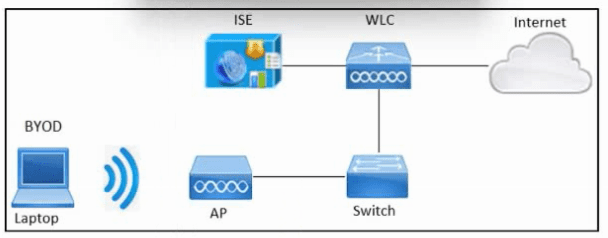
A network administrator is currently using Cisco ISE to authenticate devices and users via 802 1X There is now a need to also authorize devices and users using EAP-TLS. Which two additional components must be configured in Cisco ISE to accomplish this'? (Choose two.)
Show answerHide answer
Correct answer: C, D Common Name attribute that maps to an identity storeCertificate Authentication Profile
Explanation
Explanation:The network already uses 802.1X authentication. To additionally support EAP-TLS authorization (determining access rights based on certificate attributes), ISE must extract certificate fields and map them to identity stores. Two components are mandatory: a Certificate Authentication Profile (CAP) to define which certificate fields to parse, and mapping of the Common Name (CN) to an identity store for lookup.
Correct Options:
C. Common Name attribute that maps to an identity store
The CN extracted from the client certificate (e.g., host/PC123.domain.com or user@domain.com) must be mapped to an identity store such as Active Directory or internal endpoints. ISE uses this mapped identity to apply authorization policies (e.g., allow domain-joined machines or specific users). Without this mapping, EAP-TLS authentication succeeds but authorization cannot differentiate users.
D. Certificate Authentication Profile
The CAP defines which fields to extract from the certificate (CN, SAN, Issuer, etc.) and how to use them for identity resolution. It also enables binary comparison with AD certificates if needed. CAP is mandatory for any EAP-TLS or certificate-based authentication in ISE.
Incorrect Options:
A. Network Device Group –
NDGs classify network access devices (switches, WLCs) for policy assignment. They are unrelated to extracting or mapping certificate attributes for EAP-TLS authorization.
B. Serial Number attribute that maps to a CA Server –
Certificate serial numbers are typically not used for end-user/device authorization mapping. Serial number is for CA revocation checking, not for identity store lookup.
E. EAP Authorization Profile –
This is not a standard ISE object. ISE uses Authorization Profiles (for VLAN, ACL, DACL) and Authentication Profiles (CAP is one type). "EAP Authorization Profile" is a distracter term.
Reference:
Cisco ISE Administrator Guide – "Certificate Authentication Profile" and "External Identity Sources – Certificate Mapping"