Cisco certification · Exam 300-445

300-445 Mock Exam

Designing and Implementing Enterprise Network Assurance(300-445 ENNA)

Find out if you're ready for 300-445. Take the free timed mock exam and get your score in minutes, or study the free 300-445 questions below with answers and explanations.

20 questions · 33 minutes · free, no sign-up

Free 300-445 questions

1–10 of 20 free
Question 1 Choose 1
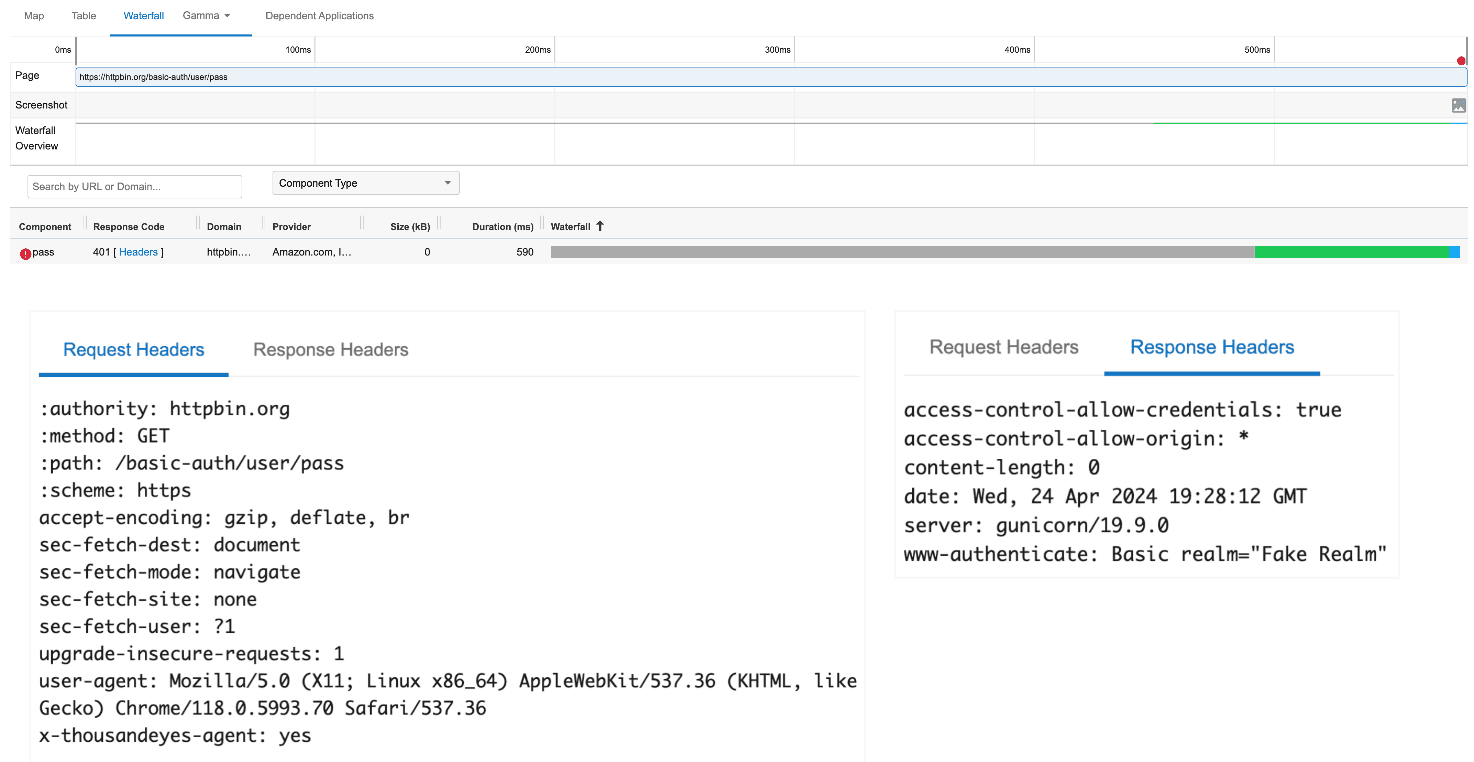
Review the exhibits. Based on the evidence, which action is most likely to solve the issue?
Show answerHide answer

Correct answer: B Modify the authentication credentials

Explanation

Explanation:

The ThousandEyes HTTP waterfall exhibit shows an HTTP 401 (Unauthorized) response. The response header WWW-Authenticate: Basic indicates that the server requires HTTP Basic authentication.

The request reaches the server, but authentication is missing or invalid. Modifying the authentication credentials with a valid username and password is the most likely solution.

Why the other options are incorrect

A. Modify the firewall rules: Incorrect because the server is reachable and returns an HTTP response.
C. Change the HTTP request method to PATCH: Incorrect because the problem is authentication, not the HTTP request method.
D. Modify the target URL: Incorrect because the endpoint is responding with 401, indicating an authentication issue rather than an unavailable endpoint.

References

Cisco ThousandEyes HTTP Server Tests
Cisco ThousandEyes API Errors and Troubleshooting
Question 2 Choose 1
Which of the following is an example of active monitoring in network performance management?
Show answerHide answer

Correct answer: C Sending a continuous ping from one office to another to measure latency

Explanation

Explanation:

Active monitoring generates synthetic network traffic to measure performance. Sending continuous ICMP ping requests between offices actively tests network connectivity and measures latency, packet loss, and response times.
Unlike passive monitoring, active monitoring does not depend on existing user traffic to evaluate network performance.

Why the other options are incorrect

A. Analyzing SNMP data: SNMP collects interface statistics such as bandwidth utilization. This is not synthetic traffic testing.
B. Capturing packets: Packet captures analyze existing network traffic rather than generating test traffic.
D. Collecting NetFlow records: NetFlow monitors actual traffic flows and patterns, making it a passive monitoring technique.

References

- Cisco Network Assurance Self-Study Guide
- Cisco Understanding Performance Routing
Question 3 Choose 1
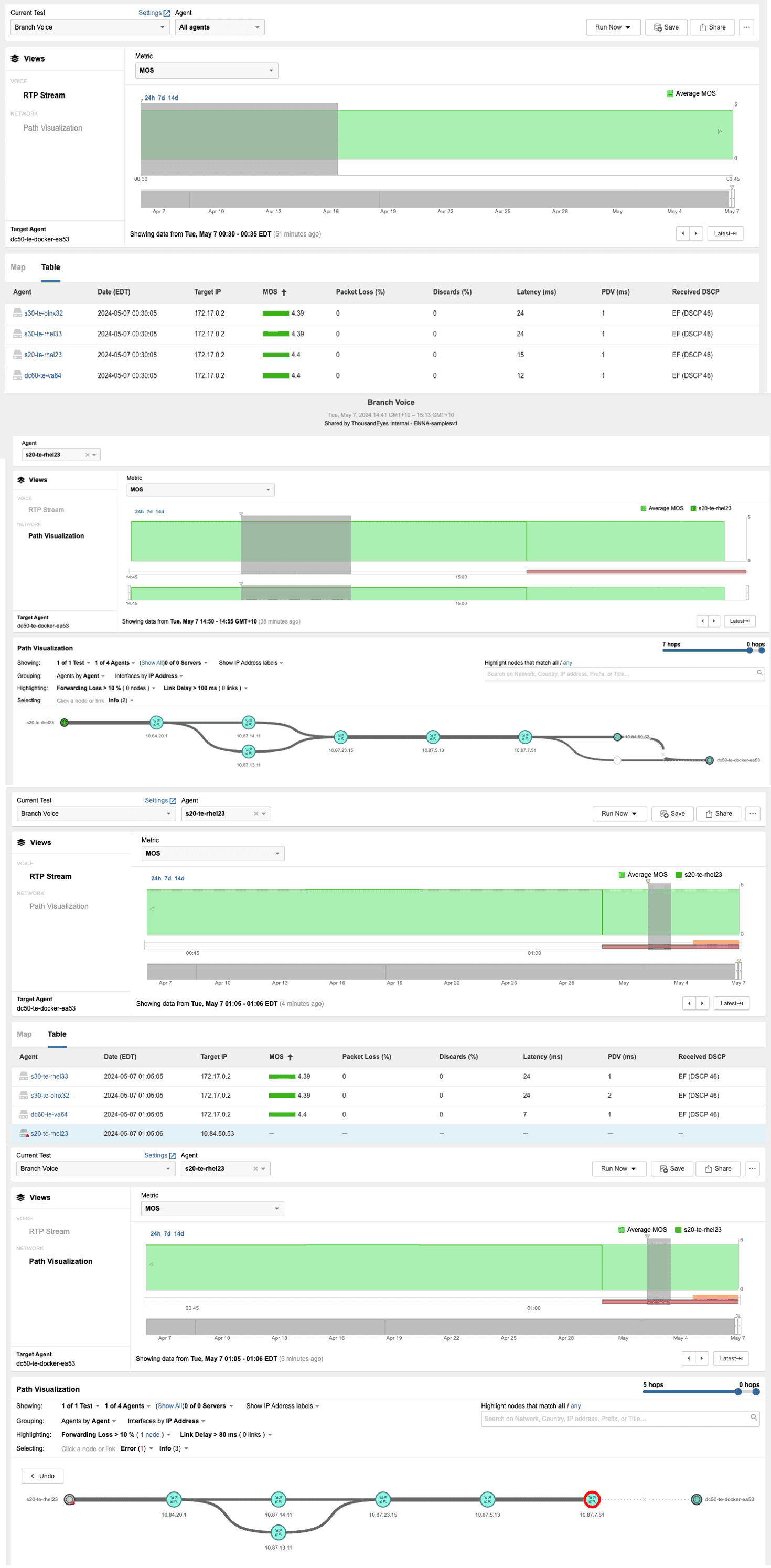
Users on remote sites are reporting voice issues, can you identify possible causes and next steps from the following exhibits?
Show answerHide answer

Correct answer: C Verify the docker host 10.84.50.53 and ensure the agent container is running.

Explanation

Explanation:

The Cisco ThousandEyes exhibits compare network performance before and during the voice issue. Under normal conditions, traffic travels from 10.87.7.51 to 10.84.50.53. During the incident, forwarding loss appears at device 10.87.7.51.
This indicates a possible routing or forwarding problem. Checking routing changes on this device is the most appropriate next troubleshooting step. Cisco's official ENNA self-study guide confirms this answer.

Why the other options are incorrect

A. Involve the Voice team: Missing RTP results for site 20 do not establish a voice-system problem. Network forwarding issues should be investigated first.
C. Verify the Docker host: The exhibits do not establish that the agent container has stopped. The forwarding loss points toward a network issue.
D. Analyze jitter and latency: These metrics are useful for voice troubleshooting, but the exhibits already identify forwarding loss at a specific network device.

References

Cisco Network Assurance Self-Study Guide
Cisco ThousandEyes Network Tests
Question 4 Choose 1
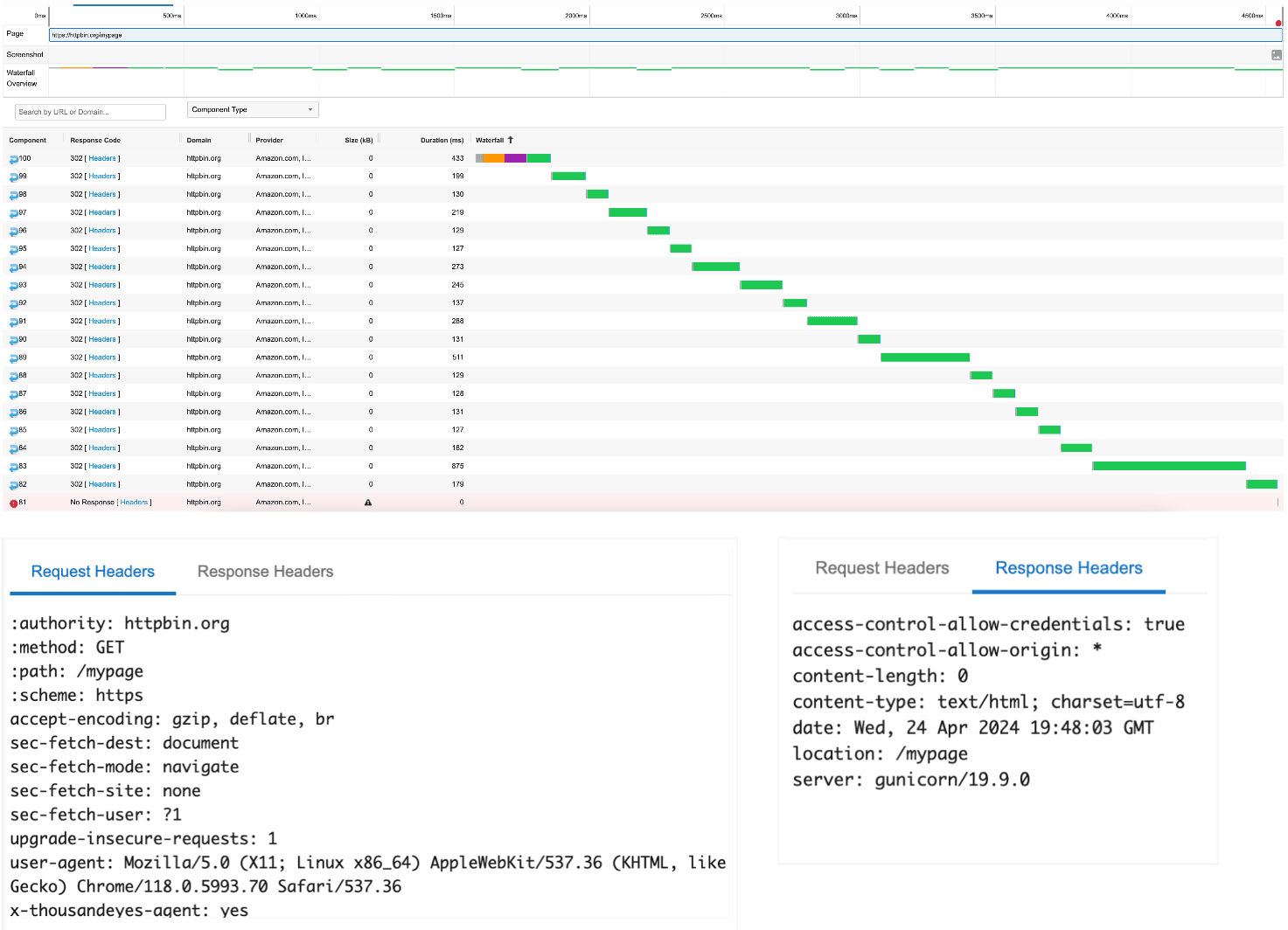
Review the exhibits. Based on the evidence, what seems to be the underlying issue?
Show answerHide answer

Correct answer: D There is a misconfiguration in the application server

Explanation

Explanation:

The Cisco ThousandEyes waterfall exhibit shows repeated HTTP 302 (Found) responses, indicating multiple redirects. The response headers contain location: /mypage, which redirects requests back to the same URL.
This creates a redirect loop, suggesting an application server misconfiguration. The server is responding, but the application cannot complete the requested page load.

Why the other options are incorrect

A. Network connectivity problem: Incorrect because the server is reachable and returns HTTP responses.
B. DOM element cannot be found: Incorrect because the exhibit does not show an HTTP 404 (Not Found) response.
C. Request timed out: Incorrect because the server responds promptly to most requests. The problem is repeated redirects, not a timeout.

References

Cisco Network Assurance Self-Study Guide
Cisco ThousandEyes ENNA Study Guide Web Application Performance Issues
Question 5 Choose 1
What is an important consideration when choosing a time period for collecting data to establish a baseline for interface utilization on a critical network link?
Show answerHide answer

Correct answer: C Capturing both peak and off-peak traffic patterns for a representative view.

Explanation

Explanation:

A network utilization baseline establishes normal traffic patterns on a network link. Collecting data during both peak and off-peak hours provides an accurate picture of typical bandwidth usage, traffic fluctuations, and periods of high demand.
This helps network engineers identify abnormal utilization, detect congestion, and plan network capacity effectively.

Why the other options are incorrect

A. Lowest network traffic: Capturing only low-traffic periods creates an unrealistic baseline and misses peak utilization.
B. Financial year: Financial reporting periods do not determine network traffic patterns.
D. Limiting the time period: Collecting data over too short a period may miss important usage patterns and produce an inaccurate baseline.

References

Cisco Baseline Process Best Practices
Cisco Capacity and Performance Management Best Practices
Question 6 Choose 1
An architect needs to analyze network path metrics from their internal network, specifically from the access layer to a cloud-hosted web server.1 Which ThousandEyes agent is most appropriate for this task?
Show answerHide answer

Correct answer: B Enterprise Agent

Explanation

Explanation:

A Cisco ThousandEyes Enterprise Agent is deployed within an organization's internal network to monitor connectivity and performance toward internal or external destinations.
By deploying an Enterprise Agent near the access layer, the architect can perform network tests toward the cloud-hosted web server and analyze latency, packet loss, jitter, and hop-by-hop network paths.
Enterprise Agents provide visibility from inside the corporate network to cloud applications, making them the most appropriate choice.

Why the other options are incorrect

A. Synthetic Agent: Incorrect because this is not a specific ThousandEyes agent deployment type. Synthetic testing is a monitoring method.
C. Cloud Agent: Cloud Agents monitor from externally hosted locations rather than from the organization's internal access layer.
D. Endpoint Agent: Endpoint Agents monitor performance from individual user devices, rather than providing a dedicated infrastructure monitoring point at the access layer.

References

Cisco ThousandEyes Enterprise Agents 
Cisco ThousandEyes Network Tests
Question 7 Choose 1
You're analyzing NetFlow data for a network supporting voice and video traffic. The data shows consistent spikes in delay and jitter during peak hours. Which optimization would you recommend?
Show answerHide answer

Correct answer: C Tune the existing QoS configuration to prioritize voice and video traffic

Explanation

Explanation:

Voice and video applications are sensitive to delay, jitter, and packet loss. Consistent performance issues during peak hours suggest that network congestion may be affecting real-time traffic.
Tuning the existing Quality of Service (QoS) configuration allows network engineers to prioritize voice and video packets using appropriate traffic classification, queuing, and bandwidth allocation.
This improves real-time application performance without requiring a complete network redesign.

Why the other options are incorrect

A. Complete QoS redesign: Unnecessary when the existing QoS policies can be optimized.
B. Increase bandwidth on all links: Expensive and inefficient because congestion may affect only specific network links.
D. Replace all network hardware: Unnecessary because the issue may be resolved through QoS configuration changes.

References

Cisco QoS Scheduling Configuration Guide
Cisco Troubleshooting QoS Choppy Voice Issues
Question 8 Choose 1
A network engineer deploys a ThousandEyes Docker agent on a switch using apphosting. 7 The agent needs to communicate through a proxy server, but this configuration was missed during the initial deployment. The engineer adds the proxy settings to the apphosting configuration. What is the next step to ensure the agent uses the proxy and appears online in the ThousandEyes portal?
Show answerHide answer

Correct answer: C Execute the full agent lifecycle: app-hosting stop appid agentname, app-hosting deactivate appid agentname, app-hosting activate appid agentname, app-hosting start appid agentname

Explanation

Explanation:

When proxy settings are added to a Cisco ThousandEyes Enterprise Agent running as a Docker container on a switch, the application must be stopped, deactivated, reactivated, and restarted to apply the updated app-hosting configuration.

This ensures the agent loads the new proxy settings and can communicate with the ThousandEyes cloud platform. Cisco's official ENNA study guide confirms this procedure.

Execute these commands in order:

app-hosting stop appid agentname
app-hosting deactivate appid agentname
app-hosting activate appid agentname
app-hosting start appid agentname

Why the other options are incorrect

A. Restart the container: Stopping and starting alone may not apply changes to the app-hosting configuration.
B. Reinstall the agent: Unnecessary because the existing installation can be reconfigured.
No action required: Incorrect because the updated app-hosting settings are not automatically applied to the running container.

References

Cisco Network Assurance Self-Study Guide
Cisco ThousandEyes Installing Enterprise Agents on Cisco Switches with Docker
Question 9 Choose 1
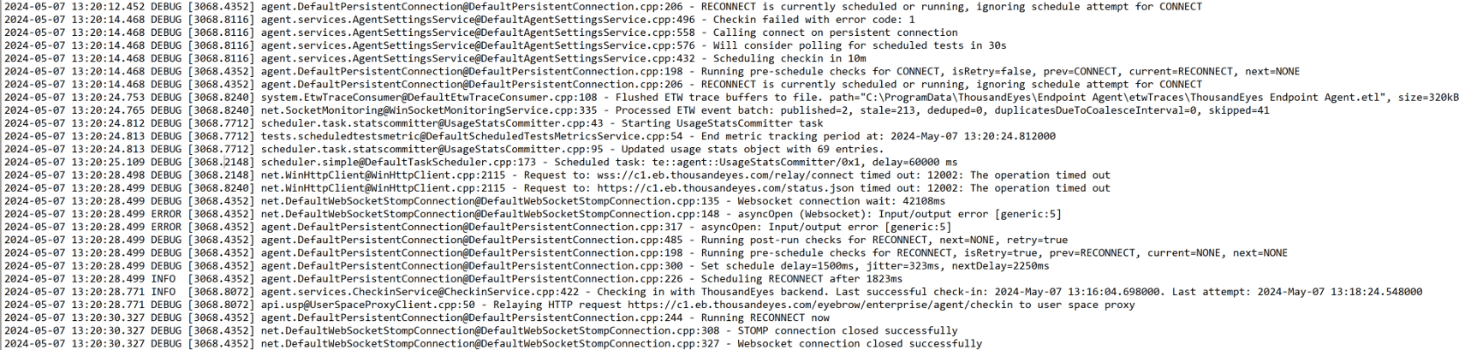
The Endpoint stopped appearing online after it was moved to another network. The customer reviewed the endpoint logs but did not identify anything suspicious. The customer also confirmed that the endpoint was online on the old network, and the new network is fully operational. Other endpoints that were moved to the new network are also online. Since the new network is small, the admin is using static IP assignment. What is the best way to bring the endpoint online?
Show answerHide answer

Correct answer: D Endpoint IP settings must be checked along with connectivity to c1.eb.thousandeyes.com.

Explanation

Explanation:

The Cisco ThousandEyes Endpoint Agent logs show connection timeout errors when attempting to reach c1.eb.thousandeyes.com, the ThousandEyes controller.

Since the endpoint was moved to a network using static IP assignment, incorrect IP settings, subnet mask, default gateway, or DNS configuration could prevent communication.
The administrator should verify the endpoint's network settings and confirm connectivity to the ThousandEyes controller to restore the agent's online status.

Why the other options are incorrect

A. Move the endpoint back: Other endpoints work on the new network, so moving it back is unnecessary.
B. Reinstall the agent: Reinstallation will not resolve incorrect IP settings or network connectivity issues.
C. Wait 10–15 minutes: The agent cannot automatically recover from incorrect static IP settings or persistent connection failures.

References

Cisco Network Assurance Self-Study Guide
Cisco ThousandEyes Step-by-Step Troubleshooting Endpoint Agent Problems
Question 10 Choose 1
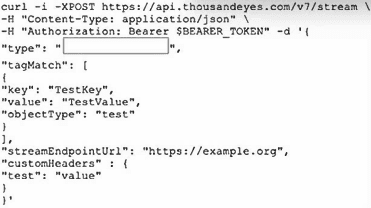
Refer to the exhibit.

Which integration type should be configured between ThousandEyes and Grafana?
Show answerHide answer

Correct answer: A opentelemetry

Explanation

Explanation:

The exhibit shows a Cisco ThousandEyes API v7 request to the /stream endpoint, which is used to configure telemetry data streaming.
OpenTelemetry (OTel) is the appropriate integration type for connecting ThousandEyes with Grafana. It enables ThousandEyes to stream network performance metrics, including latency, packet loss, and jitter, to Grafana for centralized visualization and analysis.

Why the other options are incorrect

B. custom-webhook: Webhooks are generally used for event notifications and alerts, not the standardized telemetry streaming required here.
C. push-api: Although OpenTelemetry uses push-based data delivery, push-api is not the appropriate integration type for this configuration.
D. poll-api: Polling requires periodically requesting data, rather than using the OpenTelemetry streaming integration shown in the exhibit.

References

Cisco ThousandEyes Grafana Integration Guide
Cisco DevNet ThousandEyes for OpenTelemetry API
Full mock exam

Sit the 300-445 exam before exam day

Full-length mocks with the same number of questions and the same time limit as the real 300-445 exam. Every attempt draws a new set of questions from the full bank, so you can keep going until you pass comfortably.

Get full 300-445 mock exam
  • 55questions per mock
  • 90 mintime limit
  • 68questions in the bank
  • Newmock on every attempt

Inside the Cisco 300-445 ENNA Exam: Network Assurance Skills That Matter Most

Understanding the Cisco 300-445 ENNA Exam

The Cisco 300-445 Designing and Implementing Enterprise Network Assurance (ENNA) exam evaluates your ability to monitor, analyze, and optimize enterprise network performance. This 90-minute exam is part of the CCNP Enterprise certification pathway and covers network assurance technologies, troubleshooting, data collection, and performance monitoring.

Cisco 300-445 ENNA Exam Blueprint and Weightage

According to the official Cisco ENNA v1.0 exam blueprint, the examination covers four major domains:

Exam DomainWeightage
Platforms and Architecture20%
Data Collection Implementation25%
Data Analysis30%
Insights and Alerts25%

Candidates should prioritize Data Analysis while maintaining strong knowledge of implementation and monitoring technologies.

Important Topics to Prepare

Platforms and Architecture (20%)

Study Cisco ThousandEyes, Catalyst Center, Meraki, SD-WAN assurance, active and passive monitoring, agent selection, and network performance baselines.

Data Collection Implementation (25%)

Focus on Enterprise Agent deployment, Endpoint Agent configuration, network testing, DNS monitoring, web application testing, voice performance, and authentication methods.

Data Analysis (30%)

Practice diagnosing packet loss, latency, jitter, routing failures, DNS issues, VPN connectivity problems, and web application performance. Understand how monitoring data helps identify root causes.

Insights and Alerts (25%)

Learn alert configuration, monitoring dashboards, SNMP, NetFlow, syslog, BGP monitoring, capacity planning, and network optimization recommendations.

Which ENNA Topics Deserve More Attention?

Data Analysis carries the highest weightage at 30%, making troubleshooting skills particularly important.

Spend additional preparation time on:

  • Cisco ThousandEyes monitoring and troubleshooting.

  • Enterprise and Endpoint Agent deployment.

  • Packet loss, latency, jitter, and DNS diagnostics.

  • Network alerts, dashboards, and performance metrics.

  • Cisco Meraki Insight and Catalyst SD-WAN assurance.

Practical Skills That Improve Exam Readiness

Combine theoretical study with hands-on exercises. Practice configuring ThousandEyes tests, examining network paths, interpreting browser waterfalls, and identifying performance bottlenecks.

Cisco's official training includes practical labs covering agent deployment, DNS tests, alerts, and dashboards.

How Cistified Practice Tests Help You Prepare

Cistified.com provides free Cisco 300-445 ENNA practice questions and paid mock tests to support your exam preparation.

Free practice questions help you review important concepts, while paid mock tests provide additional opportunities to assess your understanding and practice answering exam-style questions.

Use your results to identify weak domains, revise relevant Cisco documentation, and repeat practice sessions to measure improvement.

Recommended ENNA Study Strategy

Begin with the official exam blueprint, study each domain according to its weightage, and reinforce learning through practical troubleshooting.

Review incorrect practice questions carefully, concentrate on weak subjects, and practice managing your time within the exam's 90-minute duration.

For official preparation, consult the Cisco ENNA Exam Topics and Cisco ENNA Training Resources.

A combination of structured study, hands-on experience, and regular practice testing can help you approach the Cisco 300-445 ENNA exam with greater confidence.