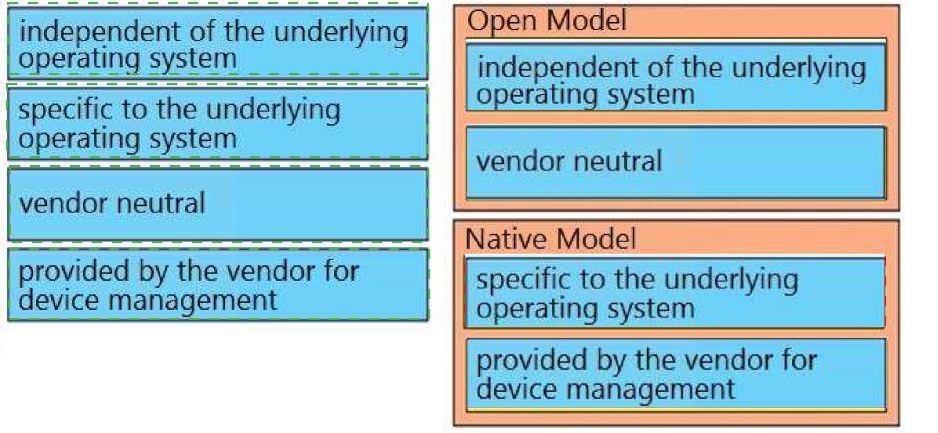
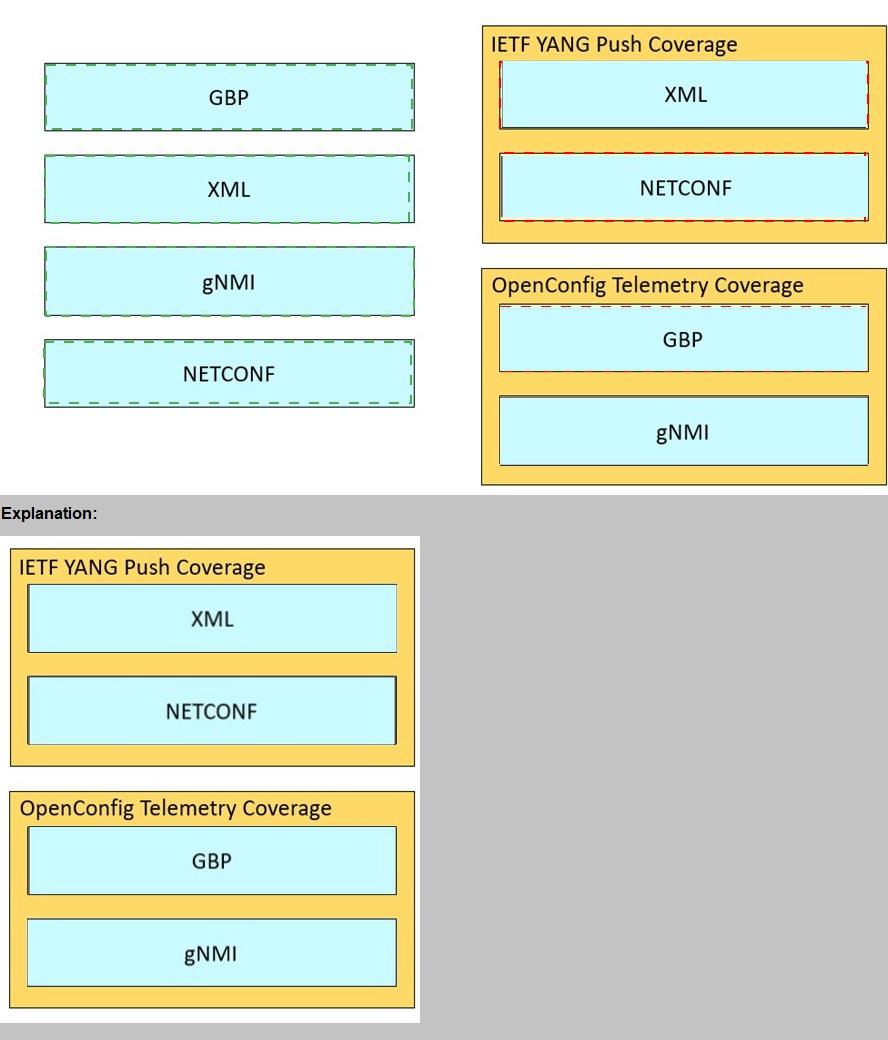
Drag and drop the characteristics from the left onto the Yang model they describe on the right. Select and Place: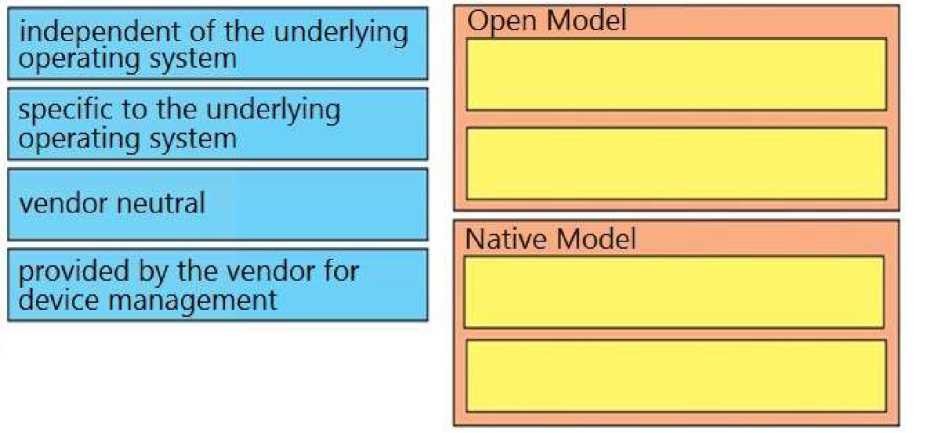
Show answerHide answer
Explanation
Designing Cisco Enterprise Networks (ENSLD)
Find out if you're ready for 300-420. Take the free timed mock exam and get your score in minutes, or study the free 300-420 questions below with answers and explanations.
20 questions · 33 minutes · free, no sign-up
Drag and drop the characteristics from the left onto the Yang model they describe on the right. Select and Place:
Refer to the exhibit.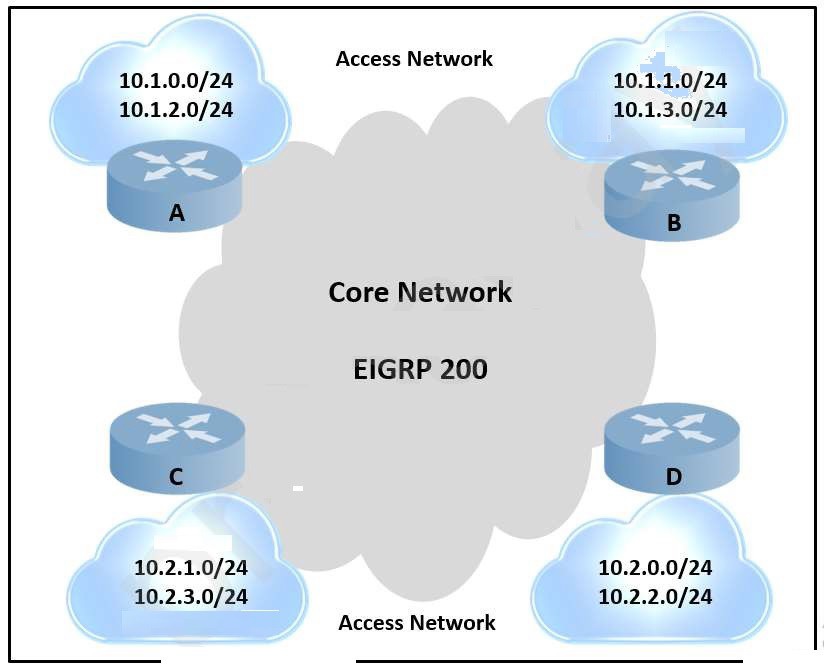
An engineer is designing a routing solution for a customer. The design must ensure that a
failure of network
10.1.0.0/24, 10.1.2.0/24, 10.2.1.0/24, or 10.2.3.0/24 does not impact the core. It also
requires fast convergence
time during any link failover in the core or access networks. Which solution must the
engineer select?
Correct answer: C
Enable FRR for the connected networks of routers A and C.
Which OSPF area blocks LSA Type 3, 4 and 5, but allows a default summary route?
Correct answer: D
totally stubby
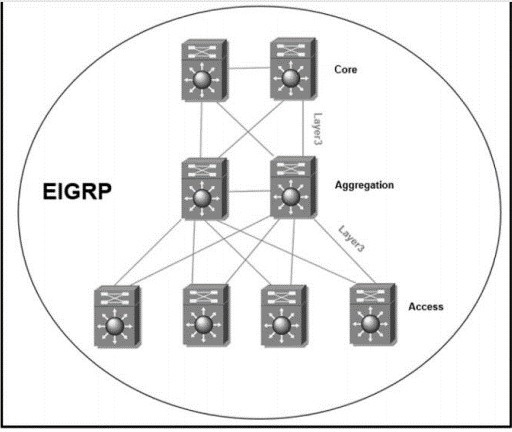
Refer to the exhibit. The full EIGRP routing table is advertised throughout the network.
Currently, users experience data loss when any one link in the network fails. An architect
optimizes the network to reduce the impact when a link fails. Which solution should the
architect include in the design?
Correct answer: A
Run BFD on the inter links between EIGRP neighbors.
An engineer is working for a large cable TV provider that requires multiple sources
streaming video on different channels using multicast with no rendezvous point. Which multicast protocol meets these requirements?
Correct answer: B
PIM-SSM
Explanation: PIM-SSM is suitable for when well-known sources exist within the local PIM
domain and for broadcast applications. Also, PIM-SSM eliminates the RPs and shared
trees
Which two techniques improve the application experience in a Cisco SD-WAN design? (Choose two.)
Correct answer: A, D
utilizing forward error correction utilizing quality of service
Reference: https://www.cisco.com/c/dam/en/us/solutions/collateral/enterprise-networks/sdwan/
nb-06-cisco-sd-wan-ebook-cte-en.pdf slide 33
The customer solution requires QoS to support streaming multimedia over a WAN. An architect chooses to use Per-Hop Behavior. Which solution should the engineer use to of mark traffic traveling between branch sites?
Correct answer: A
LLQ with DSCP EF
What is the purpose of a control plane node in a Cisco SD-Access network fabric?
Correct answer: B
to detect endpoints in the fabric and inform the host tracking database of EID-to-fabricedge node bindings
Explanation: https://www.cisco.com/c/en/us/td/docs/solutions/CVD/Campus/cisco-sdadesign-
guide.html
Drag and drop the elements from the left onto the YANG models where they and used on the right.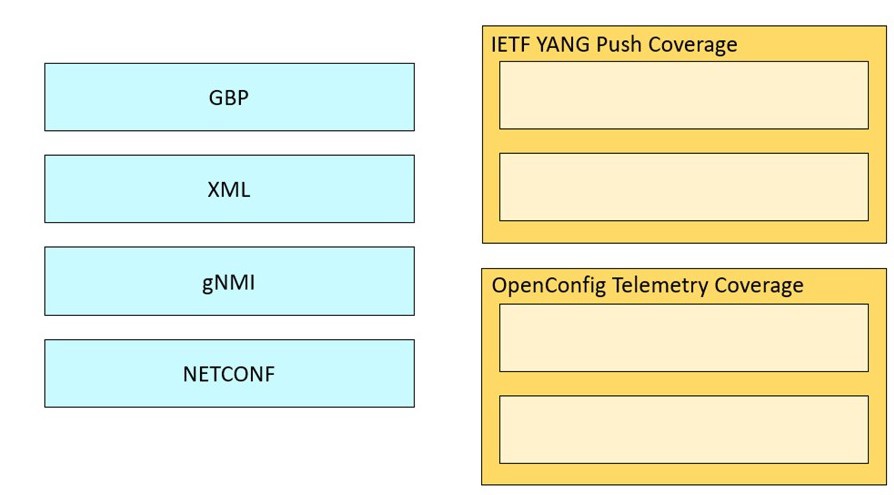
Which two statements describe source trees in a multicast environment? (Choose two.)
Correct answer: A, B
Source trees guarantee the minimum amount of network latency for forwarding Source trees create an optimal path between the source and the receivers
multicast traffic
Full-length mocks with the same number of questions and the same time limit as the real 300-420 exam. Every attempt draws a new set of questions from the full bank, so you can keep going until you pass comfortably.
Get full 300-420 mock examThe Cisco 300-420 ENSLD (Designing Cisco Enterprise Networks) exam tests your ability to design scalable, secure, and highly available enterprise networks. This 90-minute CCNP Enterprise concentration exam focuses on advanced routing, campus networks, WAN architecture, network services, and automation.
Passing the exam earns the Cisco Certified Specialist – Enterprise Design certification.
The official ENSLD v1.1 exam blueprint includes five domains:
| Exam Domain | Weightage |
|---|---|
| Advanced Addressing and Routing Solutions | 25% |
| Advanced Enterprise Campus Networks | 25% |
| WAN for Enterprise Networks | 20% |
| Network Services | 20% |
| Automation and Artificial Intelligence | 10% |
Understanding these percentages helps you organize your study schedule effectively.
Advanced Routing Solutions: Prepare IPv4/IPv6 addressing, OSPF, EIGRP, IS-IS, BGP design, route filtering, and IPv6 migration strategies.
Enterprise Campus Networks: Focus on high availability, Layer 2/Layer 3 architecture, redundancy, STP security, fast convergence, and Cisco Software-Defined Access (SD-Access).
Enterprise WAN: Study WAN connectivity options, site-to-site VPNs, high availability, cloud connectivity, and hybrid network design.
Network Services: Review Quality of Service (QoS), multicast design, and network management considerations.
Automation and AI: Understand YANG, NETCONF, RESTCONF, gRPC, gNMI, model-driven telemetry, and cloud service models.
Advanced routing and campus networks account for 50% of the exam. Spend additional time understanding BGP scalability, routing protocol selection, redundancy, and campus design.
WAN and network services contribute another 40%. Practice evaluating connectivity, resiliency, QoS, and multicast solutions.
ENSLD requires more than memorizing technical definitions. Practice scenarios involving enterprise expansion, routing scalability, network failures, hybrid cloud connectivity, and business requirements.
Learn why one network design is more suitable than another.
Cistified.com offers free Cisco 300-420 ENSLD practice questions and paid mock tests to support your preparation.
Free Practice Questions: Review important exam concepts.
Timed Mock Exams: Improve your speed and time management.
Knowledge Assessment: Identify weak areas across exam domains.
Repeated Practice: Strengthen technical understanding and exam confidence.
Follow Cisco's official exam blueprint, prioritize high-weightage domains, and review real-world network design scenarios. Use practice questions after completing each topic and timed mock exams during your final revision.
Remember: The key to ENSLD success is understanding how to select secure, scalable, and reliable enterprise network designs that meet business requirements.