What is rule-based detection when compared to statistical detection?
Show answerHide answer
Correct answer: B
proof of a user's action
Understanding Cisco Cybersecurity Operations Fundamentals (CBROPS)
Find out if you're ready for 200-201. Take the free timed mock exam and get your score in minutes, or study the free 200-201 questions below with answers and explanations.
20 questions · 26 minutes · free, no sign-up
What is rule-based detection when compared to statistical detection?
Correct answer: B
proof of a user's action
Which two elements are used for profiling a network? (Choose two.)
Correct answer: D, E
listening ports EOS fingerprint
Which evasion technique is indicated when an intrusion detection system begins receiving an abnormally high volume of scanning from numerous sources?
Correct answer: A, E
resource exhaustion
Which attack is the network vulnerable to when a stream cipher like RC4 is used twice with the same key?
Correct answer: C
ciphertext-only attack
What does cyber attribution identify in an investigation?
Correct answer: B
threat actors of an attack
Which two elements of the incident response process are stated in NIST Special
Publication 800-61 r2? (Choose two.)
Correct answer: A, B
detection and analysis post-incident activity
Reference: https://nvlpubs.nist.gov/nistpubs/SpecialPublications/NIST.SP.800-61r2.pdf
A security engineer has a video of a suspect entering a data center that was captured on the same day that files in the same data center were transferred to a competitor. Which type of evidence is this?
Correct answer: C
indirect evidence
Refer to the exhibit.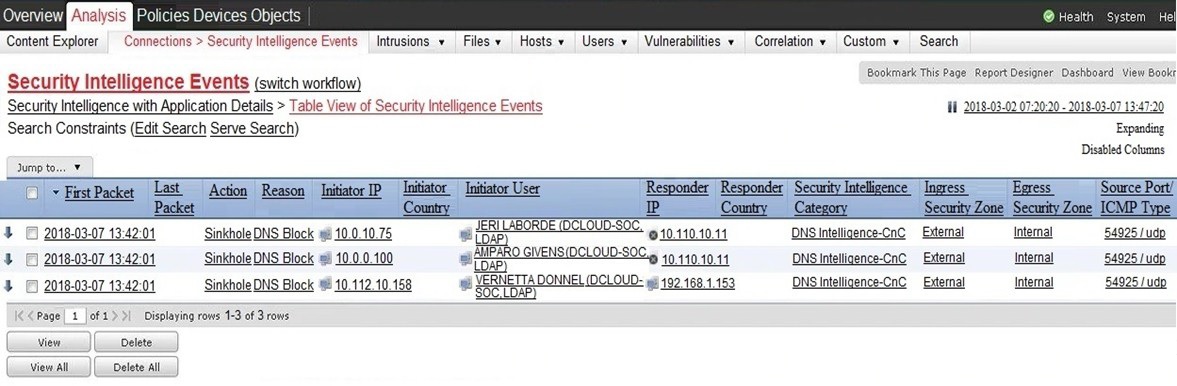
Which two elements in the table are parts of the 5-tuple? (Choose two.)
Correct answer: D, E
Source Port Initiator IP
A network engineer discovers that a foreign government hacked one of the defense contractors in their home country and stole intellectual property. What is the threat agent in this situation?
Correct answer: D
the foreign government that conducted the attack
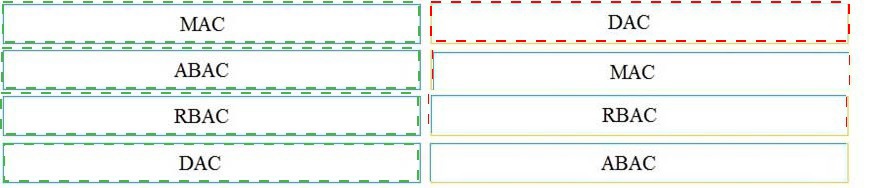
Drag and drop the access control models from the left onto the correct descriptions on the right.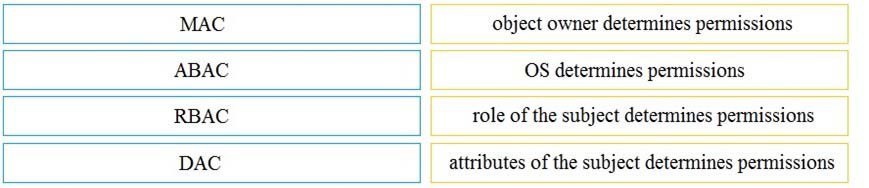
Full-length mocks with the same number of questions and the same time limit as the real 200-201 exam. Every attempt draws a new set of questions from the full bank, so you can keep going until you pass comfortably.
Get full 200-201 mock examThe Cisco 200-201 Cybersecurity Operations Fundamentals exam, formerly known as CBROPS and now updated to CCNACBR v1.2, tests essential cybersecurity skills required for Security Operations Center (SOC) roles.
The exam lasts 120 minutes and covers threat detection, security monitoring, incident analysis, and cybersecurity operations.
The official exam blueprint includes five major domains:
| Exam Domain | Weightage |
|---|---|
| Security Concepts | 20% |
| Security Monitoring | 25% |
| Host-Based Analysis | 20% |
| Network Intrusion Analysis | 20% |
| Security Policies and Procedures | 15% |
This domain carries the highest weightage. Focus on SIEM tools, network traffic analysis, security alerts, NetFlow, packet captures, and identifying suspicious activities.
Study cybersecurity fundamentals, security controls, threat intelligence, access management, vulnerabilities, and common attack methods.
Understand Windows and Linux security logs, malicious processes, endpoint protection, malware indicators, and host-based intrusion detection.
Prepare for TCP/IP packet analysis, intrusion detection systems, network protocols, malicious traffic patterns, and security event investigation.
Review incident response processes, evidence collection, chain of custody, security policies, and incident documentation.
Practical knowledge is important for the Cisco 200-201 exam. Students should practice:
Analyzing network packets using Wireshark.
Identifying suspicious activities in system logs.
Understanding TCP, UDP, DNS, and HTTP traffic.
Recognizing indicators of compromise.
Investigating security alerts and potential threats.
Cistified provides free Cisco 200-201 practice questions and paid mock tests to help students assess their cybersecurity knowledge.
Start with free practice questions to identify your strengths and weaknesses. Use paid mock exams to experience timed assessments, improve question-solving speed, and review challenging exam topics.
Regular practice helps strengthen your understanding of security monitoring, threat investigation, and incident response concepts.
Allocate extra preparation time to Security Monitoring because it represents 25% of the exam. However, do not ignore the remaining domains.
Combine Cisco's official exam objectives, practical cybersecurity exercises, and Cistified practice questions. Review incorrect answers carefully and continue practicing until you can confidently explain the concepts behind each question.